Best Areas to Buy a Flat in Pune in 2026: A Complete Guide
Pune is the city where culture and technology share the same street. Old wadas and traditional festivities are a few kilometers from glass-front IT campuses. The young professionals who built careers here are now ready to settle down. The city has stretched to meet them: Hinjewadi, Kharadi, Wakad, Mahalunge, and beyond. For many, investing in Pune property now makes more sense than renting. So, which areas are best for buying a flat in Pune in 2026? This Star Estate guide walks through four micro-markets, compares them side by side, and shares insight into where the Pune real estate is heading.
AI Powered Summary
Important Things to Know About Property Investment in Pune in 2026
Pune market today: Pune sold 24,890 homes in H1 2026 at an average of ₹10,063 per sq. ft., up 5% year-on-year.
Job-led demand: Hinjewadi real estate, Kharadi, and Baner continue to see strong job-led housing demand, as Pune recorded a record 6.6 million sq. ft. of office leasing in H1 2026.
Best localities: The best areas to buy a flat in Pune in 2026 are Hinjewadi, Wakad, Baner, Kharadi, and Mahalunge, which lead in connectivity, builder presence, and rental demand.
Budget fit: Affordable areas in Pune, such as Wakad and Mahalunge, suit tighter budgets; Baner and Kharadi suit buyers who want premium social infrastructure.
First-time buyers: Pune property investment offers metro, expressway, and ring road growth at entry prices well below Mumbai, and RERA-registered projects keep the risk low.
Best Areas to Buy a Flat in Pune in 2026
Hinjewadi Real Estate: The IT Corridor
Price: around ₹9,500 per sq. ft.
Project on Star Estate:Lodha Altero Wakad.
Connectivity: Mumbai–Pune Expressway, Pune–Bangalore Highway, and the Aundh–Ravet BRTS.
Amenities: Phoenix Mall of the Millennium, Euro School, and multi-specialty hospitals close by. It’s perfect if your workplace is in Hinjewadi, as it lowers the chance of experiencing traffic congestion.
Baner: Premium Lifestyle
Price: around ₹11,350 per sq. ft., with about 50% growth over five years.
Project on Star Estate:Kolte Patil 24K Altura.
Connectivity: Baner–Aundh Road, Baner–Pashan Link Road, and quick access to the Mumbai–Satara highway.
Amenities: Jupiter Hospital, The Orchid School, and Primrose Mall. Land is limited, which supports long-term value.
Kharadi: East Pune's Business District
Price: around ₹11,250 per sq. ft., with about 50% growth over five years.
Projects on Star Estate:VTP Altamira and VTP Pegasus.
Connectivity: Nagar Road, Solapur Highway, Magarpatta Road, the Airport, and the Ramwadi Metro.
Amenities: Phoenix Marketcity, Rising Medicare Hospital, and the EON IT Park nearby.
Kharadi vs Hinjewadi vs Baner vs Wakad: Which Is Better to Buy a Flat in Pune in 2026?
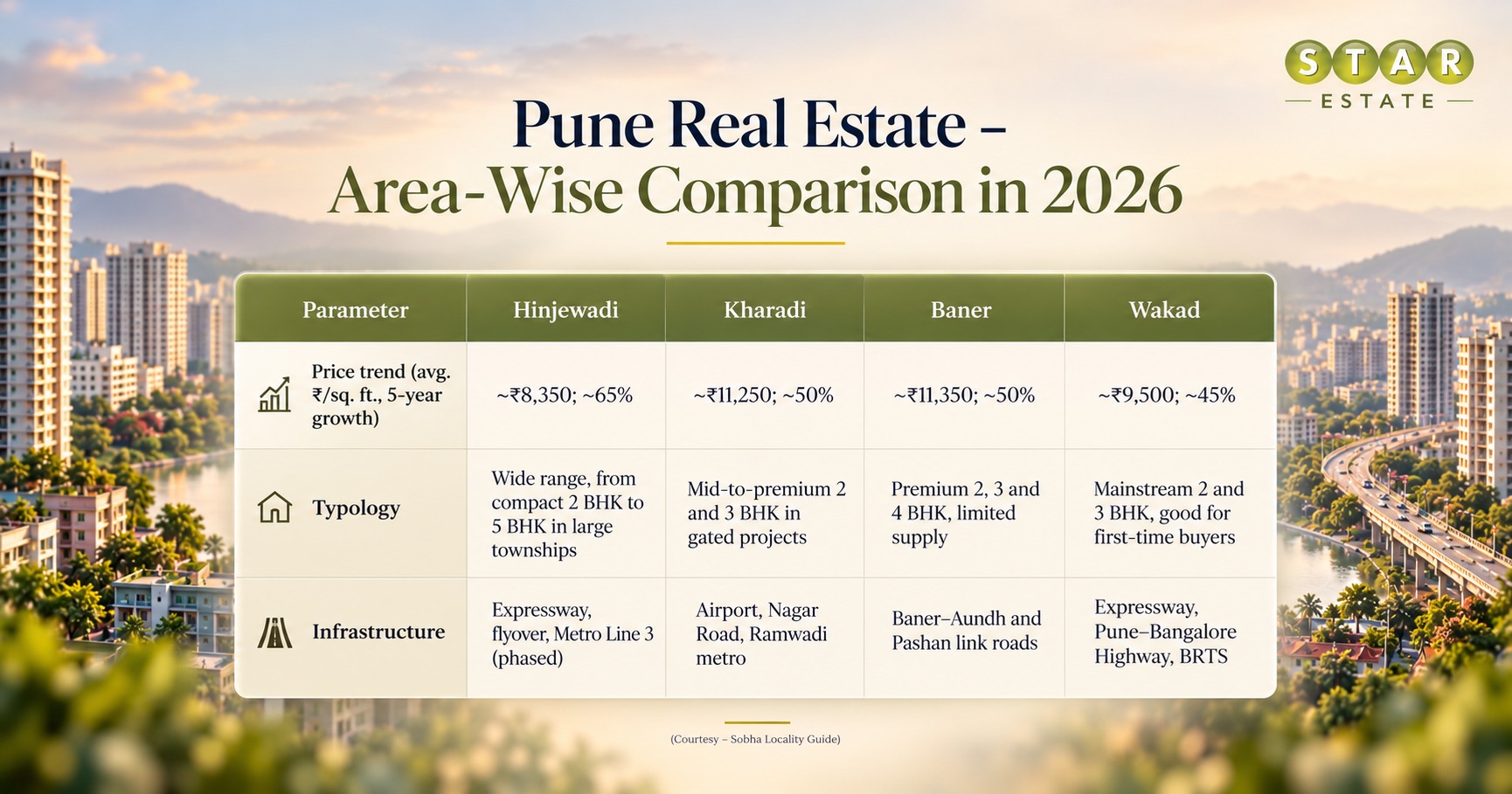
Hinjewadi grew fastest in percentage terms because it has a lower entry price and is well-positioned near the IT corridor.
Kharadi costs more today, but it has matured. Phoenix Marketcity, the EON IT Park, and the airport are already in place, so you pay for a ready neighbourhood and an easy commute to East Pune’s offices.
Baner is the premium pick. At around ₹11,350 per sq. ft., it is the costliest of the four, with about 50% growth over five years. Land is limited, so supply stays tight, and values hold well. You get Baner–Aundh and Pashan link roads, Jupiter Hospital, and Primrose Mall nearby, which suits end users who want lifestyle first.
Wakad is the balanced middle. At around ₹9,500 per sq. ft., it costs less than Baner or Kharadi, yet it sits on the Mumbai–Pune Expressway, close to Hinjewadi's offices. That brings steady rental demand from IT professionals and makes mainstream 2 and 3 BHK homes a comfortable first purchase. Pune West and Pune East are both main demand centers, according to Knight Frank India.
So, which is the best area to buy a flat in Pune in 2026? If you want a walk-to-work premium neighbourhood, pick Kharadi. If you want more square feet per rupee and an investor's upside, pick Hinjewadi. And if budget matters most, Wakad is the balanced pick among the best areas to buy a flat in Pune in 2026.
Pune Property Investment in 2026: What First-Time Buyers Can Expect
Jobs Are Still Coming
Pune recorded its highest-ever half-year office leasing in H1 2026, at 6.6 million sq. ft., up 29% year-on-year. Global capability centres now account for 32% of leasing, as per the Knight Frank India report. More jobs mean more households looking for homes near the workplace.
Roads, Metro, and Airport
The 170 km Pune Ring Road is targeted for completion by December 2026, approximately.
Metro lines are expanding to the western IT belt.
The proposed Purandar airport is a long-term story, treated as a 7–10-year thesis.
Why Buying Early Pays
Picking from the best areas to buy a flat in Pune today means buying a RERA-registered flat before these projects fully show up in prices. Analysts expect 6–9% city-wide appreciation through 2026. Add rental income of roughly 3–5% a year in IT-corridor areas, and your flat can work for you while you live elsewhere, or grow as your own home.
Why Discuss Buying a Flat in Pune with Star Estate?
Choosing the right locality among the best areas to buy a flat in Pune is half the job. Choosing the right builder and project is the other half. That's where we come in.
RERA-registered consultant: Star Estate is a RERA-registered real estate consultant.
Only RERA-registered builders and projects: we shortlist projects registered with MahaRERA, so your money sits in a regulated project.
Ground-level advice: we tell you honestly which locality fits your budget, commute, and plans, not just which flat is on offer.
Free, no-obligation consultation: talk to us before you visit a site.
Ready to shortlist? Browse new residential projects in Pune, or fill in the enquiry form, and a Star Estate advisor will call you back.