Booking Amount for Flat in India: Complete Guide to Allotment Letters & Payment Plans
You have found a flat that suits your budget and location, and the sales representative says only a couple of units are left at this price. Many first-time buyers agree on the spot and pay the booking amount without checking the paperwork, only to regret it later. This Star Estate guide explains the booking amount for flat purchases, what the allotment letter means, the flat booking process, how each property payment plan works, including the construction-linked plan, and when you can ask for a refund.
AI Powered Summary
Things First Time Homebuyers Must Know About Booking a Flat in India in 2026
Booking amount: It only reserves a unit and doesn’t make you the owner with immediate effect. Get a receipt and the refund terms in writing before you pay.
Allotment letter: It logs your name against the tower, unit, area, price, and schedule. It is a key document, but it is not the registered agreement for sale.
Payment plans: Construction-linked plans, time-linked plans, down-payment, and flexi plans change your cash flow and home loan amount. So compare them before picking the best option amongst them.
Refunds: What you get back depends on when you cancel and why: before allotment, after allotment, loan rejection, or developer delay.
Before you pay: Check RERA details, the developer’s account name, the full cost sheet, and the cancellation clause. Pay only through traceable channels.
You’ve Shortlisted a Residential Property. Should You Pay the Booking Amount Now or Wait?
A booking amount only reserves your unit. However, what happens next depends on documents that buyers often skip reading in detail until something goes wrong. The receipt, the allotment letter, the cost sheet, and the payment plan, in particular. Before you pay, work through our Star Estate realty check section.
The booking amount for a flat is a part-payment that reserves your unit, usually a small percentage of the price. Pay it only after you have seen the cost sheet, the payment schedule, and the refund clause in writing, and after you have verified the project’s RERA registration. Get a receipt every time you pay the booking amount for a flat in India in 2026.
The flat booking process is simple: booking amount, then receipt, then allotment letter, then agreement for sale, then instalments, then possession. Amounts, cancellation terms, and paperwork differ by developer, state, and project. So trust the written documents, not verbal commitments.
Booking Amount for Flat in India (2026): The Payment Journey at a Glance
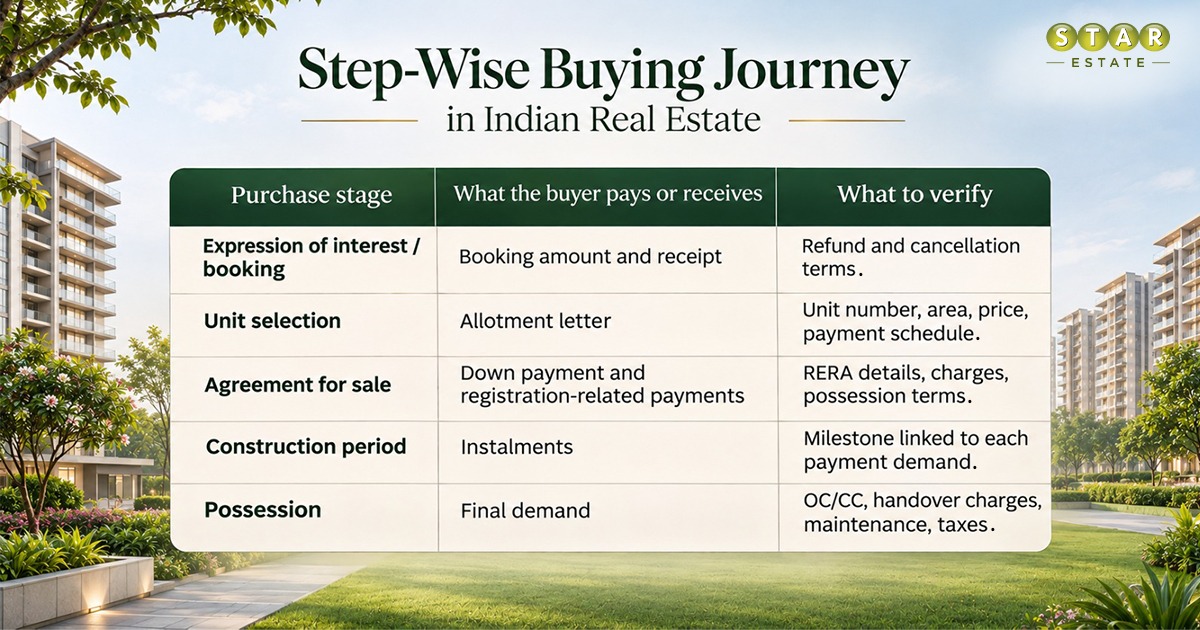
Step-Wise Buying Journey in Indian Real Estate" by Star Estate, outlining the five key stages involved in purchasing property along with the financial transactions and verification points for each phase -
Expression of interest/booking: The buyer pays a booking amount and receives a receipt; at this stage, it is essential to verify the refund and cancellation terms.
Unit selection: The buyer receives an allotment letter; key items to verify include the unit number, area, price, and payment schedule.
Agreement for sale: The buyer pays the down payment along with registration-related payments; verification should cover RERA details, additional charges, and possession terms.
Construction period: Payments are made in instalments, and the buyer needs to verify the milestone linked to each payment demand.
Possession: The buyer settles the final demand, with critical verifications including the Occupancy Certificate/Completion Certificate (OC/CC), handover charges, maintenance fees, and taxes.
What Is a Booking Amount?
The booking amount is the first payment that takes the unit off the market for you. However, it is very different from a token amount and earnest money. So confirm what the seller means by that term.
Under RERA, a promoter cannot take more than 10% of the cost as an advance or application fee before a registered agreement for sale. Rules and practices in your state may differ, so verify locally.
Difference between Booking Amount, Token Amount, and Earnest Money in Indian Real Estate
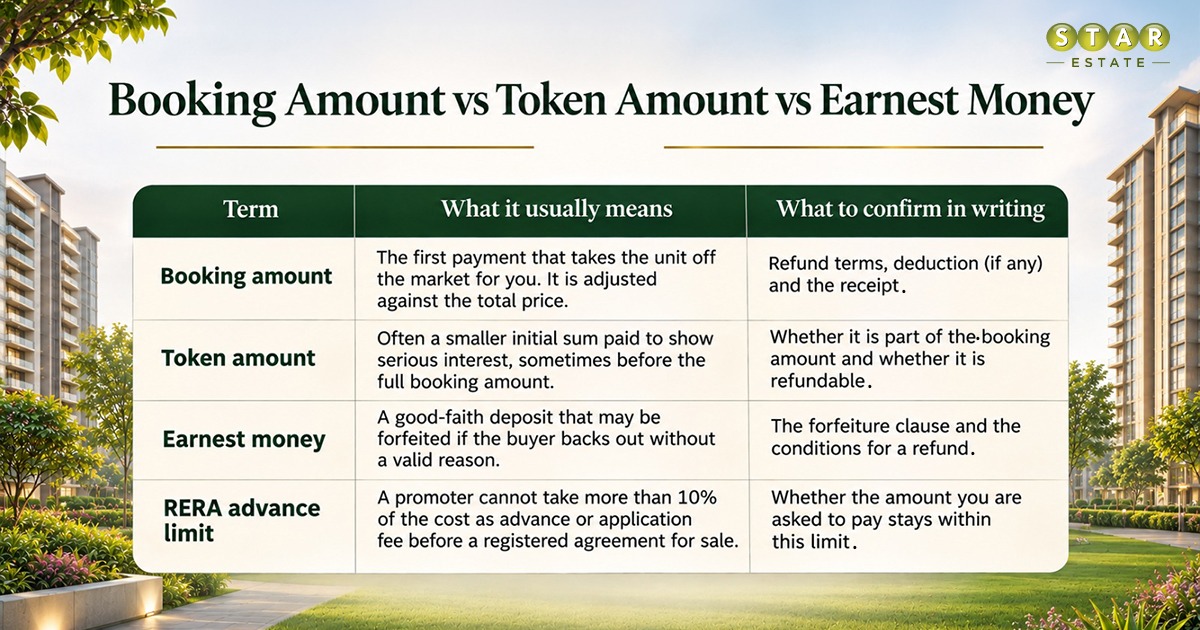
Booking amount: This is the first formal payment that reserves the unit in a residential project for you. The amount you pay at the time of booking a flat in India is adjusted against the total price of the flat. It is usually larger than a token amount and is paid once you have chosen a unit. So the developer typically issues a receipt and moves you towards the allotment letter. Check that the receipt names the unit and the amount, and confirm the refund and cancellation terms in writing before you transfer the amount.
Token money: This is usually a small initial sum you pay to show serious interest and to hold a unit for a short time while you review the cost sheet and paperwork. Some developers treat it as part of the booking amount, while others keep it separate, so ask whether it is adjusted against the price and whether it is refundable if you change your mind.
Earnest money: This is a good-faith deposit that shows you are committed to buying, and it is settled against the total price. It can be forfeited in full or in part if you back out without a valid reason, so read the forfeiture clause closely before you pay. A valid reason may include a rejected home loan or a developer delay, and you should get the refund conditions in writing.
How Much Is the Booking Amount for Flat in India? Is It Refundable?
There is no fixed amount. Developers usually ask for a small percentage of the price, and many projects set a fixed sum. Treat any quote as a starting point and ask for the refund clause before paying.
Whether you get the money back depends on the scenario:
Cancel before allotment: Often the most flexible stage, but check the booking form for a processing deduction.
Cancel after allotment: Deductions are more likely. Read the forfeiture clause line by line.
Loan rejection: Ask upfront whether a rejected loan makes the booking refundable, and get that written.
Developer delay, changes, or unmet conditions: The RERA Act provides for refund with interest where a developer fails to deliver as promised (Section 18). Keep every document in a file.
Refund timeline and deductions: The timeline and deductions should both be stated in writing, not left to discussion.
Step-by-Step Flat Booking Process in India in 2026
Shortlist and visit the project, and ask for the RERA details. Start with Star Estate’s residential projects and new launch projects.
Get the cost sheet and the proposed payment schedule in writing.
Pay the booking amount to the developer’s project account, and collect the receipt.
Receive the allotment letter with unit and payment details.
Apply for a home loan if needed, using the allotment letter.
Sign and register the agreement for sale once the amounts are within the legal limit.
Pay instalments against demand letters tied to milestones.
Take possession after checking OC/CC and final dues.
Example: Riya books a flat priced at ₹1 crore. She pays ₹5 lakh as a booking amount and gets a receipt. A week later, the allotment letter names Tower B, 12th floor, unit 1204. She gets her loan sanctioned, signs the registered agreement after paying the balance of the down payment, and then pays by construction stage. Every rupee went through her bank, and every payment has a receipt.
10 Things to Check Before Paying a Booking Amount for a Flat in India in 2026
Verify the project’s RERA registration and details. To check RERA details read the blogin detail.
Check the developer’s legal name and the bank account name.
Ask for the total cost sheet, not only the base price.
Confirm GST, parking, PLC, club charges, maintenance deposit, corpus fund, and other applicable charges.
Obtain the proposed payment schedule.
Read cancellation, refund, and forfeiture clauses.
Confirm the exact tower, floor, unit number, orientation, and carpet area.
Check whether the quoted price is conditional on a particular payment plan.
Understand home-loan eligibility and the lender’s process.
Pay through traceable banking channels and keep every receipt.
Allotment Letter Meaning: What Is an Allotment Letter in India?
The allotment letter meaning is simple: it is a developer-issued document confirming that a specific unit has been allotted to you, usually after booking and the developer’s internal verification. It is an important transaction document. But it is not the registered agreement for sale, and it should never be treated as a substitute for one.
What details should an allotment letter in Indian real estate include?
Use this as your checklist:
Buyer name(s)
Developer and project name
RERA registration details
Tower, unit and floor number
Carpet area, plus balcony or terrace details where applicable
Total consideration with value breakup
Amount already paid
Balance payable
Payment schedule
Possession commitment or indicative timeline
Cancellation and default clauses
Authorised developer signature and date
Is an allotment letter required for a home loan?
Lenders often ask for it as part of the loan file, along with other project and buyer documents. The exact list differs across lenders and loan stages, so ask your bank early. Explore your eligibility with Star Estate Home loan EMI Calculator.
Red Flags in Booking, Allotment, and Payment Schedules
Pressure to transfer money before you receive written terms
Payment requested to a personal or unrelated account
No detailed cost sheet
Vague “all-inclusive” pricing
Missing unit details in the allotment letter
A payment schedule detached from construction progress
A large non-refundable booking clause
Verbal promises missing from the booking form or agreement
Unclear subvention liability
No clarity on possession-stage charges
Even a single missing point from here is a sign to reassess the property purchase deal in India. Talk to a subject matter expert to get clarity on the same.
What Is a Property Payment Plan in India in 2026?
A property payment plan is the schedule that tells you how much to pay and when, until the flat is yours. It is usually attached to the allotment letter and the agreement for sale. Two flats can cost the same and still feel very different on your monthly budget, because the plan decides how your cash outflow and home loan disbursements are spread over time.
Before choosing, ask for the plan in writing, check that each payment is linked to a clear milestone or date, and confirm that the total cost stays the same across plans. Remember, plan names and terms vary by developer, state, and project, so rely on what is written in your documents.
All examples below use a flat price of ₹1 crore for illustration only. Actual percentages differ by developer.
Types of Property Payment Plans in India in 2026
1. Construction Linked Plan (CLP)
In a construction-linked plan, you pay in instalments as each stage of construction is completed, such as foundation, slab casting, brickwork, and finishing. Payments follow site progress, so if work slows down, your next demand is delayed too. This is why many first-time home buyers in India consider it the safest option.
Example: You pay 10% at booking, 10% on completion of the foundation, 10% on the 5th-floor slab, 10% on brickwork, and so on, with the balance due at possession. If the developer is a year behind on the slab, your payment for that stage is also a year away.
Buyer’s takeaway: Best for buyers who want payments tied to visible site progress, and for home loan buyers, since banks disburse in stages. If work slows down, your next demand slows too, which makes this a lower-risk choice.
2. Time-Linked Plan
You pay on fixed calendar dates, regardless of ongoing construction status. The schedule is set in the agreement, and a delay on your side can attract interest or a penalty.
Example: You pay 20% at booking, 20% after 6 months, 20% after 12 months, 20% after 18 months, and 20% at possession. Even if construction is behind, the dates stay the same.
Buyer’s takeaway: Best for buyers who prefer a predictable schedule and are buying in projects close to completion. You pay on fixed dates regardless of the progress on site, so choose it only if the developer has a strong past work record.
3. Down Payment Plan
You pay most or all of the price upfront, often within a few weeks of booking, usually in exchange for a discount. It puts the full burden of possession risk on you, since the developer already has your money.
Example: You pay 90% of ₹1 crore (₹90 lakh) within 30–45 days of booking and the balance at possession. In return, the developer may offer a discount of a few percent on the price.
Buyer’s takeaway: Best for buyers with ready funds who are buying in a trusted project with a clear RERA record. The discount can look attractive, but you carry the full possession risk because the developer already has your money. NRI buyers should also read the NRI guidelines before paying.
4. Flexi Plan
A flexi plan blends features of the other plans. It usually has a smaller initial payment, then a mix of date-based and milestone-based instalments, with the larger part due closer to possession. Terms differ widely, so read the schedule carefully.
Example: You pay 10% at booking, 20% within 60 days, and a further 20% in instalments linked to construction. The remaining 50% is due at possession.
Buyer’s takeaway: Best for buyers who want a lower upfront outlay and a flexible schedule, and who are comfortable reading a mixed payment plan. Confirm which instalments are date-based and which are milestone-based before you sign.
5. Subvention Payment Plan
In a subvention plan, the developer ties up with a bank. You pay a small initial amount, often around 5–10% of the price. The bank then releases a larger share (often a big part of the loan) directly to the developer, and the developer pays the pre-EMI interest on your behalf for an agreed period or until possession. You start paying EMIs when that period ends.
Example: You pay 10% (₹10 lakh) at booking and take a home loan for most of the rest. The bank releases part of the loan to the developer, who pays the interest on it until possession. Your own EMIs begin only after possession or after the agreed date.
Buyer’s takeaway: Best for buyers who want a low initial outlay and are buying from a financially sound developer. The interest cost is often built into the price, so compare the final price with a regular plan and read the tripartite agreement closely.
Booking Amount for a Flat in India: What to Expect Over the Next 12 to 24 Months
RERA has pushed developers towards written, standardized terms, and informed buyers now ask for cost sheets and refund clauses as a matter of routine. Expect that trend to continue. Lenders, too, tend to look closely at documents before disbursal, so complete paperwork will keep mattering. Always verify rules in your own state.
Ready to Book a flat in India in 2026? Talk to Star Estate First
Before you pay for booking a flat in India in 2026, let a Star Estate advisor review your cost sheet, payment schedule, and cancellation clause. We work with RERA-registered projects, explain the fine print in plain language, and match the payment plan to your cash flow and loan. Fill in the Star Estate enquiry form today for a free consultation.