Fixed vs Floating Interest Rate Home Loan: What Should Homebuyers Pick in 2026
Are you a first-time homebuyer undecided about which is better: a fixed- vs. floating-rate home loan in India? Well, the Reserve Bank of India has kept the repo rate steady since 2025 till now. This has benefited home loan borrowers across both options, as a lower repo rate lowers EMI value in 2026. So, the question arises: which interest rate is a safe option? Star Estate in this blog educates about types of home loan interest rates, how they work and comparison between fixed and flexible interest rates in 2026.
What Is a Fixed vs Floating Rate Home Loan in India?
Fixed Rate Home Loan – It fixes the interest rate for home loan repayment, at least for the first 5 years in India. After this tenure, a home loan borrower can switch the type of home loan interest rate.
Floating Rate Home Loan – It changes along with changes in the RBI’s repo rate through the External Benchmark Lending Rate. Therefore, the home loan EMI changes every time the RBI changes the repo rate.
How Fixed Rate Home Loan Work
It is a fixed interest rate on which a home loan is sanctioned and has a lock-in period. The same can be switched once the lock-in tenure is over. Let’s understand the same with an example.
Suppose you bought a Rs. 50 lakh loan for 20 years at 8 percent under a fixed-rate home loan type, then your EMI for each month will remain the same. It won’t be affected even if the RBI (Reserve Bank of India) makes changes to the repo rate in its MPC (Monetary Policy Committee) meeting.
Buyers’ Takeaway – This choice comes at a risk, as fixed-rate home loans in India are approximately 75 to 150 basis points above the floating-rate home loan.
How Floating Rate Home Loan Work
A floating-rate home loan depends upon the RBI’s repo rate through the Repo Linked Lending Rate. A repo rate cut passes the benefit of a lower EMI to home loan borrowers. However, a hike in the RBI repo rate does trick borrowers with high-cost home loan EMIs.
Fixed vs Floating Rate Home Loan in India
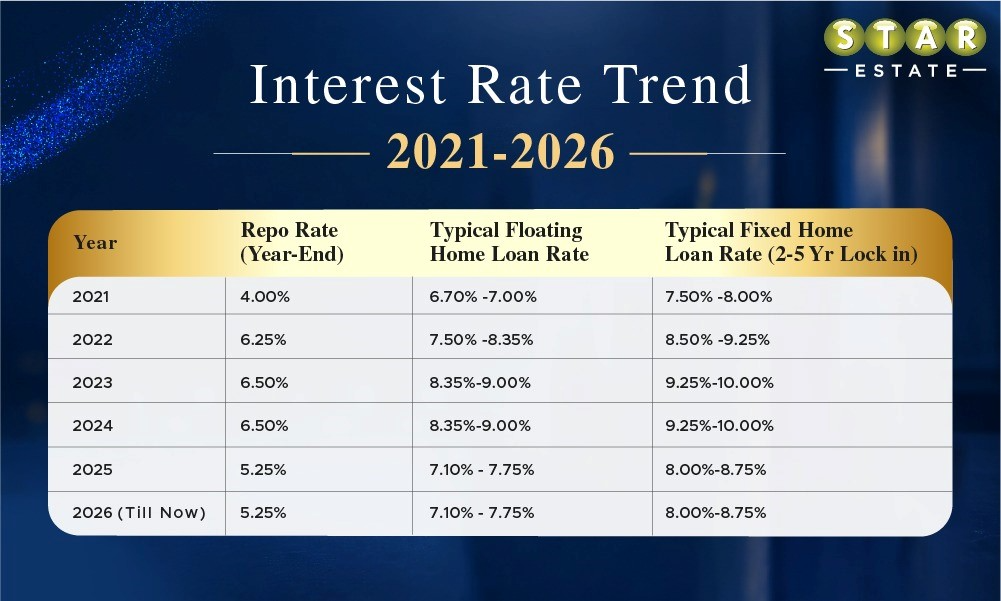
In India, home loan interest rates have evolved in the past few years. In 2021, the pre-pandemic era, a massive 4% dip in the repo rate was reflected in a 6.7% floating rate.
From April 2022, however, the Reserve Bank of India hiked the repo rate 2x 6.50% continued till 2023. However, after continued hikes in 2023 and 2024, the year 2025 brought relief for home buyers in India.
Reserve Bank of India cut the repo rate in 2025 by 25 bps. Since January 2026, the floating rate has been stable between 125 and 150 basis points.
Considering the pattern, the floating rate home loan appears to be more rewarding for homebuyers in India in 2026.
Which Is Better — Fixed or Floating Rate Home Loan Right Now?
A flexible rate home loan is a viable option. Let us understand it with an example.
A loan of Rs. 75 lakh with more than 20 years at a floating rate of 7.5% costs an EMI of Rs. ₹60,400 a month. While the same under a fixed rate of 8.75% has an EMI value of approximately Rs. 66,900.
A difference of almost Rs. 6,000 per month is similar to a loss of some lakhs of rupees.
Buyer’s Takeaway – A floating-rate home loan has an edge over the fixed rate. Considering RBI’s steadiness to keep repo rate on the lower side, it seems a better option for home loan borrowers in 2026. However, check your CIBIL score before applying for a home loan. Also, go through Star Estate’s Buyer’s Guide to know the basics of real estate purchase in India.
Benefits of Floating Rate Home Loan for Borrowers in India
Loan borrowers can pay surplus amounts at any time to lower the principal loan amount. There isn’t any prepayment penalty for early repayment of the loan amount.
Fresh rate cuts are automatically passed to the borrowers. Thus repo-linked loans reset within one billing cycle.
Floating home loan interest rates usually have 100–150 bps, which is less expensive than the fixed rate.
There is a conversion fee applicable to the transfer of a home loan from the current lender to a new one. Loan borrowers switch lender when the interest rate doesn’t match that of other lenders.
Benefits of Fixed Rate Home Loan for Borrowers in India
You have a fixed monthly EMI value with the space to adjust in case of an increase in the repo rate, which directly affects it.
Can Fixed and Floating Home Loan Rates Be Switched in 2026?
Yes, a home loan borrower can switch between a fixed and floating home loan interest rate in India. However, one has to follow the guidelines framed to complete the transition.
The RBI circular in January 2025 states that loan lenders must give loan borrowers the flexibility to choose conversion of flexible to fixed rate home loan and vice a versa. However, they can have conversion fee upfront for the same.
The loan rate conversion eligibility includes the borrower’s repayment track record, current loan-to-value ratio, and residency status. The rules are a bit stringent for non-resident Indian borrowers, as the rates are marginally higher for them. There is usually a 25-50 basic point difference for regular and NRI home loan borrowers.
Loan affordability is another factor, as it is assessed along with income and CIBIL score at the time of loan rate conversion.
For borrowers with a steady repayment history, the process is simple and less time taking. Either discuss the loan conversion with the present lender or make it work with someone else. Usually, it takes 12-18 months to complete the process.
Why This Is a Good Time to Buy a Home in India
ANAROCK’s research shows that demand for residential properties in the top seven cities in India remained resilient in 2026. The pause in the repo rate cut by the RBI signals that affordability is driving decisions.
The expansion of RERA-verified projects beyond tier I cities makes homebuyers explore immovable assets in Tier-2 and Tier-3 cities.
Tax benefits under Section 24(b) and 80C remain available regardless of whether you choose a fixed or floating structure, softening the effective cost either way.
With the festive season approaching the price rise from developers’ may be a surprise. Therefore, waiting isn’t a good option for homebuyers in India, as it can mean losing the chance to buy property at a lower price.
Check our blog on stamp duty and registration charges across India to know how they also affect homebuying decisions.
Home Loan Rate Outlook for 2027
Looking at the trend, the Reserve Bank of India may keep the repo rate unchanged. However, with the festive season approaching, the MPC meeting by the RBI in October 2026 will offer clarity on the same. Considering the fresh inflation shock from crude oil prices or global trade disruption, repo-linked floating rates may remain unchanged. A lot many factors will be considered before the RBI decides the next move.
Fixed Rate Home Loan vs Flexible Rate Home Loan – Know Your Property Beforehand
Before deciding on a loan rate, it’s ideal to consider your property purchase type. Connect with Star Estate to find a RERA-verified property and check the estimated EMI value using Star Estate’s EMI Calculator. The inventory and estimated EMI cost help you pick the best option between fixed and flexible loan rates in India.