GST on Under Construction Property in India 2026: Rates & Calculation Explained
You've shortlisted three projects. The floor plan works, the builder looks credible, and the location ticks every checkbox. Yet one thing keeps nagging you: the GST on under-construction property in India. How much will it add to the cost? Is it even worth buying before possession? Etc. The rules are simpler than they sound, and the numbers are mostly in your favour. This Star Estate blog gives you current rates, a worked example, and traps to avoid so you can decide with clarity.
AI Powered Summary
GST on Under Construction Property in India: The Quick Summary
It's 5% for most homes. For flats in India that aren't "affordable," the GST rate is 5% on an under-construction purchase, calculated on two-thirds of the agreement value.
Affordable homes pay just 1%. The flat must cost up to ₹45 lakh and meet the carpet-area limit for its city.
GST input tax in real estate stays with the builder. Builders can't pass ITC (input tax credit) to buyers, so the 5% or 1% is your final tax cost.
GST on ready-to-move flats is zero. Once the builder has the completion or occupancy certificate, GST doesn't apply to the sale.
GST on property purchase in India is separate from stamp duty. You pay stamp duty and registration charges to the State Government on top of GST.
What Is GST on Under-Construction Property in India (2026)?
GST on under-construction property in India is a tax the Government charges when you buy a flat or home before the builder has received the completion or occupancy certificate. It’s treated as a service the builder provides, so the tax is added to each instalment you pay.
GST on an under-construction property is 5% for non-affordable homes and 1% for affordable homes, charged on two-thirds of the agreement value because one-third is treated as land. Builders can't claim input tax credit (ITC), so there's no extra layering. Completed flats with an occupancy certificate attract no GST.
These rates came into effect on 1st April 2019, after the 33rd GST Council meeting. They haven't changed since, even after the GST 2.0 reforms of September 2025 that trimmed rates on several inputs like cement.
GST Rate on Flats in India: Affordable Housing Projects
A home counts as affordable when its carpet area is up to 60 sq. m (about 645 sq. ft.) in metros, or up to 90 sq. m in other cities, and its value is up to ₹45 lakh. Both conditions must be met. Miss one and you're in the 5% bracket.
Metros here means Delhi-NCR, Mumbai MMR, Bengaluru, Chennai, Kolkata, Hyderabad, Ahmedabad, and Pune. So a ₹48 lakh 2 BHK in Pune pay is 5%, not 1%.
GST Rate on Flats in India: Non-Affordable Housing Projects
The GST rate on flats above that limit, from mid-segment apartments in Noida and Thane to luxury towers in Mumbai, pay 5%. Commercial units like offices and shops are different: they attract 12%, with input tax credit available to the developer.
What Impact Does GST on Property Purchase Have on Your Under-Construction Buy in India?
Higher upfront outflow. GST is added to every instalment you pay to the builder, so your cash demand rises with each construction milestone.
Bigger loan needed. Many banks fund the GST portion only if it's part of the sanctioned cost, so check this before you sign.
No GST at possession. Wait for a completed flat, and the tax disappears, but you'll usually pay a higher base price for it.
GST on Ready-to-Move Flats in India: Why the Tax Disappears
GST on ready-to-move flats in India is a short question with a comforting answer: zero. Once the builder receives the completion or occupancy certificate, the sale is treated as a sale of immovable property, not a service, so no GST is applied to it. You then pay only stamp duty and registration.
In short, GST adds roughly 3.33% to a typical under-construction flat. That's a real number, but it's small next to the 10–20% price premium ready flats often carry over launch-stage pricing.
GST on Under-Construction Property in India: Why It Matters for Buyers in India
For first-time buyers, GST decides your budget. A ₹80 lakh flat is really ₹82.67 lakh after tax, and that's before stamp duty.
For investors and NRIs, the tax is a fixed, known cost. NRIs pay the same rate in rupees, usually through NRE or NRO accounts, and can't claim GST back. Factor it into your yield maths from day one.
For end users, it's about timing. If you need possession in two years, buying under construction means GST. If you need keys next month, a ready home saves it entirely.
How Do You Calculate GST on an Under-Construction Flat? (With Example)
The 4-Step Method
Take the agreement value (basic price plus PLC, parking, and similar charges).
Deduct one-third as land value. The balance is your taxable amount.
Apply 5% (or 1% if affordable) to the balance.
Add the GST to your agreement value to get your total payable.
Worked Example: ₹90 Lakh Flat vs ₹40 Lakh Flat
Take a ₹90 lakh apartment in Gurugram. One-third (₹30 lakh) is land, leaving ₹60 lakh taxable. At 5%, your GST is ₹3 lakh, so you pay ₹93 lakh in all.
Now, a ₹40 lakh affordable flat in Lucknow with a qualifying carpet area. The taxable value is ₹26.67 lakh, and 1% gives about ₹26,667 in GST.
GST on Under Construction Property in India: 2017 to 2026 at a Glance
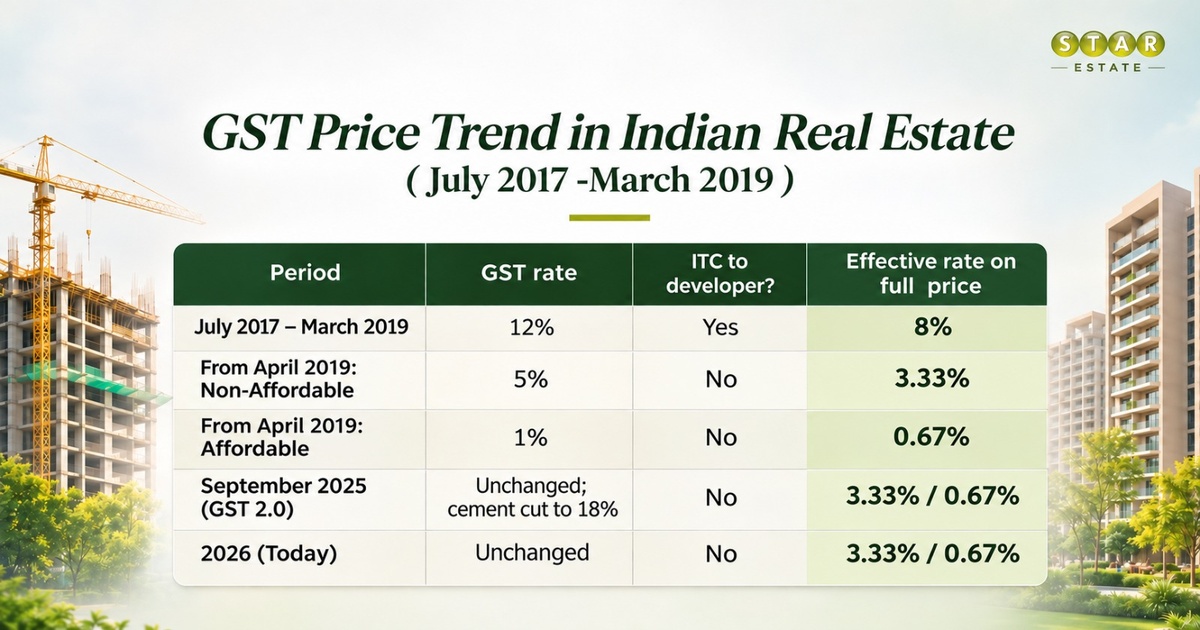
Read that table closely. GST on under construction-property fell from an effective 8% to 3.33% in 207, and to under 1% for affordable homes. So the tax burden today is the lowest it's been since GST began.
GST vs Stamp Duty vs Registration Charges: What's the Difference?
GST: A central tax on the builder's service, paid in instalments, only on under-construction homes.
Stamp duty: A state levy on the property value at registration. It typically runs 4–7% depending on the state and buyer category.
Registration charges: A smaller state fee, often 1% or a capped flat amount, for recording your sale deed.
You'll pay stamp duty and registration even on a completed flat. GST is the only one that vanishes with an occupancy certificate. For a full budget, add all three and keep a 2–3% cushion for legal and society charges.
How Does GST Affect Under-Construction Property Prices in India?
Because builders can't claim (Input tax credit) ITC, they absorb their material costs. GST 2.0 lowered several of those costs, such as cement dropping to 18%, which is eventually beneficial for developers in keeping prices steady.
GST Input Tax Credit in Indian Real Estate: Why You Can't Claim It
Here, Star Estate simplifies the GST input tax credit rule. Developers pay GST on cement, steel, and services, but for residential projects at 5% or 1%, they can't claim that tax back as input tax credit. Since the credit isn't claimed, nothing is passed on to you, which keeps your GST bill flat and simple.
The takeaway for property buyers in India? Don't expect a discount, but do expect fewer price hikes. A launch-stage price plus 5% GST is often still cheaper than the same flat at possession, which is why buyers in growth corridors like Dwarka Expressway, Whitefield, and Thane lock in early.
What Should You Check Before Paying GST on an Under-Construction Flat in India?
RERA registration: Confirm the project number on your state RERA site before you pay a rupee.
Agreement breakdown: GST should be on two-thirds of the value, not the full amount. Ask for it in writing.
Invoices: Insist on a GST invoice for every instalment.
Cancellation terms: Ask how GST is handled if you exit. It's usually adjusted through a credit note.
Affordable status: Verify carpet area and price against the ₹45 lakh and 60/90 sq. m limits before assuming 1%.
Ready to Buy Without the GST Guesswork?
GST on under-construction property is manageable once you see the numbers. The hard part is choosing the right project. At Star Estate, we shortlist RERA-verified projects run the full cost breakdown with you, and negotiate payment plans. Fill in our enquiry form today for a property consultation.