Home Loan Eligibility in India 2026: How Do Banks Decide
Are you a first-time homebuyer, and does how much loan I can get in 2026 make you anxious? The rule of thumb is simple: borrow only what you can comfortably repay. A home loan is money a bank lends you to buy a house, repaid over years through EMIs. So the bigger the loan, the higher the EMI. Since a dedicated share of your income goes toward repayment, home loan eligibility directly affects your monthly budget and lifestyle.
Since 2021, the Reserve Bank of India (RBI) has taken borrowers on a rollercoaster. The repo rate held at a rock-bottom 4% through the pandemic, climbed to 6.50% by early 2023 to tame inflation. Heading into the rest of 2026, with rates stable but not guaranteed to stay put, buyers need to know exactly how eligibility works. This blog covers what determines home loan eligibility in India, how your CIBIL score and employment stability factor in, and how to improve your chances of loan approval in 2026.
What Is Repo Rate, MCLR, and EBLR? How Do They Affect Home Loan Eligibility in India in 2026?
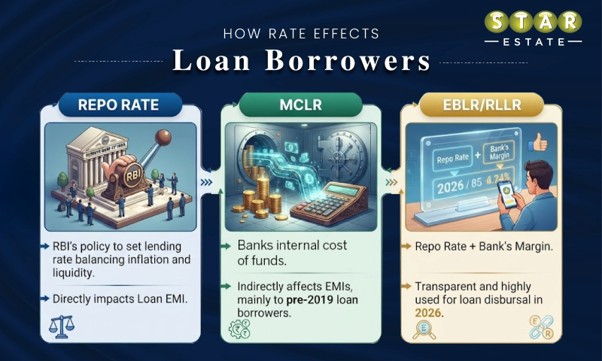
These three terms decide what interest rate you'll actually pay. Here's how each one works.
Repo rate is the rate at which the RBI lends money to commercial banks, which in turn lend to homebuyers. When the RBI raises the repo rate, borrowing becomes more expensive for banks, and that cost is extended to borrowers as a higher home loan interest rate. When the RBI cuts the rate, borrowing gets cheaper.
MCLR (Marginal Cost of Funds-based Lending Rate) is an internal benchmark each bank sets based on its own cost of funds, operating expenses, and deposit rates. Older home loans (sanctioned before October 2019) are often still linked to MCLR, and it resets slowly. Typically, it takes six to twelve months to reflect an RBI rate change.
EBLR (External Benchmark Lending Rate) is set by the RBI to fix the slow pass-through of rate changes. It ties your home loan rate directly to an external, transparent benchmark, usually the repo rate itself, instead of letting each bank calculate its own internal cost. Since October 2019, it's the default for new floating-rate home loans, and by regulation it must be reset within three months of any RBI move.
If you're a first-time home buyer in 2026, your loan will be EBLR-linked. All three benchmarks directly affect home loan eligibility. A lower rate means a lower EMI for the same loan amount, and vice versa.
Factors Banks Determine to Assess Your Home Loan Eligibility
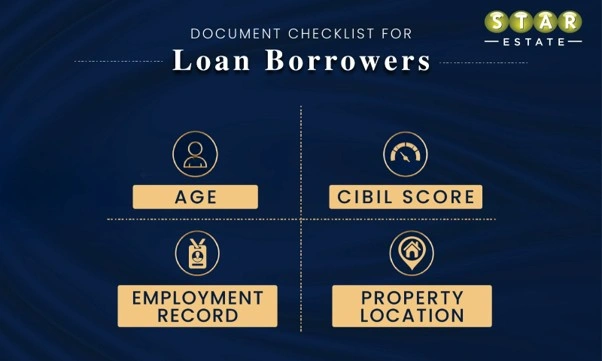
Know the details below and keep updated documents handy before you apply for a home loan in India in 2026.
Applicant's Age — Younger salaried applicants get longer repayment tenures (up to 30 years, or up to 32 years with some lenders such as Bajaj Housing Finance). It’s an ideal way to lower EMI and enhance eligibility. Banks typically cap tenure at retirement age (usually 60). Hence, an applicant at 45 gets a shorter tenure, accounting for home loan eligibility.
KYC — Banks need proof of both identity and address, and these aren't the same document. Your PAN Card establishes identity and your financial/tax trail. Aadhaar Card serve as address proof if your registered address is current. Otherwise, a utility bill, rent agreement, voter ID, or passport works. Keep at least one document from each category updated before applying.
CIBIL Score — Your CIBIL score reflects your credit repayment history on a scale of 300 to 900 and is Bank’s one of the checklist essentials. Visit the CIBIL website to check for a free full credit report. Also, visit banks’ websites to check your monthly score.
A score of 750 or above makes your home loan eligibility stronger for larger sanctioned loan amounts. The best way to improve your CIBIL is to mark paid loans as "Closed. Avoid applying for a loan immediately after closing and pay credit card bill on time. Give yourself a breather of 3-6 months before making a home loan application.
Applicant's Employment Record — Banks flag frequent job changes for salaried applicants as a red flag. For self-employed applicants, a business with less than three years' vintage can undermine eligibility.
Salaried individuals should have six months of salary slips at the time of application. Also, a relieving letter is important if they've been with their current employer for under a year. Many banks also ask salaried applicants for 2–3 years of ITR on larger loan amounts, in addition to the near-universal 3-year ITR requirement for self-employed applicants along with business registration details and GST returns for the last three years.
Property Location —Banks don't just check your finances; they scrutinise the property too. This includes the building's approved layout plan, RERA registration, and a clean chain of title verified through the encumbrance certificate, along with a fair, verifiable sale deed. A property with legal obligations can sink an otherwise strong loan application, which is why you can rely on Star Estate to find RERA-verified property listings in top Indian cities. It removes the risk of rejection due to insufficient due diligence on the property itself.
Tips to Increase Your Home Loan Eligibility in India in 2026
With home prices, inflation, and interest rates all moving in 2026, a few practical levers can meaningfully raise your home loan eligibility in India. It also ease the EMI burden once you have it.
Add a Co-Applicant — A spouse, parent, or sibling with a stable income as a co-applicant can increase your sanctioned loan amount significantly. Banks combine both incomes for home loan eligibility calculation. Several banks, including HDFC, also offer a small interest rate concession of approximately 0.05% when a woman is a co-borrower.
Make a Larger Down Payment — Paying more upfront lowers the loan-to-value (LTV) ratio the bank needs to finance. It reduces perceived risk and can improve both your approval odds and your interest rate.
Choose a Longer Tenure — Extending tenure is another way to increase your home loan eligibility, as it lowers your monthly EMI for the same loan amount. FOIR is a major attribute to consider here.
Build an Emergency Fund — It won't raise the sanctioned loan amount, but it safeguards you from an EMI bounce. Keep 3–6 months of EMI value in an SIP, FD, or RD, so a temporary income gap never turns into a missed EMI.
Formulas to Decide on Home Loan Eligibility in India in 2026
Banks assess your home loan eligibility using three core ratios:
Installment to Income Ratio (IIR) — Your proposed home loan EMI divided by your monthly income. A value below 50% is generally treated as a green flag. The assumption being that roughly half your income is already committed to regular living expenses.
Fixed Obligation to Income Ratio (FOIR) — All your existing EMIs plus the new proposed EMI, divided by monthly income. Caps vary by lender Axis Bank, for instance, publishes a range of 50–60%; so treat 40–60% as the broad band across major lenders rather than a single fixed number. For example, on a ₹60,000 salary with a ₹10,000 existing EMI, your new home loan EMI could fall anywhere between roughly ₹14,000 and ₹26,000, depending on the lender's specific cap.
Formula to calculate FOIR –
FIOR = (Total Monthly Loan Obligation / Gross Monthly Income) x 100
Loan to Value Ratio (LTV) — The percentage of the property's value that the bank will actually finance. RBI guidelines cap this at up to 90% for loans up to ₹30 lakh, up to 80% for ₹30–75 lakh, and up to 75% for loans above ₹75 lakh. The borrower self-funds the remaining amount as a down payment.
What Is EMI? How to Calculate Your EMI Value
EMI (Equated Monthly Installment) is the fixed monthly amount you pay toward your home loan for the entire tenure you've signed up for. It covers the loan amount plus interest, spread evenly across the years, so repayment stays predictable rather than a lump sum you'd struggle to manage.
Fixed rate: Your EMI stays the same for the entire tenure (or a fixed period), regardless of changes in the RBI repo rate. It's a safety net if rates rise, but you won't benefit if the RBI cuts rates either.
Floating rate (EBLR-linked): Your EMI moves with the repo rate. Given the RBI's 2021–2026 pattern of hikes followed by cuts, floating-rate borrowers have already seen their EMIs both rise and fall within the same loan tenure.
Instead of guessing EMI, input values into Star Estate's EMI Calculator to know an estimated cost. It helps first-time homebuyers to finalise a property that aligns with their financial goals and loan amount.
Factors Banks Consider for NRI Home Loan Eligibility in India
If you're an NRI, OCI, or PIO planning to buy property back home, banks apply a version of the same eligibility framework like that of regular citizens. However with a few extra checks on for cross-border income and compliance.
Applicant Category — Indian banks lend to NRIs, OCIs, and PIOs, and most treat OCI cardholders on par with NRIs for eligibility purposes. Merchant navy professionals are also eligible. The exception are OCI holders originally from Pakistan, Bangladesh, Nepal, Bhutan, Sri Lanka, China, Iran, or Afghanistan as they don't qualify under this route.
Age Window — Most lenders open the door at 23 and close it around 60, though a handful stretch the upper limit to 65 or even 70. What actually matters is the retirement. A 40-year-old NRI planning to retire abroad at 58 effectively gets an 18-year tenure ceiling, not the standard 30.
Employment Track Record — Banks want to see roughly 3 years of combined work history in India and overseas, with at least 6 months at your current overseas employer. A very recent switch even to a higher-paying role can work against you here, similar to how it affects regular applicants.
Income Threshold — It is based on the currency the applicant earns in. A salary in USD, GBP, or AED is a green flag for NRI home loan applicants in India.
Credit History, Two Ways — If you've ever held an Indian credit card or loan, your CIBIL score still counts, even from abroad. If you don't have one, banks consider your overseas credit record and your banking history.
The Account Rule — Every rupee tied to the loan, including the down payment and EMI, has to be paid through an NRE or NRO account. You can't wire funds directly from a foreign bank account to the seller or the lender. It has to clear an Indian account first.
Property Restrictions — NRIs can’t buy agricultural land, a farmhouse, or a plantation estate in India. The individual is only permitted to buy residential or commercial property in India, regardless of their income status.
Co-Applicant, Often Non-Negotiable — Many banks either require or strongly push for a resident Indian co-applicant, especially for OCI and PIO applicants. Beyond strengthening the file, it also gives the bank a reachable guarantor for the loan. Star Estate's NRI property buying guidelines walk through the details for NRI home buyers essentials.
The Bottom Line
Home loan eligibility in 2026 comes down to a fairly predictable calculation. Banks weigh your age, income, and repayment history to assess your ability to repay. Keep your bills paid, consider a co-applicant if you want a higher sanction amount, and be clear on whether you're signing up for a fixed or floating rate. It affects how your EMI behaves over time.