IGBC vs GRIHA Rating: Why Green Buildings Are Gaining Popularity Amongst Indian Buyers
Step outside in almost any big Indian city these days, and you’ll know why health now tops every homebuyer’s checklist. Poor air quality has people asking a simple question: can the building I live and work in actually help me breathe easier? That’s where green buildings come in. Families aren’t flinching at paying a little above budget for a home surrounded by greenery, better ventilation, and smarter water use. But not every “green” badge means the same thing. Here, Star Estate explains the IGBC vs. GRIHA rating, what IGBC certification means, how the GRIHA rating works, and what you should check before you sign the homebuying deal.
AI Powered Summary
Here’s Why Indian Buyers Are Choosing Green Homes
• Green homes can cut energy and water use, but savings depend on how well features are built.
• IGBC is the more common badge on Indian launches, rated Certified to Platinum.
• GRIHA is Government-backed and scores projects out of 100+5 points.
• A certificate isn’t a guarantee. Check the features and how they’re built.
• NRI investors should ask for the final certificate, not just a pre-certificate.
What Does a Green Rating for Homes Mean in India?
A green rating for homes is an independent score for how responsibly a project is designed, built, and run. A third party checks it against a fixed list of criteria, so it isn’t just a builder’s claim.
What gets assessed
Energy use and efficient lighting, cooling, and appliances
Water saving, rainwater harvesting, and wastewater reuse
Construction materials, and waste handling
Indoor air quality, daylight, and ventilation
Landscaping, open space, and site planning
What it means for your wallet
Efficient lighting, cooling, and water systems can bring down your energy and water bills. How much you save depends on how well the features are built and maintained.
Also, keep one caution in mind. Outlook Money (July 2026) reminds buyers that a certificate doesn’t automatically mean lower monthly expenses or better premium build quality.
IGBC vs GRIHA Rating: What IGBC Certification Means in India (2026)
IGBC certification means something simple. The Indian Green Building Council, founded in 2001 as part of the Confederation of Indian Industry, audits a project against its Green Homes criteria. If the project qualifies, it gets a rating.
The four IGBC levels
Homes are rated Certified, Silver, Gold, or Platinum. The scores start at 50 points for Certified and reach 80-100 for Platinum.
Ask the developer whether the project holds a pre-certificate (issued at the design stage) or a final certificate (issued after completion). They aren’t the same thing.
Where are IGBC projects cluster
Green building is no longer a metro-only story. Uttar Pradesh ranks second nationally with, 1,673 IGBC-registered projects covering 1.78 billion sq ft (Construction World, March 2026).
How Is IGBC Certification Different From a GRIHA Rating?
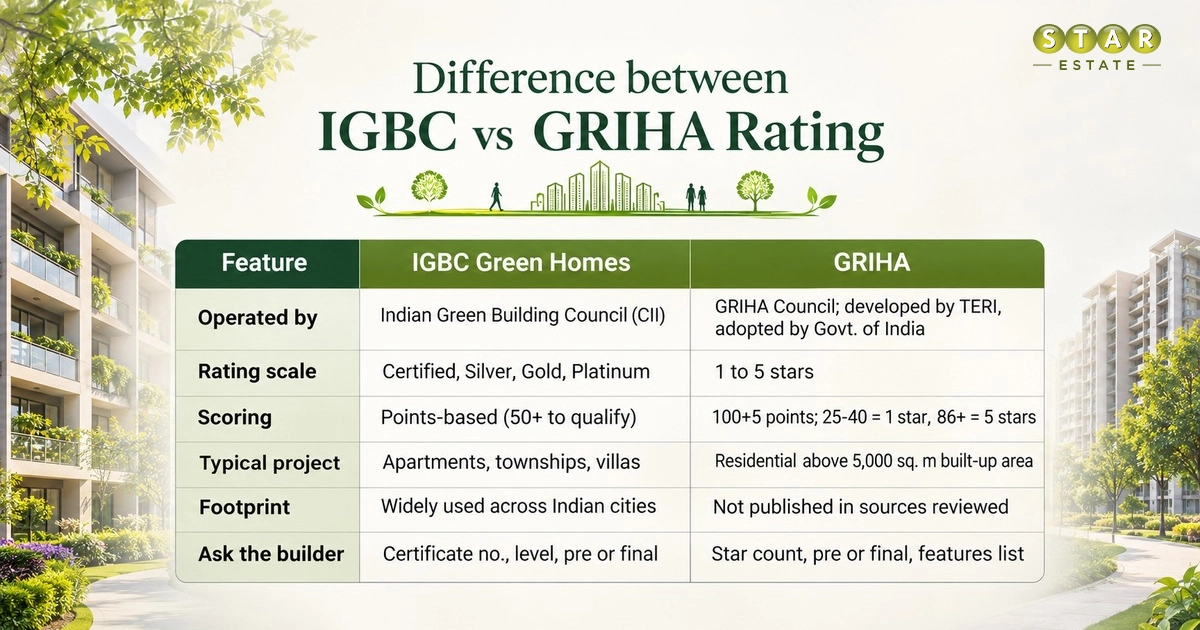
One question which everyone asks about green homes: how much energy, water, and waste does this building create? They differ in who runs them, how they score, and which projects they suit.
So in the IGBC vs GRIHA rating debate, IGBC is the one you’ll spot most often on Indian launches. GRIHA is the rigorous, government-linked option. Neither is automatically “better”. The right question is which one your project actually holds, and whether it’s final.
IGBC vs GRIHA Rating in India: What the GRIHA Stars Actually Tell You
GRIHA stands for Green Rating for Integrated Habitat Assessment. It was developed by TERI (The Energy and Resouce Institute) and later adopted by the Government of India, which is why you’ll often see it on public and institutional projects.
How GRIHA scores a project
Projects are scored out of 100+5 points. The star bands run from 1 star (25-40 points) to 5 stars (86 and above).
Which homes qualify
The main GRIHA rating applies to residential projects above 5,000 sq. m of built-up area, with at least 80% residential use. So a small boutique building may not fit this route at all.
What Should You Consider When Buying Property With a GRIHA Rating in India?
A star rating looks reassuring on a brochure. Before it influences your decision, run through this checklist:
Ask for the certificate details: registration number, star level, and current status.
Confirm whether it’s a pre-certificate or a final certificate.
Get the list of green features promised, such as solar, rainwater harvesting, sewage treatment.
Check the project’s RERA registration separately. A green rating doesn’t replace it.
Visit the site and see whether those features are actually built and working.
Benefits of Buying a Green Building in India in 2026: What NRI Investors Should Know
If you’re an NRI investing from abroad, you can’t pop over to check the building every month. A well-built green project can quietly reduce the surprises.
Why Green Homes are Gaining Ground
Lower running costs: Efficient lighting, cooling, and water systems can reduce monthly energy and water bills.
Healthier living: Better daylight, ventilation and greenery matter more as air quality worsens.
Something to verify: A certificate number and rating level give you a verifiable fact when you can’t visit the project yourself.
Buyer's Takeaway - Green homes are the cost-efficient to own a home to embrace clean fresh air and inhale minimum toxcis.
Why Should You Check Green Ratings for a Home Before Buying a Property in India?
Because “eco-friendly” is easy to print and hard to prove. A rating gives you something to verify. It tells you an outside body has reviewed the design, and it gives you a certificate number to ask about.
It also helps you compare projects fairly. Two towers at the same price can have very different water, power, and air-quality performance.
Don’t rush by the rating
A Platinum or 5-star label shouldn’t close the deal. Look at the features and their execution status. Is the sewage treatment plant running? Are the solar panels installed or only planned? Is the certificate final?
Not sure how to read a project’s green claims? Fill in Star Estate’s enquiry form and one of our advisors will walk you through RERA-registered options and check the certification details with you, free and with no obligation. We do the checking, so you don’t have to guess.