Investing in Property? Know how Metro Impact Property Prices in India in 2026
Ask property owners in Delhi NCR, Pune or Hyderabad what changed their neighbourhood, and many will say the same thing: the metro arrived. The metro's impact on property prices in India is no longer guesswork. A property near a metro station now has a different price, rental pull, and resale story from one stuck in traffic. This Star Estate guide explains how metro expansion is impacting real estate capital values and rents, why developers are changing locations, and how to read the signals before you buy.
AI Powered Summary
Things to Know about the Impact of Metro Expansion on Property Prices in India
Property prices start increasing as soon as a metro project is announced.
A property near a metro station yields higher rental income and appreciation.
Metro connectivity impacts all segments of Indian real estate, including commercial real estate.
An investment in land near a metro line unfolds chance of property appreciation.
End-users and investors prefer property purchases near metro stations in India in 2026
From Proposed to Functional Corridors: Metro Impact on Property Prices in India, 2026
India’s metro network has grown rapidly
According to the Press Information Bureau, India’s metro and RRTS network grew from 248 km in 2014 to about 1,095 km by 2025. In September 2026, Union Housing Minister Manohar Lal put the network at 1,170 km across 26 cities, with roughly 1,000 km still under construction. Daily ridership now exceeds 11.5 million, as per a report.
What Factors Interlink Metro Line and Property Appreciation in India
Announcement: land and under-construction prices start moving as investors price in the future.
Construction: digging and diversions can dull demand locally, but launches begin clustering around planned stations.
Operation: commute savings become real, premiums firm up, and rents follow.
How Does Metro Impact Residential Property Prices in Top Metro Cities?
Metro expansion impacts real estate in an optimistic way; however, each buyer should interpret it differently.
First-time buyers (Pune): CREDAI experts say homes within 500 metres of a station are seeing 10–25% annual appreciation. Corridors like Hinjewadi–Shivajinagar have lifted Baner, Wakad and Hinjewadi. Compare your budget against the corridor premium, and also check homes one or two stops farther out.
Resale buyers (Gurugram): A peer-reviewed study of Gurugram plotted housing found the biggest price jumps near stations and the smallest beyond 1.5 km. For resale, ask for transaction history by distance-to-station, not city averages.
Investors (Hyderabad): A report by a real estate analyst states Kondapur values up 85.7% and Gachibowli up 48.7% since metro plans surfaced. Treat these as upper-end, IT-corridor numbers, not a national norm.
End users (Bengaluru and Mumbai): A study of Namma Metro found the effect strongest closest to stations and fading with distance. Colliers India expects a 10–15% rise in residential and commercial values along Mumbai’s Metro 3 corridor near BKC. For daily commuters, walkable access matters more than headline appreciation.
Metro Impact on Property Prices in Tier II Cities — 2026 Outlook
A Knight Frank–CII report found residential prices in 11 tier-II cities rose 63% between 2021 and 2026, against 42% in the top eight metros. Metro is one driver among several, alongside jobs, expressways, and logistics, so treat it as a tailwind rather than the whole story.
First-time buyers (Indore): A 17-km corridor with 16 stations, built at Rs 2,850 crore, opened on 5th September 2026. Homes still list at roughly ₹5,500–₹7,500 per sq ft, well below metro levels, according to a report.
Resale buyers (Lucknow): The metro already runs, so you can verify rental history and resale demand instead of paying for promises. Knight Frank–CII notes Lucknow’s growing retail base as well.
Investors (Meerut): The 23.6-km Partapur–Modipuram metro opened in February 2026, and the 82-km Delhi–Ghaziabad–Meerut Namo Bharat corridor is fully operational. That ties Meerut closer to NCR jobs. Early-stage, so verify each project carefully.
End users (Nagpur and Kochi): A short metro stretch here gave a fillip to realty along those corridors, so ridership and feeder links are worth checking.
How Is Metro Impacting Commercial Real Estate in India?
Footfall, rents and the station effect
JLL’s work on Indian metros found that close to stations, the visible effect is stronger on commercial values than residential, and it fades with distance. With seamless feeder services, the influence can stretch to 4–5 km. More commuters mean more footfall for malls and high streets, which supports rental values. Fortune India reported rising rents near the BKC–Worli belt as Mumbai’s metro expanded.
Why Property near Metro Stations in India is in High Demand
Higher permissible FSI along corridors, as JLL notes, raises land value and density near stations.
Offices and retail near stations draw wider talent and customer pools.
Developers launch projects where footfall is predictable, which compounds the appreciation.
Reasons for Appreciation in Property Prices near Metro Stations in India (2026)
Shorter, predictable commute: saving 30–45 minutes daily is worth real money.
Transit-oriented development: higher FSI and mixed-use plans lift land value.
Rental demand: tenants pay for walkable access to offices and colleges.
Developer clustering: new launches and amenities follow stations.
Wider buyer pool: metro-linked homes appeal to end users and investors alike.
Scarcity: land within walking distance is limited, so premiums hold.
Metro Impact on Property Prices in India: City-Wise Snapshot, 2021–2026
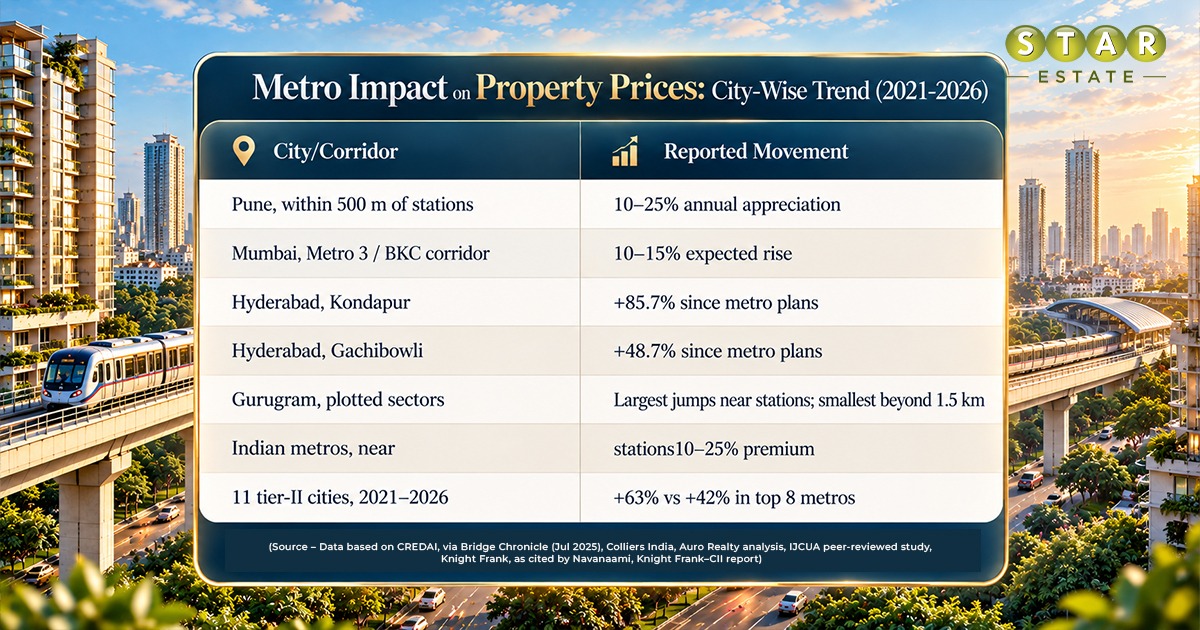
What do these numbers mean for you? The metro’s impact on property prices is real but uneven. IT corridors and fast-growing nodes show the steepest jumps, while mature lines show steadier premiums. Use the table as a range, not a promise, and always compare a specific project with similar homes beyond the station catchment.
Does Metro Always Mean Higher Prices? Risks and an NRI Checklist
Not always, as transit effects vary by city, timing, and distance. Delays hurt sentiment: the proposed Aqua Line extension to Greater Noida West, a 7.5-km, Rs 1,500 crore plan, is reported to bring metro access only by 2028–29.
Confirm the line is sanctioned and funded, not just announced.
Check real walking distance and last-mile links, not straight-line distance.
Verify RERA registration and the developer’s delivery record.
NRIs: compare rental yield with the premium you pay, and confirm title and payment routes with a qualified advisor.
How Is Metro Connectivity Shaping the Future of Indian Real Estate? A 24-Month Roadmap
Next 6 months
Delhi Metro Phase IV segments opened in March 2026, and Mumbai’s Line 2B stretch followed in August. Expect continued price discovery around newly opened stations in NCR and Mumbai.
6 to 12 months
The Public Investment Board cleared the 60-km Ahmedabad Phase III in August 2026. NCRTC submitted a revised DPR for the 72.4-km Ghaziabad–Jewar Airport RRTS, and the Centre gave in-principle approval for the Delhi–Haridwar RRTS. Approvals like these tend to wake up land markets early.
12 to 24 months
Expect premiums to concentrate in funded corridors and connected tier-II cities, while delayed lines test buyer patience. Greater Noida West remains a ‘watch and verify’ market until timelines firm up.
Weigh the Pros and Cons before Buying Property near a Metro Station in India
Metro expansion lifts property prices through shorter commutes, higher rents, and denser, better-planned neighbourhoods. But premiums vary widely, and buying late can mean paying for gains already made. Before you decide, run this check:
Pros: faster commute, stronger rental demand, wider resale pool, better liquidity.
Cons: higher entry price, possible construction disruption, delay risk, uneven last-mile access.
Want a shortlist matched to your budget and corridor? Explore Star Estate’s new projects in Noida and new projects in Gurugram, or speak with our Noida and Gurugram advisors. Fill in the enquiry form today for a free, no-obligation consultation on metro-linked, RERA-registered options.