Leasehold vs Freehold Property: What Noida & Greater Noida Buyers Must Know
AI Powered Summary
Most property in Noida is leasehold. The Noida Authority allots land on long-term leases. Group housing land typically carries a 90-year lease.
Greater Noida and the Yamuna Expressway (YEIDA) also follow a leasehold system. Much of Ghaziabad’s residential property is freehold.
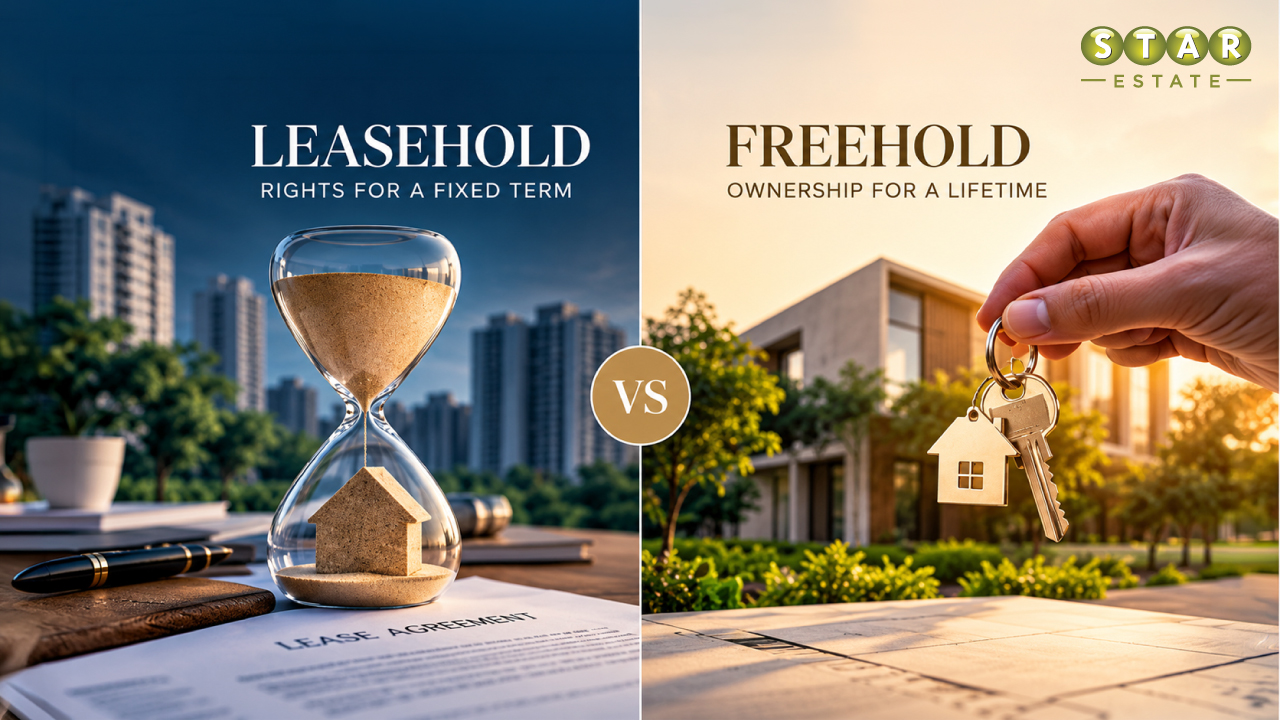
Freehold generally means ownership of the land with no fixed expiry. Leasehold means rights for the lease term.
There is no operative leasehold-to-freehold conversion policy in Noida as of the latest reports. The Noida Authority gave in-principle approval in 2018, but no scheme has been implemented.
Banks do finance leasehold flats. Some lenders ask for an authority mortgage permission.
Resale flats in Noida attract an authority transfer charge on top of UP stamp duty (7% for male buyers) and a 1% registration fee.
Before buying, check the lease start date, remaining term, authority dues and transfer conditions.
Introduction
Whether a property is leasehold or freehold decides what you actually own, how easily you can resell it, what your bank will ask for, and what you pay at transfer. For most Noida buyers the answer is already set: nearly all Noida apartments stand on leasehold land allotted by the Noida Authority. The practical question is not whether to buy a leasehold, but how to buy it safely.
This guide explains both ownership types in plain terms. It covers how leasehold works in Noida, Greater Noida and nearby areas, the current position on freehold conversion, and the costs and documents to check before you commit.
1. What Is Leasehold Property?
Leasehold property gives you the right to hold and use a property for a fixed period under a lease, while the original landowner keeps ownership of the land. In Noida, that landowner is the Noida Authority.
The authority leases land to developers. Developers then sell apartments to buyers through sub-lease or tripartite arrangements. The buyer holds rights over the flat and a share of the land for the remaining lease term.
Leasehold does not stop you from selling, renting, gifting or inheriting the property, or from taking a loan against it. These rights simply come with conditions: authority permission for transfer, payment of transfer charges, and compliance with the lease deed.
2. What Is Freehold Property?
Freehold property gives the owner ownership of both the land and the building, with no fixed expiry date. The owner can sell, gift or bequeath it without authority permission, subject to registration, tax, land-use and building rules.
For example, a buyer of a legally documented freehold residential plot in Ghaziabad owns the land and any approved construction on it.
Freehold status brings simpler transfers and no lease rent. It does not guarantee better location, construction quality or appreciation. A legally sound leasehold flat in a strong location can be a better buy than an overpriced freehold property with weak demand.
3. Leasehold vs Freehold Property: Key Differences
Factor | Leasehold Property | Freehold Property |
Land ownership | The authority (lessor) keeps ownership of the land | The owner owns the land |
Ownership period | Fixed lease term (typically 90 years for Noida group housing) | No fixed expiry |
Lease rent | Payable annually or as a one-time lease rent | Not applicable |
Resale process | Needs authority transfer approval and transfer charges | Sale deed and registration |
Home loans | Available; some lenders need an authority mortgage permission | Available, subject to lender approval |
Renewal | Relevant as the lease nears expiry | Not applicable |
Conversion | Only under an operative authority policy | Not applicable |
Key documents | Lease deed, sub-lease deed, transfer memorandum, NOCs | Title deed, sale deed, mutation records |
These are general principles. Always check the specific property’s documents.
4. Is Noida Property Leasehold?
Yes. Almost all land in Noida is leasehold, allotted by the Noida Authority on long-term leases. Noida was established under the Uttar Pradesh Industrial Area Development Act, 1976. Under this framework, the authority keeps ownership of the land and allotts it on lease rather than selling it outright.
Group housing (apartment) land in Noida is typically leased for 90 years. Some allotments carry different terms, and 99 years is also commonly cited, so confirm the term in the property’s lease deed.
When you buy a flat directly from a developer, you sign a sub-lease deed. When you buy a resale flat, the Noida Authority records you as the new sub-lessee through a transfer memorandum.
Explore options through Star Estate’s residential properties in Noida and residential properties in Greater Noida listings.
5. Is Greater Noida, YEIDA or Ghaziabad Property Leasehold?
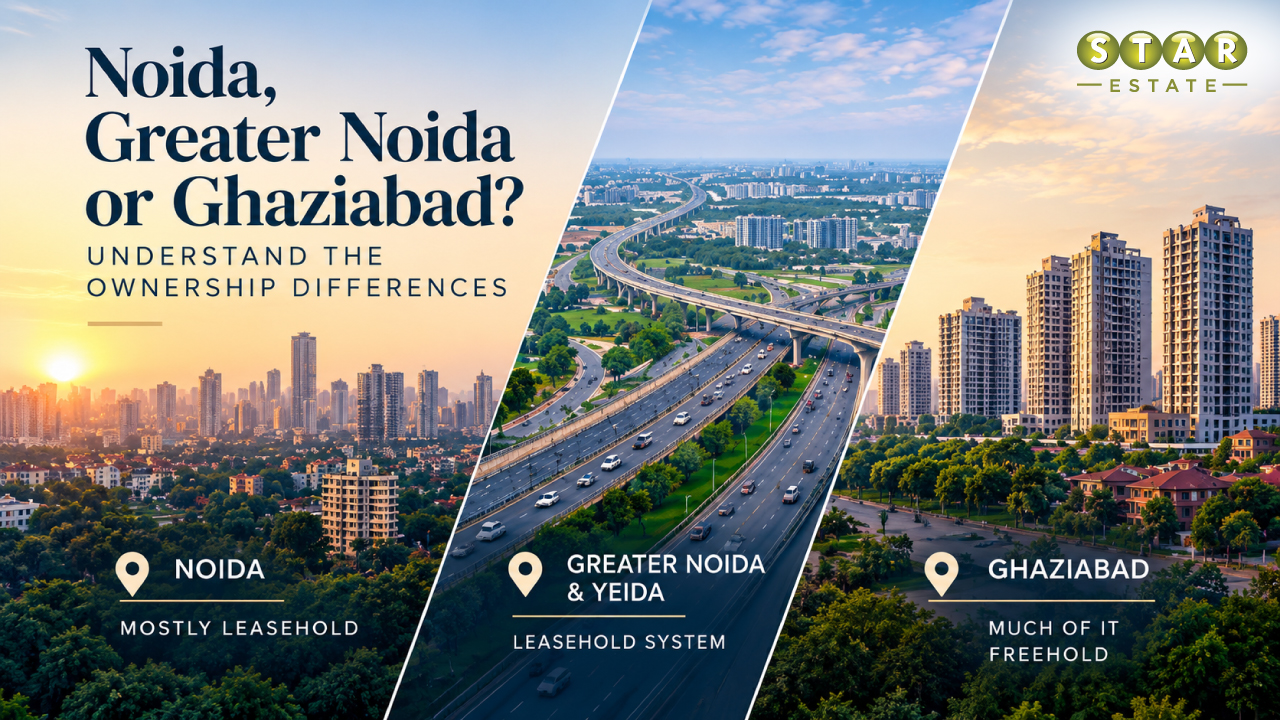
Greater Noida: Yes. The Greater Noida Industrial Development Authority (GNIDA) also allots land on a leasehold basis. Its transfer rules and charges differ from Noida’s.
Yamuna Expressway (YEIDA): Yes. The Yamuna Expressway Industrial Development Authority follows a leasehold system, including for plots and projects near the Noida International Airport, Jewar.
Ghaziabad: Much of Ghaziabad’s residential property, including plots allotted by the Ghaziabad Development Authority (GDA), is freehold. Some areas developed by other authorities, such as UPSIDA, may be leasehold, so verify each property.
Always confirm which authority governs the land before you buy. Two projects a few kilometres apart can have different ownership structures.
6. What Does a 90-Year Lease Mean?
A 90-year lease gives the lessee rights for 90 years from the lease commencement date, not from the date you buy.
Example: A Noida project whose land lease began in 2005 runs until 2095. A buyer in 2026 gets roughly 69 years of remaining lease, not 90.
The commencement date usually comes from the authority’s original lease deed with the developer, not from the project launch or possession date. Ask the seller or developer for:
The original lease commencement date
The lease expiry date and remaining term
Renewal or extension conditions in the lease deed
Proof of lease rent paid (annual or one-time)
Any outstanding authority dues
The permissions needed for resale or mortgage
7. What Happens When a Noida Lease Expires?
Renewal or extension of an expired lease depends on the lease deed’s terms and the authority’s policy at the time. Noida was set up under the 1976 Act, so no 90-year residential lease there has expired yet, and there is no settled precedent for what happens at expiry.
For buyers, this means:
Read the renewal clause in the lease deed carefully.
Factor the remaining lease term into resale and loan planning. A shorter remaining term can affect lender appetite and resale value.
Treat any claim about “automatic renewal” or “future freehold” as unverified unless it appears in an official authority notification.
8. Can You Convert Leasehold Property to Freehold in Noida?
Not currently. As of the latest reports, there is no operative leasehold-to-freehold conversion policy in Noida.
The history matters here:
November 2018: The Noida Authority gave in-principle approval to converting leasehold rights to freehold, subject to Uttar Pradesh government approval.
Since then: Resident welfare associations have repeatedly demanded freehold rights, but no conversion scheme has been implemented.
November 2025: An Economic Times report noted that a general conversion policy had still not been implemented in Noida.
Conversion schemes elsewhere don’t apply to Noida, and even established schemes can change. Delhi’s DDA has offered conversion for years, but in 2026 it paused new applications while it reviewed the policy.
If conversion matters to your decision:
Identify the authority that governs the property.
Obtain the original lease deed and current ownership documents.
Ask the authority in writing whether any conversion policy applies.
Consult a property lawyer before paying any premium for an assumed future conversion.
Do not pay extra because a seller says the property “will soon become freehold.” An in-principle approval or proposal is not an operative policy.
9. Can You Get a Home Loan on Leasehold Property?
Yes. Banks routinely finance leasehold flats in Noida and Greater Noida, subject to the property’s legal documents and the lender’s rules.
Lenders assess your repayment capacity, the property’s title, its valuation, project approvals and the remaining lease term. Some also need a mortgage permission or NOC from the authority. For example, Punjab National Bank’s loan checklist lists authority permission for the transfer and mortgage of certain leasehold properties as a required document.
Documents your bank may ask for:
Registered lease deed, sub-lease deed or transfer memorandum
Project approvals and UP RERA registration details
Authority mortgage permission or NOC, where required
Proof that authority dues are cleared
The bank’s own legal and technical assessment
Ask your bank to review the property’s documents before you pay a booking amount. Approval for one unit does not guarantee approval for another in the same project.
10. What Are Transfer Charges in Noida?
Transfer charges, also called Transfer of Memorandum (TM) charges, are fees paid to the Noida Authority when a leasehold property is resold. The authority charges them to record the new buyer as a sub-lessee.
Key facts:
Noida: In September 2021, the Noida Authority halved transfer charges on residential properties from 5% to 2.5%. They are calculated by property category and the applicable sector rate.
Greater Noida: In June 2021, GNIDA cut transfer charges on resale residential plots and houses from 5% to 2.5%. It capped charges on resale group housing flats at 1%.
New flats bought directly from a developer do not attract transfer charges. They apply on resale.
Transfers between blood relatives generally attract lower or nil charges, subject to authority rules.
Transfer charges are separate from:
Stamp duty: 7% for male buyers in Uttar Pradesh. Women buyers get a limited concession; check the current rate on the IGRSUP portal.
Registration fee: 1% of the property value.
Brokerage, legal fees, society dues and maintenance deposits.
Example cost stack for a ₹1 crore resale flat (male buyer): ₹7 lakh stamp duty, plus ₹1 lakh registration, plus the authority transfer charge, plus brokerage and society dues. Ask for a written cost breakdown and confirm who pays each item.
11. Leasehold vs Freehold: Which Is Better for Noida and Greater Noida Buyers?
Freehold suits buyers who want permanent land ownership and simpler transfers. A well-documented leasehold flat suits most Noida buyers, because nearly all Noida apartments are leasehold. In Noida, location, legal clarity and remaining lease term matter more than tenure.
Choose a leasehold if you want a home in an established Noida or Greater Noida community with good connectivity, amenities and security, and the remaining lease term is long.
Choose freehold if you want to hold land for the long term, plan your own construction, or prefer fewer authority approvals. Areas like Ghaziabad are where to look.
Your priority | What to examine |
Self-use home | Location, commute, amenities, legal title, remaining lease |
Rental income | Tenant demand, maintenance costs, rental yield, transfer conditions |
Capital appreciation | Infrastructure, supply, entry price, legal risks |
Residential plot | Land title, land use, building permissions, lease terms |
Inheritance planning | Ownership documents, nomination, transfer conditions |
12. How Property Ownership Affects Investment Decisions
Noida and Greater Noida attract buyers for their planned sectors, IT and employment hubs, expressway connectivity, Aqua and Blue Line metro access, and links to Delhi. Infrastructure alone does not guarantee appreciation, though. Location, local demand, supply and entry price decide returns.
On the Noida–Greater Noida Expressway, buyers typically prioritise access to employment centres. In Greater Noida West, buyers weigh commute routes, social infrastructure and budget. Along the Yamuna Expressway, the Noida International Airport drives interest. Judge such projects by their actual stage of completion, not announcements.
Ownership structure shapes your exit options. Factor the remaining lease term, transfer charges and lender acceptance into your expected resale value.
For location comparisons, read Star Estate’s guide to the best areas to invest in Noida, including Sector 150 and the Noida Expressway.
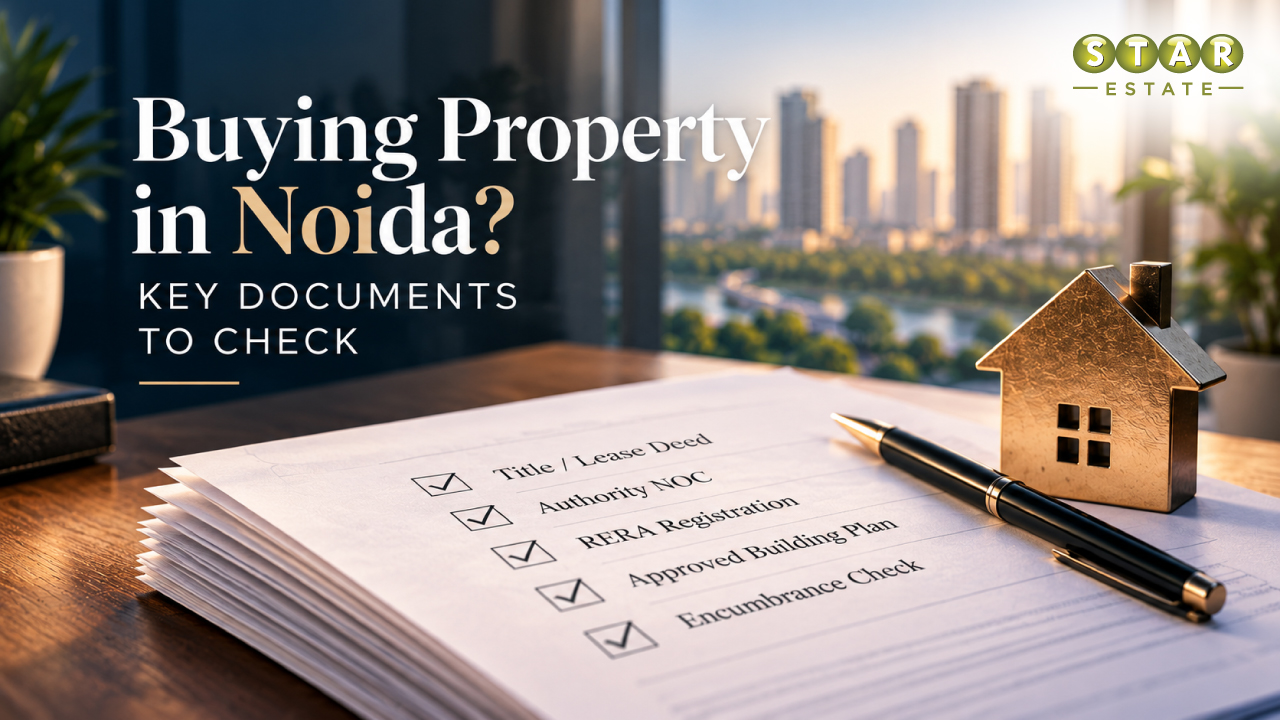
13. Documents to Check Before Buying Property
Document | Why it matters |
Title / lease deed | Confirms the seller’s rights and the lease term |
Sub-lease or conveyance deed | Shows the rights granted to the flat buyer |
Transfer memorandum (resale) | Confirms authority-recorded ownership |
Authority NOC and dues clearance | Ensures no pending lease rent or charges |
UP RERA registration | Verifies project details (check on the official UP RERA portal) |
Approved building plan and occupancy certificate | Confirms legal construction and use |
Encumbrance and litigation check | Reveals loans, claims or disputes |
Cost breakdown | Stamp duty, registration, transfer charges, dues |
The exact list depends on whether you are buying a plot, an under-construction flat, a ready flat or a resale unit. For complex purchases, hire an independent property lawyer. Brokers and sales teams can explain the process, but independent verification protects you.
Conclusion
Leasehold or freehold is ultimately about the rights your documents grant. In Noida, Greater Noida and along the Yamuna Expressway, leasehold is the norm. Freehold conversion is not currently available in Noida, so buyers should focus on what they can control: the remaining lease term, clean documents, cleared authority dues, lender approval and a full cost breakdown.
Get those right, and a leasehold home in a well-connected location can serve you as well as any freehold property.