Strategic Ways to Save for a Home Loan Down Payment in India (2026)
You got the job. The salary is steady. And now the flat you’ve been eyeing as your first property seems viable. Then comes the real question: how do you buy a high-value asset so early in life? How long should the loan run? And where will the home loan down payment come from, and how do you save for down payment money on a salary? Most young professionals turn to family or friends for advice. Everyone means well, but everyone has a different story, and none of it is a plan. This guide from Star Estate puts everything first-time buyers need to know about home loan down payments in India in one place, from the minimum down payment to what a 20 percent down payment on a flat really costs.
AI Powered Summary
Home Loan Down Payment in India 2026: An Overview
What it is: The down payment is the part of the price you pay from your own pocket. The bank funds the rest.
How much: RBI rules mean you’ll need at least 10% to 25%, depending on the property price. For most flats, plan for a 20 percent down payment.
Hidden costs: Stamp duty, registration, and processing fees come on top. Budget roughly another 5% to 10%.
How to save for a down payment: Automate SIPs, use recurring deposits, trim lifestyle spending and use your PF where eligible.
Why pay more: A bigger down payment lowers your EMI and total interest, and makes approval easier.
What Is a Home Loan Down Payment in India?
A home loan down payment is the portion of a property’s price that you pay upfront from your own savings. The lender finances the rest. For a ₹60 lakh flat, a 20 percent down payment means you pay ₹12 lakh and the bank lends ₹48 lakh. That’s the whole idea.
What Is the Minimum Down Payment for a Home Loan in India?
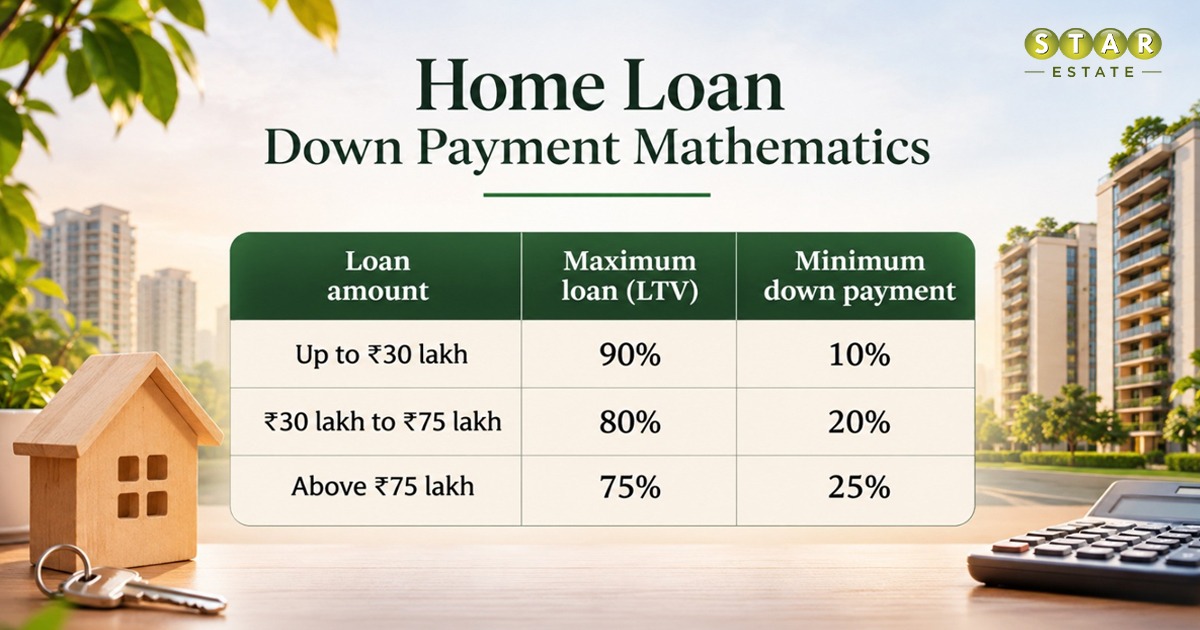
The Reserve Bank of India (RBI) caps how much of a property’s value a bank can finance. This is called the loan-to-value (LTV) ratio. Whatever the bank cannot lend, you must pay from your own funds as the down payment.
For most flats in metro cities, where prices cross ₹30 lakh easily, the minimum down payment for a flat works out to20% or more. No bank in India offers a 100% home loan.
Costs the loan does not cover
The down payment is not your only upfront cost. Budget separately for:
Stamp duty and registration: Usually 5-8% of the property value, depending on your state. These are generally not financed by the bank.
Processing fee: For example, SBI charges 0.35% of the loan amount, with a ₹2,000 minimum and ₹10,000 maximum.
Other charges: Legal and valuation fees, brokerage, GST on under-construction flats, and loan insurance premiums.
How much home loan can a salaried person obtain in India?
Banks decide your loan amount mainly through the Fixed Obligation to Income Ratio (FOIR). It is the share of your monthly take-home pay that goes to fixed obligations, including your proposed home loan EMI and existing loans.
Most lenders allow total EMIs of about 40-60% of net monthly income. Higher earners usually get the upper end of that range.
Banks use your net take-home salary, not your gross CTC. Some banks also apply a quick multiple of 48-60 times your net monthly salary and give you whichever method produces the lower figure.
Example: With a net salary of ₹1,00,000 per month, an interest rate of 8.5%, a 20-year tenure, and a 50% FOIR, your maximum EMI is ₹50,000. That supports a loan of roughly ₹57 lakh. At 80% LTV, this would fund a property of about ₹71 lakh, with a down payment of about ₹14 lakh plus stamp duty and other costs.
If you already pay a ₹15,000 EMI on another loan, the eligible loan falls to about ₹40 lakh. Clearing small loans before applying can raise your eligibility significantly.
Other factors that banks check
Credit score: 750 or above is preferred. A higher score also gets you a lower interest rate.
Age and tenure: The maximum tenure is usually 30 years, and the loan must typically mature by around age 70. Younger borrowers can get longer tenures and larger loans.
Minimum income:Most lenders ask salaried applicants for ₹ 15,000- 25,000 per month, depending on the lender and city.
Job stability: Frequent job changes or an unconfirmed (probation) position can lower your eligibility.
Co-applicant: Adding an earning spouse or parent increases the loan you can get.
Property: The title must be clear, the project approved by the bank, and RERA-registered where applicable. The bank lends against its own valuation, which can be lower than the agreed price.
Documents: KYC, 3-6 months of salary slips, 6 months of bank statements, Form 16 or ITRs, and the property papers.
Interest rates and charges to keep in mind
Home loan rates across major lenders currently start at around 7.25% and go above 9%, depending on your profile. Lenders have been raising lending rates recently, so check the current rate before you apply. Since January 2026, RBI rules have prohibited prepayment charges on floating-rate home loans for individuals. Fixed-rate loans are not covered.
How to improve your eligibility
Check your credit report and correct errors 2-3 months before applying.
Close small loans and reduce credit card balances.
Add a co-applicant with stable income.
Pay more than the minimum down payment, which lowers your EMI and often your rate.
Compare at least three lenders on rate, processing fee, and the LTV they will actually offer.
Get an in-principle approval before finalizing a flat.
Figures are indicative and based on mid-to-late 2026 lender information. Rates and FOIR limits vary by bank, so confirm the details with your lender before deciding.
What If the Seller Asks for More Than a 20 Percent Down Payment?
It happens, especially in resale deals. Sellers sometimes want extra cash, or the registered value is lower than the deal value. Don’t agree to anything off-record.
Pay only what’s documented in the agreement. Any “extra” outside the bank-funded amount is a legal and tax risk for you, not the seller. If the demand is genuine, negotiate the price instead.
How Does Your Home Loan Down Payment Affect Your EMI in India?
A bigger down payment means a smaller loan. Loan amount = property price − down payment. Your EMI is calculated only on the loan, so every extra rupee you put down is a rupee you don’t borrow.
EMI falls almost in proportion to the loan. At an illustrative 8.5% for 20 years, each ₹1 lakh borrowed costs about ₹868 a month. Borrowing ₹1 lakh less saves roughly ₹868 on every EMI.
Total interest falls too. Interest is charged on the outstanding loan, so a smaller loan means less interest over the full tenure.
A lower EMI frees up cash. You have more monthly room for other expenses, savings, or investments, and a smaller loan leaves more of your FOIR (the share of income banks allow for EMIs) free for other credit.
An Illustrative Example –
Example: a ₹60 lakh flat at 8.5% for 20 years (approximate figures)
Paying ₹12 lakh more upfront cuts the EMI by about ₹10,400 a month. It also saves about ₹13 lakh in total interest.
A higher down payment can lower your interest rate. Lenders treat a lower LTV as lower risk. For example, SBI adds a 10 bps premium on loans up to ₹30 lakh when LTV is above 80%.
A larger down payment improves your approval chances. The loan is smaller relative to your income, so it is easier to qualify for.
You can choose between a lower EMI and a shorter tenure. With a higher down payment, you can keep the same EMI and finish the loan sooner, which cuts interest further.
There is a trade-off. Don’t drain your emergency fund for the down payment, because a smaller loan helps only if you stay financially comfortable. Keep 6 months of expenses aside, and don’t forget stamp duty, registration, and other costs, which the loan does not cover.
The RBI minimum is the floor, not the target. The minimum down payment is 10%, 20%, or 25% depending on the loan size, but paying more reduces your EMI and interest burden.
These figures are illustrative, calculated at 8.5% over 20 years. Your actual EMI depends on your lender’s rate, tenure, and charges.
How to Save for a Home Loan Down Payment in India (2026)
Saving ₹12 to ₹20 lakh sounds heavy. Broken into months, it isn’t. If you’re wondering how to save for a down payment, start with the number, then choose the strategy.
Set a Target and a Date
Work backwards. Want a ₹60 lakh flat in four years? The down payment for a flat of that price, at 20 percent, is ₹12 lakh. Add about 8% for stamp duty and registration. That’s roughly ₹17 lakh, or ₹35,000 a month.
Write the number down. Vague goals rarely get funded.
Put Your Savings on Autopilot
SIPs in hybrid or index funds: A considerable option for a goal three to five years away. Markets can dip, so shift to safer options in the last year.
Recurring deposits or FDs: Boring, but predictable. Ideal for the final 12 to 18 months.
Salary-day transfer: Move the amount the day your salary lands, before you can spend it.
Use PF and Other Eligible Funds
EPFO members can use up to 90% of their PF accumulations towards a down payment and EMIs, subject to eligibility rules. Check your service period and withdrawal conditions first.
Bonuses, ESOPs and maturing investments can also top up the corpus.
Cut the Leaks, Not the Life
You don’t need to stop shopping or spending leisurely. Audit your subscriptions, impulse EMIs, and weekend spends. Redirecting even ₹5,000 a month adds ₹2.4 lakh in four years, before returns.
Bring in Family Support the Right Way
Parents or siblings can contribute. Get it as a documented gift or loan, with a gift deed or bank transfer trail. Lenders will ask for the source of funds.
For NRIs: Plan for Currency and Compliance
NRIscan fund the down payment through NRE or NRO accounts or inward remittances. Remit in tranches when the rupee is favourable, and keep every bank record. Rental yield and appreciation matter, but a clean funding trail matters more at the time of registration.
Why Do Sellers Ask for a Home Loan Down Payment in India?
It’s not just about the money. The down payment tells everyone you’re serious.
Banks see skin in the game. Borrowers who invest more are less likely to default.
Builders and sellers get certainty. A booking amount locks the deal and reduces back-outs.
RBI rules require it. Lenders legally can’t finance 100% of the price.
For under-construction flats, the down payment is often paid in stages linked to construction milestones, not all at once.
How to Pay Your Home Loan Down Payment in India (2026)
Payment mode matters as much as the amount.
Bank transfer, NEFT/RTGS, cheque, or demand draft: Always route payments through banking channels so there’s a clear paper trail.
Stage-wise payment: In under-construction projects, pay as the builder raises demands, with the bank disbursing its share separately.
Before disbursement: In most cases, you pay your share first, and then the lender releases its portion.
Avoid large cash payments. They’re risky and can be questioned later.
Things to Remember Before Paying the Down Payment for a Flat in India
Dos
Keep 5% to 10% extra for stamp duty, registration, GST (on under-construction homes), and processing fees.
Get a pre-approval so you know your loan limit before you pay a token amount.
Verify the title, RERA registration and approvals before transferring money.
Keep an emergency fund of six months’ expenses separate from the down payment.
Don’ts
Don’t drain your savings completely. Job loss plus a fresh EMI is a rough start.
Don’t pay cash or “black” components. It voids your protection.
Don’t take a personal loan to fund the down payment. Banks check this, and the interest hurts.
Don’t pay the full booking amount before the sanction letter is in hand.
What Are the Benefits of a Higher Home Loan Down Payment in India?
Lower EMI: The higher down payment value is the lower loan you will borrow.
Less total interest: Roughly lakhs of money is saved over 20 years at the same rate.
Better loan terms: Lenders see you as lower risk, which can help with approval and negotiation.
More equity from day one: You own a bigger share of the home, which gives you more cushion if prices move.
The flip side: don’t stretch so much that you lose liquidity. A balanced 20 percent to 30 percent down payment works for most buyers.
Start Your Home Loan Down Payment Plan Today
A smart home loan down payment plan has three parts: a clear target, automated savings, and a buffer for the extras. Do those, and the loan becomes manageable.
Not sure how much home you can afford, or which projects fit your budget? The Star Estate team can shortlist residential and commercial options, run the numbers with you, and connect you with the right lenders. Visit www.starestate.com and talk to an advisor today.