Top Indian Cities for NRI Property Investment in 2026 – All You Need to Know
While the country remains attentive to currency shifts, with the Indian Rupee trading near Rs. 95 against the US Dollar in 2026, Non-Resident Indians (NRIs) are actively capitalizing on this strategic window. Earning in USD, AED, GBP, and EUR, international buyers are leveraging currency arbitrage to secure larger, premium residential and commercial spaces across top Indian metro cities and growth corridors.
The search for high-performing NRI property investment options in 2026 is gaining significant momentum. This comprehensive guide details price trends, infrastructure catalysts, legal and regulatory updates under FEMA and RERA, micro-market breakdowns, and high-yield commercial real estate opportunities.
Price Dynamics and Market Momentum (2025-26)
The data from the Reserve Bank of India (RBI) in All-India House Price Index (HPI) exhibit India's real estate trajectory as a sustainable, non-bubble, demand-driven growth:
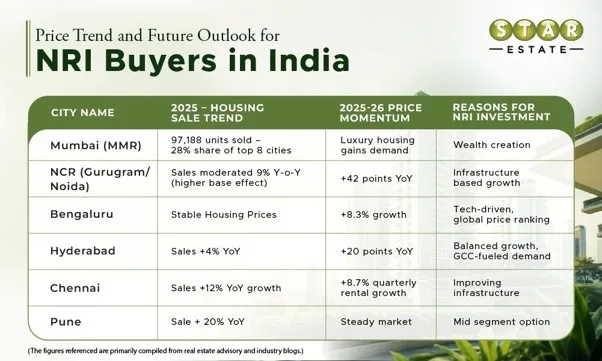
Delhi-NCR leads Appreciation Table - India’s Housing Price Index across 13 cities registered a robust 14-point rise on a year-to-year basis by September 2025. Delhi-NCR led the tally with a 42-point annual rise, followed by Bengaluru and Hyderabad at 24 and 20 points respectively.
Bengaluru Property Growth - Also, Bengaluru’s prime residential prices rose 8.3% YoY between April 2024 and March 2025. It is the sharpest ranking amongst Indian cities and the fourth in the global list.
RBI Confirms Stability - The RBI’s All-India House Price Index grew to 3.58% YoY in Q4, 2025. The HPI reflects organic growth driven by end-users and investors, instead of speculative demand.
Mumbai leads Sales - Mumbai recorded the highest transaction volume in 2025 by selling 97,188 housing units. It is nearly 28% of the overall sales across the top eight Indian cities. Chennai and Hyderabad recorded the strongest annual growth at 12% and 4%, respectively.
Why Property Investment in India is a Smart Choice for NRIs in 2026?
The six core factors make 2026 the perfect time for NRI investors to venture into Indian real estate.
Foreign Currency Arbitrage: A strong foreign currency against the Indian rupee allows NRIs to buy 15-20% more built-up area compared to the last couple of years.
Fast-Track Infrastructure Development: Major expressway corridors are either operational or they nears completion. Dwarka Expressway, the Noida-Greater Noida metro extension, Bengaluru's Peripheral Ring Road, and Chennai's Poonamallee-Porur Metro Line 4 are all reshaping property values along their corridors.
Market Premiumization: Reputed real estate developers prioritize projects with luxury apartments featuring top-notch amenities. The private elevators and smart home automation in projects align with the NRI lifestyle.
Structured RERA Act: Escrow-based fund flows and mandatory disclosures lower the risk of stalled projects.
Climbing Rental demand & Yield: GCC and tech-sector hiring in Bengaluru, Hyderabad, and Pune keeps rental occupancy and yields healthy in the 3-4% band, with select micro-markets doing better. The hybrid work model maintains occupancy rates above 90% in Tier I cities.
FEMA and Repatriation: The clear rules laid under the Foreign Exchange Management Act (FEMA) ensure easy repatriation of capital and rental proceeds.
Regulatory and Tax Reforms in 2026 for NRI Investors
The new regulatory and tax reforms have simplified real estate purchases for foreign currency investors.
PAN-based TDS Processing – The domestic buyers purchasing property from an NRI seller anywhere in India no longer require a Tax Deduction and Collection Account Number (TAN). Tax Deducted at Source (TDS) under Section 195 can now be remitted easily using PAN details. The process diminishes the turnaround time massively.
Standard $1M Repatriation Limit – NRIs can now repatriate up to $1 million USD per financial year from their NRO accounts, representing property sale proceeds, subject to fulfilling capital gains tax obligations under FEMA regulations.
Digital Transaction – End-to-end property acquisition is now possible, including virtual site tours, digital KYC, registered Power of Attorney (PoA), and E-Registration, which can now be completed digitally from anywhere in the world.
Top Metro Cities in India for NRI Property Investment in 2026
Star Estate suggests investors mark localities instead of an entire city as the key search metric to find the best property investment option in India. Such as
Gurugram: Golf Course Road Extension, Dwarka Expressway, Sector 113, Sector 65, and Sector 79 witness residential developments from reputed real estate developers like M3M and Smartworld.
Noida & Greater Noida: Sector 150 and the Noida Expressway have potential for growth as the ripple effect of neighbouring the Jewar (Noida International) Airport. While Greater Noida West continues to offer relative affordability. Star Estate's Gurugram project listings are a good starting point if this corridor fits your budget.
Bengaluru: Whitefield, Sarjapur Road, and the upcoming Peripheral Ring Road belt command rental demand from tech professionals. Star Estate's Bengaluru project listings showcase the latest launches across these micro-markets.
Hyderabad: HITEC City, Kokapet, and the Financial District continue to attract GCC-linked rental demand.
Chennai: OMR, East Tambaram, and the Outer Ring Road near Poonamallee are benefiting straight away from the upcoming Metro Line 4. Star Estate's Chennai project listings highlight live projects along this corridor.
Mumbai & Pune: South Mumbai and BKC hold their premium for wealth preservation, while Pune's Hinjewadi and Baner corridors offer a calmer, mid-ticket alternative. Star Estate's Mumbai project listing and Pune project listings cover both corridors in detail.
Emergence of Tier II Cities in India as Top Real Estate Investment Destinations for NRIs

For NRI property buyers, Tier II cities like Pune, Jaipur, Kochi, Coimbatore, Lucknow, and Ahmedabad are emerging as smarter bets than saturated metro markets in 2026.
Infrastructure is the biggest catalyst: The Smart Cities Mission has selected over 100 cities for development. Also, the new regional airports in smaller cities like Shirdi, Kannur, and Sindhudurg are improving connectivity. Several cities are witnessing a surge in employment in the IT and ITES sector in 2026.
Affordability: A 2-BHK apartment that costs ₹1.5-3 crore in Mumbai can cost 50-70% less in a comparable Tier II city, giving NRIs significantly more space and quality of life per rupee invested.
High Return on Investment: On the income-to-expense side, Tier 2 cities currently offer rental yields of 5-7%, notably higher than fixed deposit returns of 6-7% when the lower entry price is factored in, making the rent-to-price ratio far more favorable than in oversaturated metros.
This combination is already translating into strong capital appreciation: Jaipur, Vadodara, Nagpur, and Lucknow currently lead Tier II cities in capital appreciation. Overall Tier II property price growth is projected at a CAGR of 6.5-7% between 2026 and 2030 — nearly double the pace many Tier I markets are expected to sustain.
For NRIs seeking long-term capital value growth rather than just rental income. It makes early entry into India's Tier II cities one of the more compelling reasons in the current market cycle.
Commercial Real Estate and Fractional Ownership Options for NRI Buyers in India
While luxury residential properties maintain their popularity, premium A-grade office spaces are the new options to explore. These properties are amplifying office space leasing activity in India.
Institutional Grade ‘A’ office buildings, tech parks, and retail high street Shops are likely to yield rentals between 6 – 9 percent.
Fractional Ownership and SM REITs allow NRIs to own immovable assets with minimal maintenance hassle. Also, the Union Government’s backing for REITs in the Union Budget 2026-2027 lures global tech companies to expand their presence in the country.
The Future Outlook | Top Property Investment Destinations in India for NRIs in 2026
The current pattern is expected to stay for a long time. NCR's infrastructure-led rally should keep outpacing other metros through 2027 as the Dwarka Expressway and Jewar Airport are now operational.
While Bengaluru and Hyderabad continue benefiting from GCC expansion, both cities are structurally positioned to keep pulling premium rental demand.
Chennai and Pune look best-placed for investors who want appreciation without Gurugram's ticket sizes, and Tier-2 cities like Kochi and Ahmedabad should keep narrowing the price gap with metros as connectivity improves.
Talk to Star Estate Before You Decide
The cities above have their pros and cons. Factors like location, developer, infrastructure and demand for property decide which micro-market best suit you.
That's where a RERA-verified, on-ground consultancy team plays a pivotal role for property investors. With Star Estate, narrow down the search for live projects based on budget, timeline, and risk appetite.
Talk to a Star Estate advisor for a free, no-obligation consultation on the best-performing projects across these cities.