NRI vs Resident Home Buyers in India- Know the Difference between eligibility, loan tenure and more
Home back in the country is always special, whether you live in India or abroad. However, the income pattern across continents does draw a line of difference between NRI and resident homebuyers. The change in residency status changes the entire homebuying process in India. While domestic buyers have a small document checklist, NRI buying restrictions begin with payment mode and dual proof of addresses. From token money transfer to the NRI home loan process, there is a massive difference. This Star Estate guide covers eligibility, NRI buying restrictions, and resident vs. NRI home loan options in India.
AI Powered Summary
Reasons for the difference between the NRI vs resident homebuying process in India
- Difference in earning currencies. India-based buyers earn in INR, while NRIs earn in foreign currencies like dollars, dirhams, Yen, and more.
- Loan repayment affordability depends on stable earning capacity for both buyers.
- Loan tenure and Loan-to-value ratio depend upon residency status.
- Interest rates are lower for resident homebuyers, while NRIs are often eligible for higher interest rates on home loans.
- While a single proof of address or income works for resident buyers, NRIs have to submit permanent and current details to buy a property in India.
Difference between a Non-Resident Indian Buyer and a Resident Buyer
Who is an NRI buyer in India?
An NRI is an Indian citizen who lives outside India for work or business for more than a defined tenure. They can only purchase residential and commercial property in India. Also, real estate transactions are possible only if they agree to pay via legal banking channels by following FEMA guidelines.
Who is a resident buyer?
A resident buyer lives in India for most of the year and earns in Indian currency. They face no FEMA payment rules and can buy any property type, including agricultural land and farmland. However, few property purchase comes udner State norms.
What is the NRI property purchase process in India?
FEMA Guidelines
FEMA allows NRIs to buy residential and commercial property freely. It restricts the purchase of agricultural land, plantations, and farmhouses unless you inherit them. In some cases, special RBI permission is possible; however, it is an exception.
NRE, NRO and FCNR accounts
• NRE: holds foreign earnings in rupees, fully repatriable
• NRO: holds India-sourced income like rent, repatriation within limits
• FCNR: foreign-currency deposit, also usable for funding
• Cash or foreign currency notes cannot be used for the purchase.
Sale-time repatriation needs Forms 15CA and 15CB; check with your banker as well. Sign a Power of Attorney (PoA) only after a lawyer has proofread the draft.
Steps for an NRI to apply for a home loan in India?
1. Open an NRE or NRO account with the lending bank, as most banks expect one.
2. Check eligibility for your country of residence, employer, income, and age.
3. Get pre-approval before you finalise the flat.
4. Submit documents including passport, visa, salary slips, overseas bank statements, and Indian account statements.
5. Complete legal and technical checks on the property.
6. Sanction and disbursement. Some lenders need you physically in India; others accept a power of attorney or attested forms.
7. Repay EMI from NRO account.
NRI vs Resident property buying in India: Eligibility Compared
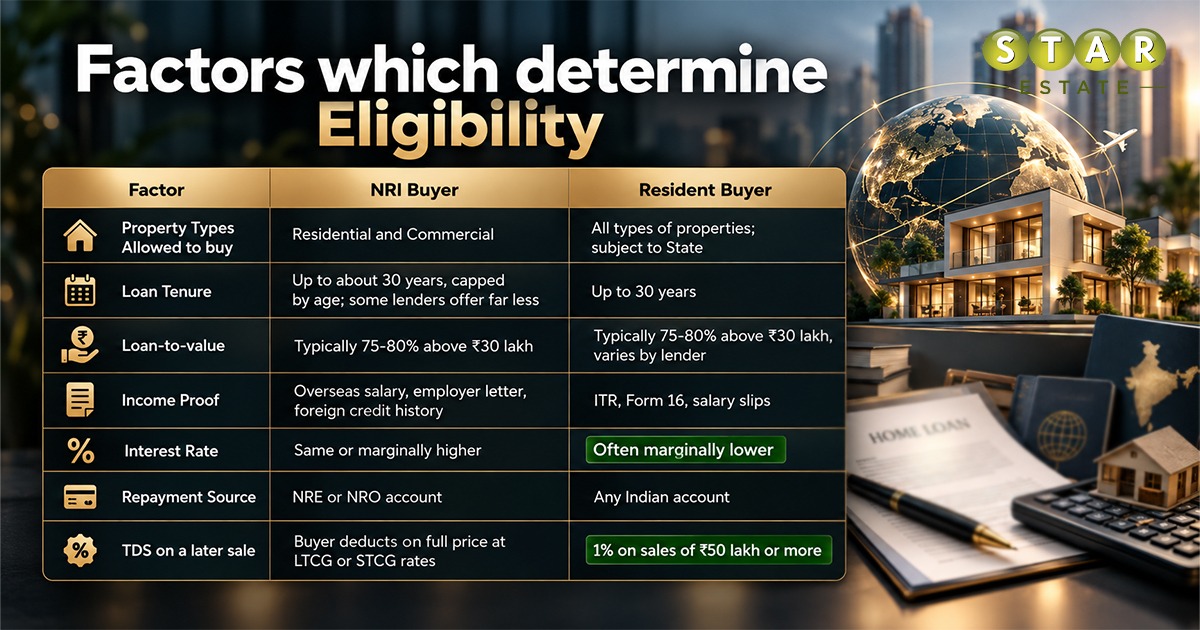
Understand in detail how eligibility plays a significant role in the NRI property purchase process in India and for a regular citizen.
1. What can you buy?
NRI: You can buy homes (flats, villas, houses) and commercial property like shops and offices.
Resident: You can buy almost any type of property, but some states have their own rules (for example, only natives can buy farmland in the State).
2. How long can you take to repay the loan?
NRI: Usually up to 30 years, but the bank also considers your age, since the loan should end before you retire. Some banks offer loans for shorter tenure.
Resident: Up to 30 years.
3. How much will the bank lend?
NRI and Resident: For loans above ₹30 lakh, banks usually lend 75-80% of the property price. You pay the remaining 20-25% yourself as a down payment. The exact figure depends on the bank.
Example: For a ₹1 crore flat, expect a loan of about ₹75-80 lakh and a down payment of ₹20-25 lakh.
4. What documents prove your income?
NRI: Your foreign salary slips or contract, a letter from your employer, and your credit history from the country where you live.
Resident: Your Income Tax Return (ITR), Form 16, and salary slips.
5. Interest rate on the loan
NRI: Same as residents, or slightly higher.
Resident: Often slightly lower.
6. From Which Bank Account Can You Pay EMIs?
NRI: You must pay EMIs from your NRE or NRO account. These are special bank accounts for NRIs, used to hold money earned abroad or in India.
Resident: Any Indian bank account works.
7. Tax is deducted when you sell the property later
NRI: When you sell, the buyer must deduct tax on the entire sale price, not just your profit. The rate depends on whether you held the property for a long or short time. This can block a lot of your money until you claim a refund or file for a lower deduction certificate.
Resident: The buyer deducts only 1% if the sale price is ₹50 lakh or more.
Document Checklist for Resident and NRI buyers in India
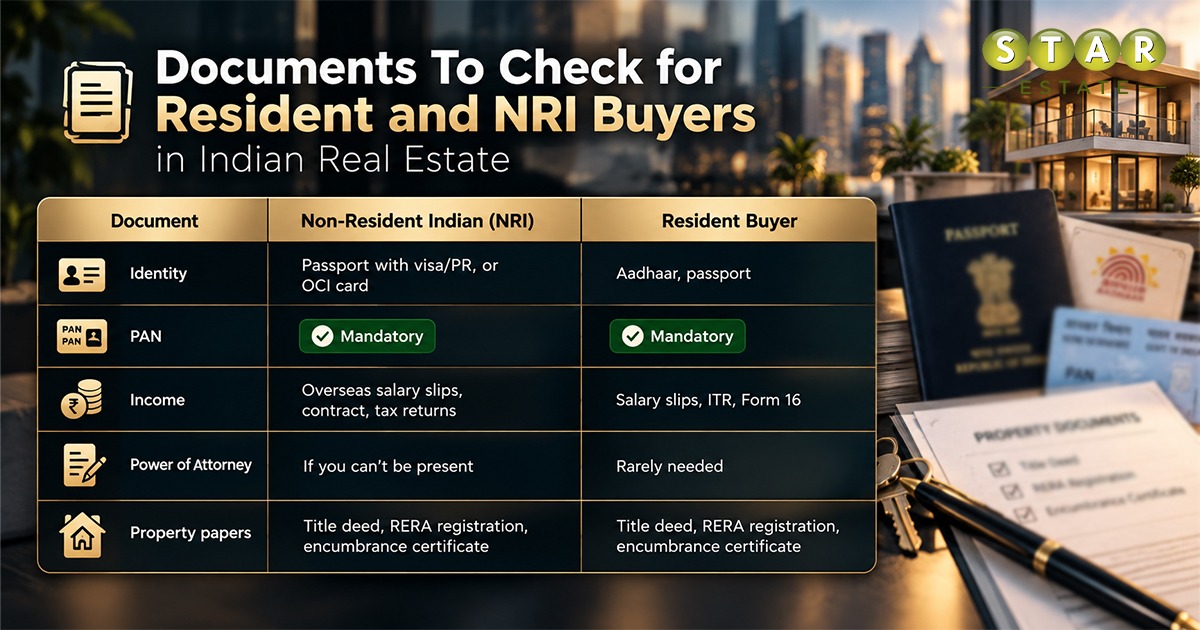
A detailed understanding of the different paperwork for NRI vs. resident buyers in India.
1. Proof of identity: Who are you?
NRI: Your passport along with your visa or PR (permanent residency) card for the country you live in. If you hold an OCI card (Overseas Citizen of India), that works too.
Resident: Your Aadhaar card or passport is enough to prove residency status.
2. PAN card: A must for everyone
NRI and Resident: PAN is mandatory for both. Without it, you can't complete the purchase, take a home loan, or handle the tax side of things. If you don't have one yet, apply early so it doesn't delay your deal.
3. Proof of income: Can you afford the loan?
NRI: Your salary slips from your overseas job, your employment contract, and your tax returns from the country where you work. Banks use these to check your earning capacity.
Resident: Your salary slips, Income Tax Return (ITR), and Form 16 (the tax certificate your employer gives you every year).
4. Power of Attorney (POA): In case you can’t be present to sign purchase/sell documents
NRI: If you can't travel to India for the registration, you can authorise a trusted person (like a family member) to sign on your behalf. This authorisation is called a Power of Attorney. It must be prepared, and signed carefully, so get a lawyer to help.
Resident: Rarely needed, since you can usually be present in person.
5. Property papers: Is the property safe to buy?
· NRI and Resident: The checks are the same for both NRI and resident buyer
· Title deed: Proves the seller is the real owner of the property.
· RERA registration: Shows the project is officially registered with the real estate regulator, which protects you as a buyer.
· Encumbrance certificate: Confirms the property has no pending loans, dues, or legal disputes attached to it.
Parameters on Which India Banks consider an NRI Home Loan Application?
• Job stability, employer profile, and years of overseas experience
• Country of residence and whether it is a lender-approved geography
• Foreign credit history and Indian CIBIL history, if any
• Repayment record through NRE or NRO accounts
• Age at maturity and the property's legal standing
What do banks consider when a resident buyer applies for a home loan?
• CIBIL score and repayment history
• Fixed obligations-to-income ratio
• Employment type: salaried applicants usually face lighter scrutiny than self-employed ones
• ITR consistency and existing loans
• Property valuation and builder credentials
Buying in a booming corridor? Our guide to property investment near airports in India shows where demand is heading.
Conclusion
NRIs and residents can both buy well. The difference is preparation: accounts, documents, loan structure, and tax. Sort those early, and the transaction is smooth from booking to registration.