Yashobhoomi Metro Link: Gurugram Real Estate and Dwarka Expressway Outlook for FY2026-27
What if the ride from Dwarka Expressway to Cyber City, the airport network, and a ₹25,000 crore convention hub ran on a single metro line? That's the idea behind the Yashobhoomi metro proposal, and Gurugram's property market is already buzzing. The proposed corridor would join Yashobhoomi in Dwarka Sector 25 with Rajiv Chowk in Gurugram. It's still at the proposal stage, but the direction is exciting: two real estate markets that grew side by side could finally work as one. For buyers and investors, this is exactly the kind of Gurugram metro story to track early. Here, Star Estate explains what's proposed, what it could do for homebuyers along Dwarka Expressway, how commercial real estate may respond, and how to plan property purchase sensibly in FY2026-27.
AI Powered Summary
Yashobhoomi Metro at a Glance: Why Gurugram Real Estate Is Worth a Watch
A new Gurugram metro link is proposed. The Yashobhoomi metro corridor would connect Yashobhoomi (Dwarka Sector 25) to Rajiv Chowk, Gurugram. It is one of eight routes sent for approval under Delhi Metro's Phase V(B).
Still a proposal. Alignment, stations, and timelines are not final. Any price impact will depend on these details.
Dwarka Expressway stands to gain. Better metro access to the airport, Cyber City, and Yashobhoomi could lift end-user and investor interest. Gains will be strongest near stations.
Commercial real estate may widen its catchment. A larger workforce pool and convention-led footfall could lift hospitality and retail demand. Mixed-use projects look best placed.
Buy with homework, not hype. Check station distance, last-mile access, and RERA status before committing to a property purchase.
What Is the Yashobhoomi Metro and Why Does It Matter?
The Yashobhoomi metro is a proposed Delhi Metro corridor between Yashobhoomi in Dwarka Sector 25 and Rajiv Chowk in Gurugram. If approved, it would link the convention centre, Cyber City, and the airport network, widening workforce catchments and improving access to Dwarka Expressway, which should support residential, commercial, and mixed-use demand.
Where the proposal stands today
According to an RTI reply cited in a PTI report on 18th November, the Yashobhoomi–Rajiv Chowk line is among eight corridors submitted to the government under Phase V (B). The package also aims to connect several dense outer parts of Delhi.
This is still a proposal, and approval, alignment, station sites and timelines are all pending. So plan around the possibility, not a promise.
Which places it could bring closer.
Think of it as joining three things that matter to daily life: a major event and business venue, Gurugram's office belt, and the wider Metro network. Through interchanges, commuters could reach IGI Airport and other commercial centres with fewer changes.
On the Gurugram side, that means easier access to some of the city's best-known business addresses.
Yashobhoomi Metro and Dwarka Expressway Residential Real Estate in FY2026-27
Why the Dwarka Expressway belt is in focus
Dwarka Expressway has become a go-to address for premium and luxury housing over the last few years. It sits close to Dwarka, the airport, and Gurugram's job hubs, so any better public transport only strengthens its case.
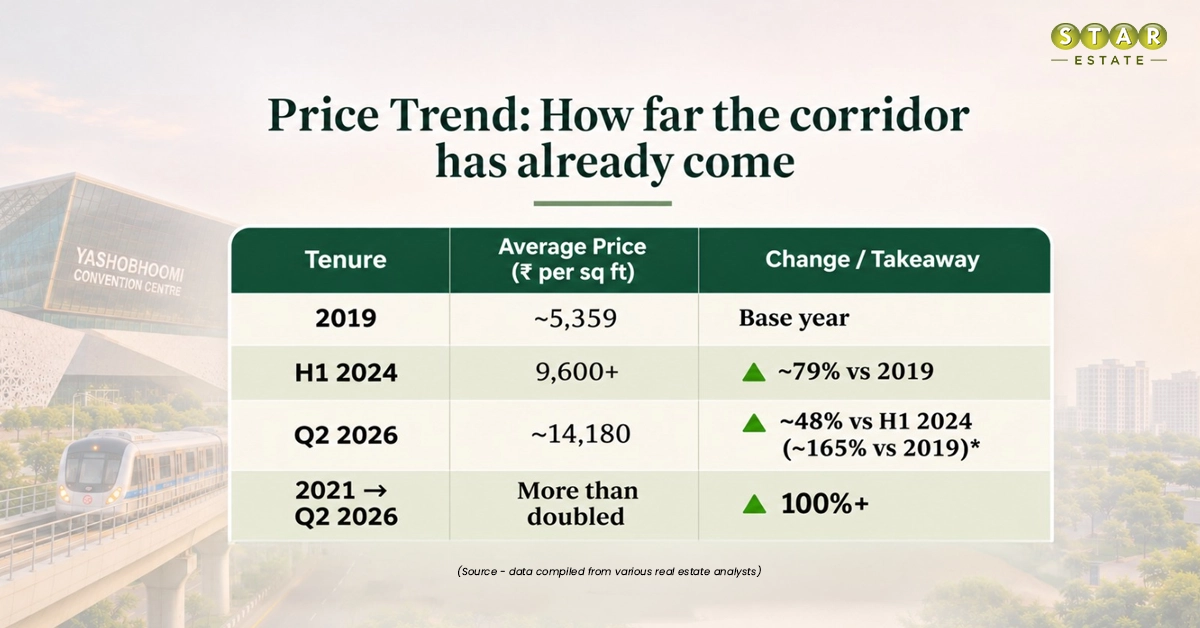
A senior veteran at a leading real estate analyst company says residential demand could firm up in micro-markets around the proposed stations and along the expressway. Prices there have more than doubled since 2021 and were around ₹14,180 per sq ft in Q2 2026.
Here's what the numbers say. Even before the Yashobhoomi metro was proposed, Dwarka Expressway real estate had already moved from roughly ₹5,400 to ₹14,000-plus per sq ft in about seven years. So the metro isn't the start of the story; it's a possible next chapter.
Who benefits most from Yashobhoomi Metro to Gurugram?
Self-use buyers: Easier cross-city commutes and quicker access to workplaces and the airport.
Investors: One more infrastructure-led growth factor, though returns depend on final stations and timelines.
Resale buyers: Well-connected, established societies close to future stations could see stronger interest.
First-time buyers: A wider choice of locations within a sensible commute.
The analyst veteran adds that gains won't be even. Projects with easy station access, ready social infrastructure and good last-mile links should feel the effect sooner, while those farther away may see a smaller response. Established neighbourhoods across Gurugram could benefit from stronger regional connectivity too.
Will the Yashobhoomi Metro Push Gurugram Real Estate Prices Up?
Possibly, but it isn't guaranteed. Metro announcements often lift sentiment first; actual price movement follows approvals, construction progress, and visible stations. Much of today's optimism may already be priced in, so timing and project selection matter.
Before you invest, run through this checklist:
Distance and walking or feeder access to the nearest proposed station.
RERA registration, approvals and the developer's past work record.
Nearby schools, hospitals, retail, and daily-needs infrastructure.
Possession timeline versus the likely metro timeline.
Your budget, home loan eligibility, and EMI comfort, which you can test on Star Estate EMI calculator.
Gurugram Commercial Real Estate in FY2026-27: How the Yashobhoomi Metro Could Impact Businesses
A bigger talent pool for office occupiers
Smoother Gurugram metro connectivity to Dwarka can widen the area from which companies hire. Employees living along Dwarka Expressway would find Cyber City, and Udyog Vihar easier to reach, and Gurugram residents would find Dwarka easier too.
That makes locations around Dwarka and the expressway more viable for mixed-use projects that combine offices, retail, hospitality and homes. You can browse current options on Star Estate's commercial projects page.
Yashobhoomi's own pull on hospitality and retail demand
Yashobhoomi, formerly the India International Convention and Expo Centre, spans 221 acres and has an estimated investment of ₹25,000 crore. Phase one includes two exhibition halls of 32,000 and 28,000 sq m, an 11,000-capacity convention centre and underground parking for over 3,000 cars.
Phase two envisages a multipurpose arena, three more exhibition halls, eight hotels, nine Grade A office buildings, three retail blocks and a serviced apartment facility. Some land parcels are expected to go to private concessionaires, much like the Aerocity model. For hotels, restaurants, and shops nearby, that pipeline points to steady hospitality and retail demand once footfall improves.
What Colliers India says
Arvind Rai, Executive Director, Valuation & Advisory, North at Colliers India, told Hindustan Times that the line could pass through mature business hubs such as Udyog Vihar, Cyber City and IFFCO Chowk. Even so, he expects the real estate impact to cluster around Yashobhoomi and its neighbouring areas.
Rai also noted that progress at the campus has been gradual so far, and that metro access could bring fresh momentum and investor attention. He sees office leasing and investment gaining support, including at a planned 50-acre private mixed-use project nearby with a sports stadium, five-star hotels and an estimated 7–8 lakh sq ft of retail space. Aerocity may benefit indirectly, he added.
Future Outlook: How the Yashobhoomi Metro Could Shape Gurugram Real Estate Beyond FY2026-27
The rest of FY2026-27 will likely be about clarity rather than construction. Watch for these milestones:
Formal approval of the Phase V(B) package, including this corridor.
The final alignment and exact station locations.
Leasing and development progress at Yashobhoomi's second phase.
Private concession parcels being offered for hotels, offices and retail.
If those pieces fall into place, Dwarka Expressway and the Gurugram commercial real estate belt could operate as one connected market. If they slip, the benefit will arrive later and stay more localised. Either way, buyers who choose well-connected, RERA-registered projects are better protected.
Planning to Invest in Gurugram Real Estate? Talk to Star Estate
The Yashobhoomi metro is a promising proposal, not a promise, and the smartest buyers treat it that way. Star Estate helps you shortlist RERA-verified real estate projects, compare micro-markets, and match them to your budget and goals. Explore new launches and residential projects, or read our guide to NRI property investment.
Ready to move? Fill in our enquiry form or call +91 70884 70884 for a free, no-obligation consultation on Gurugram's best-performing projects.