Economic Survey 2026 backs Technology, Small Cities, and Sustainability as epicenter of India’s Growth
 Economic Survey 2026 backs Technology, Small Cities, and Sustainability as epicenter of India’s Growth
Ahead of the Union Budget 2026-27, the economic survey exhibits sturdy economic growth. Indian real estate remains a strong partner in shaping the country’s walk toward becoming the world’s third-largest economic power.
The Economic Survey 2025-26, tabled by Nirmala Sitharaman, Finance Minister, shows seamless and swift disbursal of dream homes across the country.
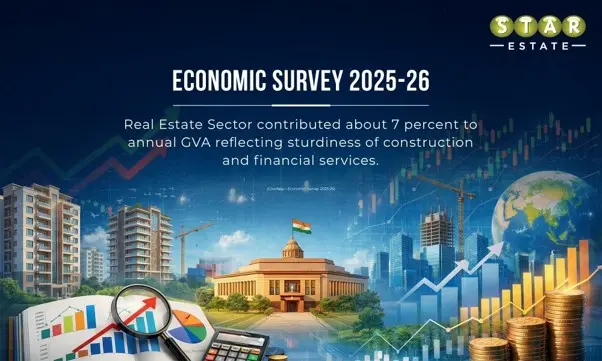
The survey reports, the India’s second largest employer has contributed 7 percent to annual *GVA on average. The value hints at strong fundamentals of the construction and housing sector associated with the growth of construction and monetary services.
(*GVA - Gross Value Added is a parameter to measure contribution of a sector in the economy.)
The reforms, including GST (Goods and Services Tax) and RERA (Real Estate Regulatory Authority), played a significant role in streamlining the Indian real estate sector. Following it is Housing for All, a Government-initiative which led to the realization of a home ownership in the country.
The introduction of these measures has gained a growth momentum for real estate sales post September 2021. Thus, reflecting a strong physical asset creation, regulated by increased household savings.
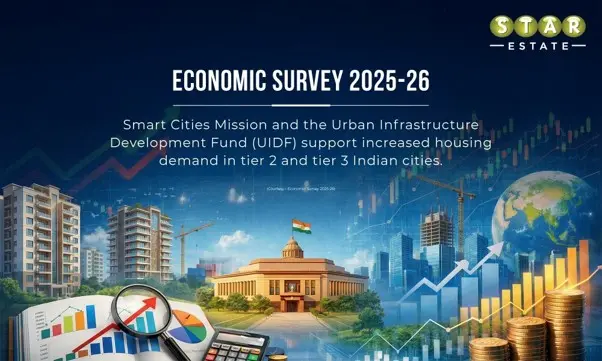
Policy reforms, including the implementation of the Real Estate (Regulation and Development) Act (RERA), GST, and the Housing for All mission, have supported greater formalisation of the sector. Demand-side measures, such as interest subvention under PMAY (Urban), the Affordable Housing Fund, lower interest rates, and streamlined credit processes, have further strengthened access to housing finance. Urban initiatives, such as the Smart Cities Mission and the Urban Infrastructure Development Fund (UIDF), have supported housing demand in Tier 2 and Tier 3 cities,” the Economic Survey said.
Economy Survey 2026 | Housing Loan boost Loan-to-Value Ratio
The survey 2026 further shows, “Backed by these reforms, the sector entered a sustained upcycle from September 2021, post-COVID, as reflected in improved sales, driven by higher household savings channelled towards physical assets. The momentum has continued in recent quarters, supported by favourable affordability conditions and easing inflation.”
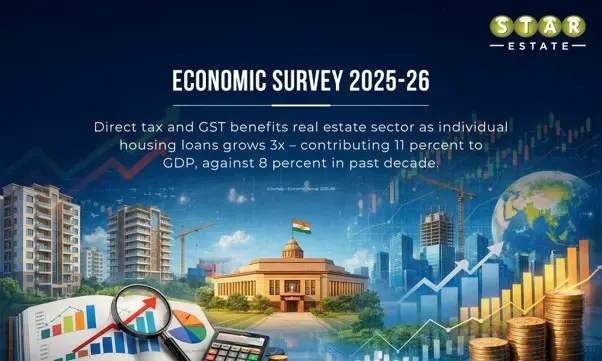
In comparison to FY 2022- FY 2024, real estate sales in the residential segment have increased massively. Housing finance gained overwhelming momentum, with three fold increase in outstanding individual housing loans. It rose from Rs. 10 lakh crore in March 2015 to Rs. 37 lakh crore in March 2025.
Also, the home loan rose from 8 percent to over 11 percent of GDP. Thus, resonating a strong real estate growth in the country.
As a reflection of the ended fiscal and a roadmap to the upcoming fiscal year, the economic survey hints at integrated development. FM Nirmala Sitharaman shed light on the cohesive development of the Indian real estate sector. Furthermore, the survey focuses on the overall development of small cities in the streamlined usage of technology with respect to sustainability.
In the present scenario, focus needs to be on systematic performance against autonomous projects. The economic survey 2026 talks about collective development based on housing, mobility, sanitation, climate change, and finance. It will lead to the development of qualitative accommodations, making cities' future and environment resilient.
The survey states that the futuristic urban nation must stand on the foundation of “our cities economically, dynamic, socially inclusive, environmentally sustainable, and institutionally capable.”
Economic Survey 2026 |India roots for Housing for All with strong Civic Infrastructure
Under the Smart Cities Mission (SCM), smaller cities have significantly developed as maximum planned projects achieve robust facilities. From smart roads, cycle tracks, and advanced water and sewage networks. Approximately 90 percent of projects are complete with an estimated investment of Rs. 1.64 lakh crore. These consist of over 8,000 projects in smaller cities in the country. The figure accounts updated on May 9, 2025.
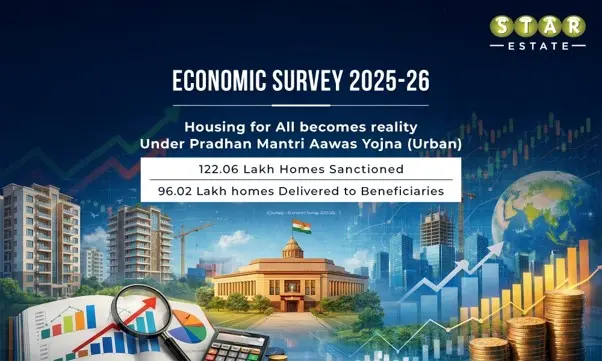
Also, “The Government has undertaken multiple interventions to support affordable housing in urban areas. These include direct tax and GST benefits, inclusion in priority sector lending, which enables higher loan-to-value ratios and therefore smaller down payments, and provision of infrastructure status, amongst others. Under the two phases of the Pradhan Mantri Awas Yojana – Urban (PMAY -U), a total of 1.22.06 lakh houses have been sanctioned, of which 96.02 lakh have been completed and delivered to the beneficiaries across the country as on 24.11.2025,” the Economic Survey 2026 said.
Economic Survey 2026| Roadmap to Thoughtful Housing
Nirmala Sitharaman, Finance Minister, while applauding top Indian developers for introducing spacious layouts at affordable prices, also exhibited concern. The investment in large plots on the city outskirts renders affordable homes; however, the lack of infrastructural amenities raises doubt about purchasing potential.
Thus, the Economic Survey 2026 focuses on integrated development, which includes connectivity, healthcare, lifestyle, and employment avenues. The raising of such development will ease apprehensions amongst homebuyers and will also open doors to streamlined income for investors. These are essential measures to look forward to as Indian real estate gears up to become a $1 trillion sector by 2030. Therefore, focusing on futuristic development will be a significant factor in the country’s economic growth.