Agreement to Sell vs Sale Deed: The Complete Legal Guide for Property Buyers in India (2026)
Is an Agreement to Sell and a Sale Deed the same thing? No — however, homebuyers confuse them for synonyms of each other. Unfortunately, it is the costliest mistake when buying a flat in India. These documents involve the same buyer and seller, but are two steps in the process of homebuying in 2026. This guide breaks down their definition and legal course to check before signing either one.
An Agreement to Sell is a contract that records the buyer's and seller's intent to transfer a property in the future. It doesn't, by itself, transfer ownership. A Sale Deed, by contrast, is the final, registered legal document under the Registration Act, 1908, that immediately transfers ownership from the seller to the buyer. Every property purchase in India moves through both steps in sequence. It's only once the Sale Deed is registered that you become the legal owner.
The checklist around these two documents shift slightly depending on whether you're a first-time buyer, a resale buyer, an investor, or purchasing a ready-to-move-in home. This guide walks through each scenario.
What is an Agreement to Sell?
An Agreement to Sell is a legal contract that outlines the terms of a property transaction that will be completed in the future. Signing it shows mutual intent from the buyer and seller to continue with the deal on the drafted terms and conditions. However, it is only the first formal step toward property registration in India. Interestingly, it typically includes a refund clause to protect homebuyers from property defects caused by negligence on the Seller’s part.
Things at a Glance – Inclusion in Agreement to Sell
Whether drafted for an under-construction or ready-to-move-in purchase, a properly worded Agreement to Sell should cover the following:

Together, these inclusions give the buyer written proof of what was promised. The price, the timeline, and the Seller’s declarations; so there is a clear record to fall back on if a dispute arises before the Sale Deed is signed. For a fuller checklist of what to verify at every stage of the purchase, see Star Estate’s homebuyer’s guide.
What Is a Sale Deed?
A Sale Deed is the legal document that actually completes a property transaction. The registered and signed Sale Deed passes the ownership from the seller to the buyer with immediate effect.
It is the secondary step in the home-buying process in India, drafted after both parties have already agreed to the terms in the Agreement to Sell.
Under the Registration Act, 1908, a Sale Deed registered at the Sub-Registrar's office is considered official. In effect, the Sale Deed covers all points listed and agreed upon in the Agreement to Sell.
Agreement to Sell vs Sale Deed: Key Differences at a Glance
The table below summarises the legal distinctions every buyer should know before signing either document.
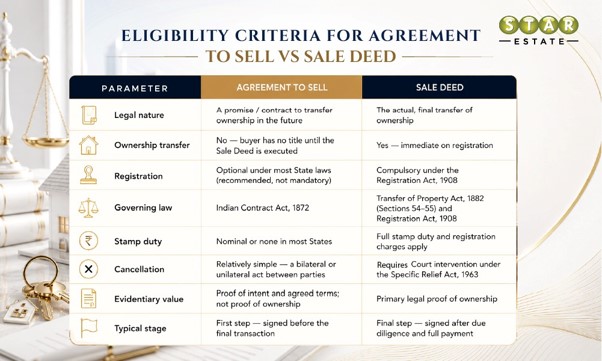
In short, the Agreement to Sell only sets out intent and terms. The Sale Deed is the document that legally transfers the property into your name. Until the Sale Deed is registered, you are not the recognised owner, no matter how detailed or binding the Agreement to Sell may be.
A first-time homebuyer should confirm that the Agreement to Sell actually grants clear ownership rights and should physically inspect common areas for any pre-existing damage.
A resale buyer faces different risks, such as unpaid utility bills or a pending home loan still attached to the property. It can safeguard themselves by requesting an Encumbrance Certificate that proves the property is free of any legal or financial liabilities.
A property investor should thoroughly review the terms mentioned in the Agreement to Sell and make sure the agreement itself gets properly registered to hold legal weight.
Lastly, an end-user purchasing a home to live in should keep a close watch on the timeliness of possession and registration. Any delay here can create complications with loan repayment down the line. This checklist essentially acts as a safety net, helping each type of buyer avoid common pitfalls specific to their situation.
Things Homebuyers in India Must Check Before Signing the Agreement of Sell
The Agreement of Sell is the first legal document in the Indian home-buying process. The buyer and Seller details and the exact timeline for property title transfer must be clearly stated. Beyond these basics, these five checks tell how much the buyer is legally protected:
Payment Schedule — Defines how loan disbursement is structured based on the chosen payment plan. For under-construction properties, this often takes the form of a construction-linked payment plan tied to project milestones. Use Star Estate's EMI calculator to plan disbursements against your loan tenure.
Penalty Clause — If possession is delayed, including the buyer's rights to a refund or cancellation. This is one of the most important protections in the entire document.
Encumbrance Certificate — It confirms the property carries no pending monetary or legal claims. Always check that this is attached to the Agreement of Sell, not promised for later.
Property Details and Map — Verifies the actual layout matches what's being sold, preventing disputes over boundaries or built-up area later.
Title and Ownership Mentions — Confirms that the buyer and seller named in the document match official records.
Things Homebuyers in India Must Check Before Signing Sale Deed
The Sale Deed is the official, registered confirmation of the Agreement to Sell — and the document that actually transfers ownership. Before signing, verify:
Names and Title Transfer Details — Every party named must match prior ownership records exactly.
Saleable Value — Since a property purchase is a major financial commitment, confirm the declared saleable value of the immovable asset matches what you agreed to pay.
Transfer of Common Amenities and Rights — A key difference between an Agreement to Sell and a Sale Deed is that only the Sale Deed transfers common amenities. Along with all existing rights, interests, and claims tied to the property, to the new buyer.
Compensation Clause — Protects homebuyers from financial loss caused by the Seller's negligence, such as an undisclosed property defect.
Title Chain — Trace the ownership history as far back as possible to confirm the current Seller has the legal right to sell. A clean title chain protects buyers against future claims from anyone alleging prior ownership.
Ways to Avoid Legal Complications When Buying a Flat in India – Things to Know about Agreement to Sell vs Sale Deed
With distinguished property purchase intent, understand the operational roles of an Agreement to Sell vs. a Sale Deed. It is a safety net in the home-buying process in India; skipping it can make buyers open to legal vulnerabilities.
Types of Homebuyers and Checklist for Property Buying in India in 2026

As the table shows, the checks that matter most shift depending on who you are: first-time buyers should focus on ownership clarity, resale buyers on outstanding dues, investors on registering the Agreement to Sell itself, and end-users on timely possession. The points below expand on each of these buyer profiles.
First-time buyers often mistake an Agreement to Sell as absolute ownership. However, it is an interim step towards ownership with a promise of property title transfer in the future. Interestingly, the Sale Deed does exactly the opposite, but only when it is registered. The registration of the Sale Deed under the Registration Act, 1908, entitles them to property title and ownership.
Resale buyers need to be more cautious, as the Seller might have some unpaid monetary liabilities. Therefore, ask for documentation on no outstanding bills, zero mortgage or loan liability to ensure you are not carrying the financial burden along with the keys to the property.
Property Investors preferring to purchase under-construction property have an Agreement to Sell for consideration. It lists the present property value and terms and conditions related to the purchase. It is the only document they can count on. Under Section 13 of the RERA Act, registration of the Agreement to Sell is mandatory. Also, the developer cannot ask for more than 10% of the property value as token money before registering and signing the same. NRI investors can find purchase-specific guidance at Star Estate's NRI Corner.
End-Users in India must consider the time frame for possession and registration in the Agreement to Sell. It is one of the important things to consider, as it directly affects the immediate transfer of property.
Ways to cancel a property deal in India - Know Agreement to Sell vs Sale Deed Differences
A real estate transaction is a big deal, and sometimes, things don’t go as planned. Therefore, as an informed buyer, you must know how to cancel a property purchase deal in India.
Agreement to Sell is simple to cancel, as it is not a registered document. It can be terminated if any of the parties, the buyer or the Seller, disagrees with the terms and conditions.
Sale Deed cancellation is a legal process that might take a few years to reach closure. Firstly, there should be serious concerns, such as fraud or unclear details, to raise a cancellation request.
Legal Checks about Cancelling the Agreement of Sell vs Sale Deed in India
Agreement to Sell, a non-registered document, will not comply with Sections 54 and 55 of the Property Transfer Act, 1882. The Act laid out terms and conditions for the legal sale of the property.
Sale Deed is registered under the Registration Act, 1908. The cancellation of the same mandates consent from the parties (buyer and Seller) along with a Court notice. The Court can make the Sale Deed stand cancelled based on the provisions of the Specific Relief Act, 1963.
The Bottom Line
The unclear real estate definitions can lead buyers into legal trouble and massive financial loss. To curtail the risk of getting duped for time, money, and ownership rights, it is ideal to get an Agreement to Sell drafted initially.