Documents Required to Buy Property in India: The Complete 2026 Checklist
Is property ownership the next thing on your wish list? However, the thought of signing up for the wrong deal is making you sceptical about how to navigate the paperwork? Well, nothing can go wrong for informed buyers, as due diligence restricts fraudulent intentions. So, instead of going by homebuying tips from well-wishers, know the essential documents to check before buying property in India in 2026.
A Master Document Checklist for Buyers in India in 2026
The stakes are high when it comes to buying a property in India, as it involves a large financial commitment. Once the property is registered in your name, you are liable for unpaid dues. To experience a peaceful life after ownership, know the actual paperwork.
Property Documents Required to Buy Property in India in 2026
Sale Deed — It is the legally registered document that immediately transfers property title from the seller to the buyer. The document is registered at the sub-registrar's office, and without it, the ownership claim remains null and void.
Mother Deed — The document traces back to the original owners, followed by the chain of owners up to the current owner and the seller. It confirms a smooth or broken chain of sale/purchase for the asset. Thus, clearing buyers’ doubts about property title. Therefore, ask the seller for the mother deed when buying a property in India in 2026. It is important to check, particularly in the case of resale properties. For a deeper walkthrough of these two documents, see Star Estate's guide on how to check for a clear property title in India.
Mutation/Land Records — Known as Khata in Bengaluru, Patta in Tamil Nadu, or the 7/12 extract in Maharashtra. It updates the local municipal or revenue department to list the owner's name and what the property tax bill will be based on.
Power of Attorney (PoA) — It is necessary if the seller is an NRI or has a representative to complete the sale process. Here, ask the seller for the original PoA and do not sign a photocopy of it to complete the property purchase process.
Building Layout — An important document to check when buying property in India. Ask the seller to share the sanctioned plan approved by the local development authority. It confirms the sanctioned structure layout by the respective authority.
Zoning Approval — A property is classified as residential or commercial use. Therefore, check for zoning approval to know which category the property you are buying in 2026 falls. Because once bought, there isn’t a chance of revoking the classification.
Buyer’s Takeaway – Don’t ignore missed property-related documents, as even a single missing paper trail can cost you a heavy penalty as an owner. Therefore, ask the seller to share all documents before signing the deal.
Construction-Related Documents to Check before When Buying a Property in India in 2026
The past decade has been transformative for real estate in India. Therefore, here is the list of documents required to check before buying a property in 2026. Their unavailability is a serious concern for buyers, as it reflects a careless approach on the developer's or seller’s end.
Commencement Certificate (CC) — With this, the municipal authority permits construction commencement. Any project without this certificate is illegal, thus leading to legal implications.
Completion Certificate — The Municipal authority releases the certificate once the construction is complete according to the sanctioned plan. List this as important amongst the documents required to buy a property in India. It denies allegations of unlawful construction.
Occupancy Certificate (OC) — It’s a go-ahead sign from the municipal authority and is released after confirming the building is fit for people to live in.
Letter of Possession — The developer releases this document to the buyers to inform the date of possession. It is important to consider this in the list of documents required to buy property in India, as it dates property age.
Buyer’s Takeaway – The availability of these documents holds significance for loan applicants. Banks prefer to sanction home loans for properties attached with these documents. However, the absence of an OC can derail your loan application. Therefore, consider this paperwork important for buying an immovable asset in 2026 in India.
Clearance Documents required to check before buying a Property in India in 2026
The next thing is to verify documents for buying a property in India, including clearance from authorities, including RERA and local body, and the Ministry. A skip to check the same can lead to major legal hassles for you, the new owner.
RERA Registration Details — The RERA Act, 2016 requires every developer and agent to register themselves with the State RERA body. Also, every project occupying more than 500 sqm and more than 8 apartments must be registered under RERA. Visit the State RERA portal to check these details, as it is the way to verify a genuine sale offer in 2026. Star Estate's reality check before buying a property breaks down exactly what a fraud-free, RERA-compliant deal should look like.
NOCs from Civic Authority, Environment Ministry, and Fire Department— Check for no-objection certificates for the project from the civic, environmental, and fire departments. These NOCs are important for safety scrutiny. Therefore, mark them as important among the documents required to check before buying property in India in 2026.
Property Purchase documents checklist in India
A clear property title means zero financial liability. As a buyer in 2026, you must know what is included in financial due diligence. Also, these are the important documents for buying property in India, as pending bills will fall upon you for clearance since you will be the new owner after purchase.
The stamp duty and registration charges also factor into your final outlay. Check Star Estate's state-wise stamp duty and registration charges guide before you prepare a budget for the purchase.
Property Tax Receipts — Ask the seller for the latest paid receipts to confirm there are no outstanding bills attached to the property.
Utility Bills — Check for electricity bills, water supply charges, and (where applicable) the IGL piped-gas bill, all cleared up to date.
Home Loan NOC — In case the seller has financed the property, check for a no-dues certificate from the respective bank to confirm there isn’t any loan pending against the property. Also, check for original property title papers are with the seller. These are some important documents you require to check when buying property in India in 2026.
No Dues Certificate from Society — It is an essential document to check for the resale of a residential property in a gated society. Ask the seller for a no-dues certificate from the society to avoid the possibility of paying pending dues after the transfer of title.
Property Title Transfer Documents Required to Buy Property in 2026
If you are buying an under-construction property in India, then make sure you check for the documents listed below.
Sale Agreement — It sets out the terms and conditions for the sale of the unit, including the price, payment schedule, and possession date. It is the primary document followed by the sale deed, which legally registers the transfer of property title. For the exact legal distinction between the two, read Star Estate's Agreement to Sell vs Sale Deed guide.
Allotment Letter — Issued by the builder, it confirms the unit allotted to you, followed by the terms and conditions.
Builder-Buyer Agreement — It is a legal document that covers construction timelines, specifications, penalty clauses for delay, and your rights as a buyer under RERA.
Documents NRI Buyers Must Verify Before Buying a Property in India
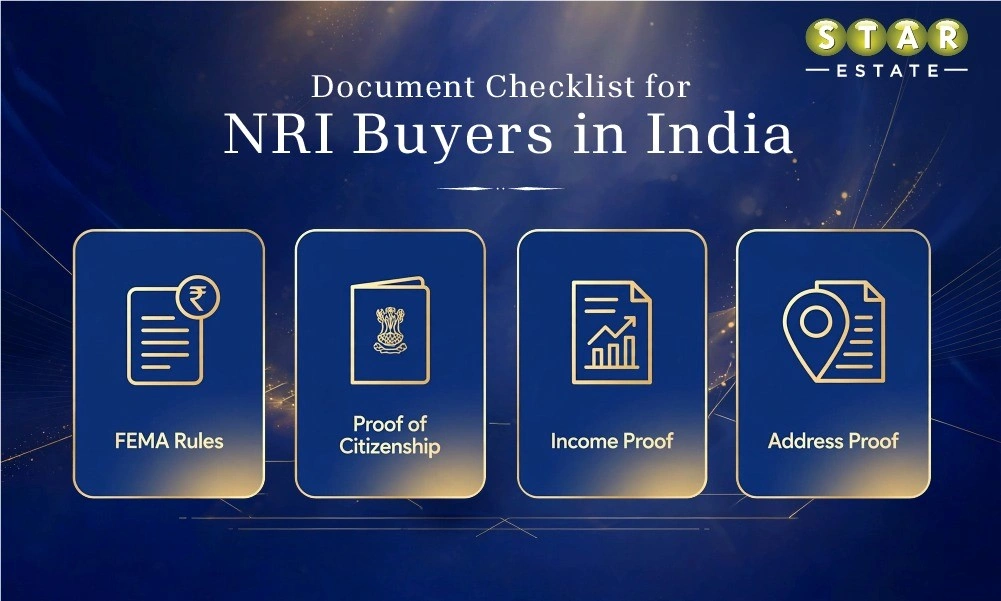
If you are a non-resident Indian planning to buy a property in India, then here are the important documents to check. NRIs and OCI cardholders can buy residential and commercial property in India. However, they are required to follow FEMA guidelines to complete a legal property purchase in India in 2026.
Payment Trail — Every payment made by an NRI to buy a property in India must be channelled through proper banking channels. It can be via an NRE, NRO, or FCNR account. No real estate transaction can be carried out via cash, foreign currency, or traveller's cheques, as strictly prohibited under FEMA rules.
PoA for remote transactions — A registered Power of Attorney will work if you can't be present for registration in person.
PAN card and OCI/passport copies — Compulsory for property registration and home loan application.
Repatriation paperwork — Form 15CA/15CB and related tax clearances are needed later if you plan to send sale proceeds abroad.
NRIs can’t buy agricultural land, farmhouses, and plantation property in India. Therefore, the property type is an important thing to check for buyers in 2026.
The Bottom Line
Verify property-related documents to protect yourself from any legal trouble after acquiring possession. It also helps you score high on the home loan sanction possibility. Also, different property types and construction status yield different returns. Therefore, at Star Estate, every listing is RERA-verified so you can experience a seamless property purchase, instead of doing the guesswork. Browse Star Estate's home buyer's guide for more on choosing between ready, under-construction, and resale properties before you sign.