Buying a Home in India - Know if Smart Home Features Worth spending in 2026?
Remember waking up to an alarm clock? Today your phone buzzes with the weather, a doorbell camera tells you the courier has arrived, and the geyser is already warm. So, the question for homebuyers in India is: are smart home features worth it, or just fancy home features? Yes, smart home features are worth it when they solve a real problem. Like security. Instead of a padlock and a watchman’s word, you now get live camera feeds, door-lock logs, and instant alerts, even when you’re sitting in Delhi, Dubai, or Toronto. That’s why home automation is worth it for homebuyers and investors alike. This Star Estate smart home buying guide covers what a smart home is, the best smart home devices for your home, the smart home cost-benefit, how demand is shaping up across India, and where to find smart homes for sale in India. Irrespective of first-time buyer or an investor, start with the essentials and keep the rest upgradable.
AI Powered Summary
Reasons Why Smart Homes Are Worth Buying in India
Stronger security: Smart locks, video doorbells, and cameras give you entry logs and live alerts, even when you’re abroad.
Lower energy bills: Wi-Fi-enabled ACs, smart plugs, and lighting timers stop you from cooling or lighting premises when you are home away.
Remote control: You can manage lights, locks, and appliances from your phone.
Growing demand: India’s home automation market is growing about 15.5% a year, so buyers increasingly expect smart features.
Better resale and rent appeal: Smart-ready homes with proven essentials are easier to live in, rent, and resell.
What Is a Smart Home?
A smart home links your everyday devices through wifi or a central hub, letting you manage lights, locks, and appliances with a tap on your phone, a voice command, or a set schedule. Your home responds to you, so comfort and security are always within easy reach.
Best Smart Home Devices for Your Home in 2026
Security and access
This is where the money works hardest. A smart lock removes the lost-key problem, and a video doorbell lets you screen visitors from anywhere. For NRIs, a camera and door log on your phone is the next best thing to being home. A smart home must include -
Keyless door entry: opens with a fingerprint, PIN, or phone, and logs who came in
Wi-Fi-enabled air conditioner: cools the room before you reach home
Remote-controlled drapes: open at sunrise or close at sunset
Video doorbell: shows your visitor on your phone, wherever you are
Voice assistants: Alexa or Google Home to operate lights, fans, and music
Comfort and energy savings
Indian summers are challenging as they drive up utility bills. Like a wifi-enabled AC or smart plug lets you schedule it, switch it off remotely, and avoid extra cooling if you forget to pull the plug. Smart lighting adds the same control for far less money.
Wi-Fi-enabled air conditioners with scheduling
Smart lights and switches on timers and sensors
Smart meters that show where your units are going
Luxury Upgrades Worth Considering Later
Remote-controlled drapes feel wonderful, but they cost more and rarely attract end-users. Treat them as a lifestyle upgrade: spend on safety and energy savings first, then add these luxuries once the basics work well.
Is Home Automation Worth It? Smart Home Cost Benefit for Indian Homes?
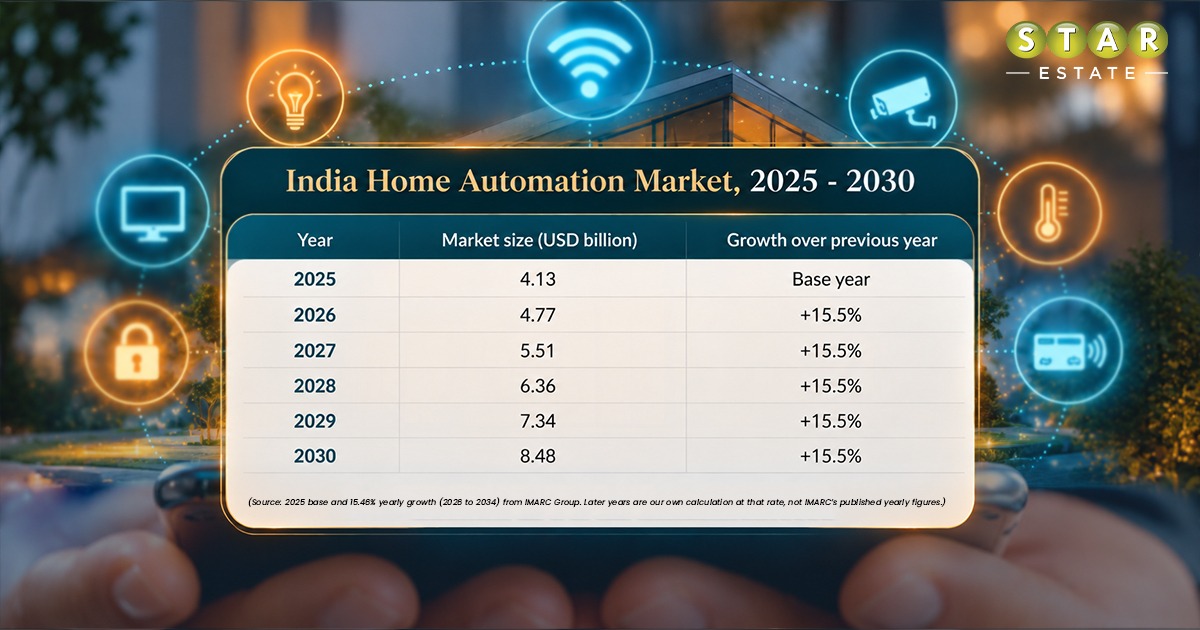
India’s home automation market was worth USD 4.13 billion in 2025, according to IMARC Group. That’s roughly 15.5% growth per year. Security and safety is the biggest slice at 42%, and wireless systems hold 67%, which suits flats that can’t be rewired.
The table shows it growing at about 15.5% a year, to USD 4.77 billion in 2026 and USD 5.51 billion in 2027. It then reaches USD 6.36 billion in 2028, USD 7.34 billion in 2029 and USD 8.48 billion in 2030, roughly doubling in five years. IMARC’s own forecast runs to USD 15.07 billion by 2034.
For buyers and investors, this means smart features are becoming an expected part of a home. Security and safety is the largest segment at 42%, and wireless systems hold 67% of the market, which suits flats that can’t be rewired.
So are smart home features worth it for an investor? The numbers say the category is growing fast, and buyers now expect it. The demand is for features that work reliably, not gadget count. Pick proven essentials, and your home stays easy to live in, rent, and resell.
Smart Home Buying Guide: 7 Features Worth Paying For First in 2026
Short on time or budget? Here are the seven best smart home devices and features worth paying for first, in rough order of value.
Smart door lock: No lost keys, entry logs, and remote access for a maid, tenant, or relative
Video doorbell and cameras: Live view and alerts, essential if you’re an NRI
Wi-Fi-enabled AC or smart plug: Schedule cooling and cut on energy wastage at home
Smart lighting: Timers, dimming and motion sensors at a modest cost
Leak, smoke and gas sensors: Cheap, and they stop small faults becoming big repairs.
Smart meter or energy monitor: Shows which appliance is eating your units
Voice assistant hub: One place to control everything, ideally one that supports the Matter standard.
For a 2 or 3 BHK apartment in Noida, Greater Noida or Gurugram, a starter setup (smart plugs, a video doorbell, a smart lock and a few smart lights) typically costs about ₹30,000 to ₹70,000. A mid-range wireless setup with lighting, AC control, and sensors runs about ₹1.5 lakh to ₹4 lakh. A fully wired premium system starts from ₹5 lakh. These are indicative market ranges, not quotes, so ask your developer what is already included before buying separately.
What Is the Future of Smart Home Automation in India?
Simpler, more compatible devices
The biggest shift is compatibility. Matter, a shared standard, aims to let devices from different brands work together, so you’re not locked into one app. That matters if you plan to add features over time.
Wireless, AI, and Security first
Wireless systems already lead the market, and security is the top use. Expect more AI-driven automation, such as lights and cooling that learn your routine. For investors, smart-ready wiring and robust broadband in a building will count for more each year.
The smart choice isn’t the home with the most gadgets. It’s the one built so you can add them later.
Best Smart Home Projects for Sale in India in 2026
These are live listings on starestate.com, from the cities where our buyers ask the most. Connect with our advisors to confirm which smart features come as standard before you decide. Prices shown are indicative figures and are subject to change.
Emaar DigiHomes, Sector 62, Gurugram
Emaar DigiHomes in Sector 62, Gurugram offers RERA-approved 2 and 3 BHK apartments by Emaar India, with indicative prices of more than Rs. 1 Crore. The project promises “technology-enabled living.
Smart World One DXP, Sector 113, Gurugram
Smart World One DXP in Sector 113, Gurugram is a 16-acre gated community by Smartworld with 2 and 3 BHK homes. The prices here start from about ₹2.55 crore and go up to ₹3.79 crore for a 3 BHK. This is believed to be one of the best under-construction smart home projects for sale in Gurugram. The possession expected between December 2026 and 2027.
Kolte Patil Life Republic Atmos, Hinjewadi, Pune
Kolte Patil Life Republic Atmos in Hinjewadi, Pune, sits within a 400-acre integrated township and offers 1 to 4 BHK homes. About 70% of the township is green, with a 3.5-acre urban park and EV charging at parking spaces.
Conclusion
So, is home automation worth it? Yes, when you start with the essentials and buy in a project built to add more later. Browse more residential projects or new launches. If you are planning a budget, try our EMI calculator. Buying from abroad? Read our NRI investment guide. Ready to find a smart home that actually pays off? Fill in the enquiry form on starestate.com, and a Star Estate advisor will call you for a a free consultation.