Data over Opinions: Why Property Price Trends in India Matter before You Buy
Table of Contents
3. Top Cities to Invest in Based on Property Price Trends in India
3.1. Bengaluru – Strong Employment Growth and Long-Term Appreciation
3.2. Delhi-NCR – Infrastructure-Led Growth across Emerging Corridors
3.3. Mumbai Metropolitan Region – Premium Value and Strong Rental Demand
3.4. Noida – Planned Development and Emerging Premium Housing
3.5. Gurugram – Corporate Employment and Premium Residential Demand
3.6. Hyderabad – Affordable Entry and Stable Residential Growth
3.9. Ahmedabad – Lower Entry Prices and Expanding Economic Activity
3.10. Kolkata – Affordable Housing and Established Urban Infrastructure
Introduction
From slow growth in 2021 to stalled progress during the pandemic, then a sharp price rise post-pandemic. The top Indian cities have absorbed many changes in the last five years.
A Five Year Property Price Trend in India: 2021 – 2026
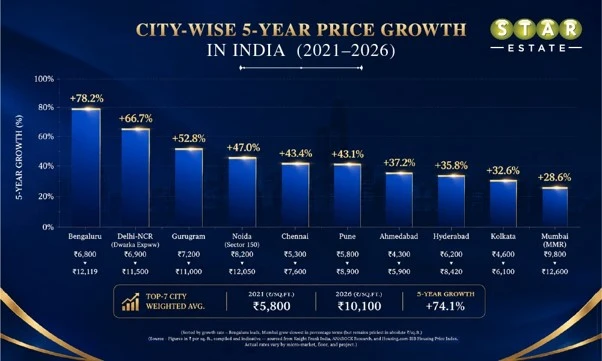
The year 2021 was slow as the pandemic was gradually expanding, keeping buyers away from Indian real estate. Investors' wait-and-watch approach before making a move made builders hesitant to increase property rates in top Indian cities.
As the pandemic neared its peak and work-from-home became a way of life, spacious homes turned from a choice to a necessity for families. That shift, paired with home loan rates at some of their lowest levels in decades, gave homebuying sentiment across India a real lift.
By 2022, work-from-home had settled in as the norm even as offices partially reopened. It pushed up demand for homes with a dedicated workspace, and apartments with an extra room emerged as the most popular choice among homebuyers in India that year.
According to the Anarock report, the year recorded a 5 percent annual price rise in the last four years. It is 2x more than in comparison to the each of the past years.
In 2023, the Reserve Bank of India (RBI) hiked the repo rate from 4.40% to 6.50%, a 2.5% increase. The decision was taken to combat soaring inflation and was gradually reversed by maintaining the same in 2024 and a few basic point cuts since 2025 till August 2026.
The property price trend in India during 2023 showed home prices moving up by 4.3 percent. The Anarock report shows that average residential property prices in the top cities in India increased from approximately Rs. 7,080 per sq ft in 2023 to Rs. 8,590 per sq ft in 2024.
A massive 21% jump in the real estate market in India was witnessed in the last decade.
In 2024, strong purchasing power and reputed builders' presence bridged the gap between demand and supply in Indian real estate. The premium homes at sought-after locations worked in favour of homebuyers and builders.
The year 2025 witnessed a turnaround with a moderate 8 percent rise in property prices. This growth was supported by real-time demand for housing.
Firstly, a simple base effect. After two years of sharp growth, affordability had genuinely stretched in the lower and mid segments, and thus attracting buyers.
Secondly, sales volume actually dipped by 14 percent in the top seven cities, to roughly 395,625 units from 459,645 units in 2024 because it was specifically the sub-₹50-lakh and ₹50-lakh–1-crore segments that softened, not the market overall.
Thirdly, total sales value still rose because buyers who remained active shifted decisively toward bigger-ticket homes, and the ₹1-crore-plus bracket absorbed demand fast enough to lift the rupee value of the market even as the unit count fell.
The year witnessed filter buyers in the market with a strong home-buying sentiment to meet modern-day lifestyles.
Key Factors Driving Property Trends in India — Their Impact on Housing Prices in Top Cities in 2026
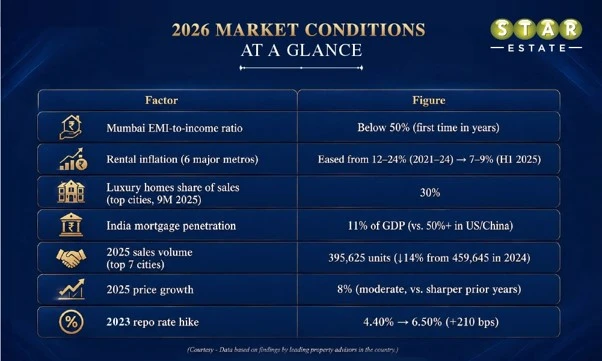
Some of the major factors contributing to the changing price rise in Indian cities in 2026.
Mature social infrastructure – The robust healthcare, qualitative academic establishments, and secure neighbourhoods continue to witness high demand across cities. Simultaneously, newer corridors are being boosted by metro lines, expressways, and airport-linked development. These factors determine the rise in real estate prices in India in 2026.
Rental demand – Housing demand near business districts yields attractively for investors. Top metro cities with a strong base of IT, corporate, and industrial employment witness a stable and upward trajectory in price rates against markets driven mainly by speculation.
Affordability Matters - Cities with a comparatively low entry price encourage first-time buyers and NRIs to explore diversified portfolios in Indian real estate.
Stable EMI Value – Successive repo rate cuts by the Reserve Bank of India have brought EMIs down to a far more comfortable level. Lower home loan rates over the past year and a half have fed directly into demand – and into property price trends in India more broadly. In Mumbai, the EMI-to-income ratio has dropped below 50 percent for the first time in years, a meaningful shift in affordability.
Constant Rental Yield – Rental growth has settled into a steadier pattern that works for landlords and tenants alike. Annual rental inflation across major metro cities, which ran at an aggressive 12–24 percent between 2021 and 2024, has eased to a more sustainable 7–9 percent through the first half of 2025.
Infrastructure Development – Expressway and metro expansion – the Dwarka and Yamuna Expressways in NCR, and the Bengaluru–Mysore corridor in the south – is pushing double-digit growth in the micro-markets they touch, well ahead of city-wide averages.
RERA Verification – RERA has meaningfully cut down the risk of fraudulent transactions. A RERA-registered project today comes with legal protections that simply didn’t exist a decade ago – something that matters as much as price when deciding where to invest.
The structural demand in luxury homes remained resilient, with approximately 30 percent of all homes sold across India’s top cities in the first nine months of 2025 falling in the luxury bracket. Interestingly, India’s mortgage penetration still sits at roughly 11 percent of GDP against over 50 percent in the US and China. It is a gap that points to a long runway of credit-led housing demand still ahead. Taken together, these are the factors really driving housing prices in India in 2026.
Top Cities to Invest in Based on Property Price Trends in India
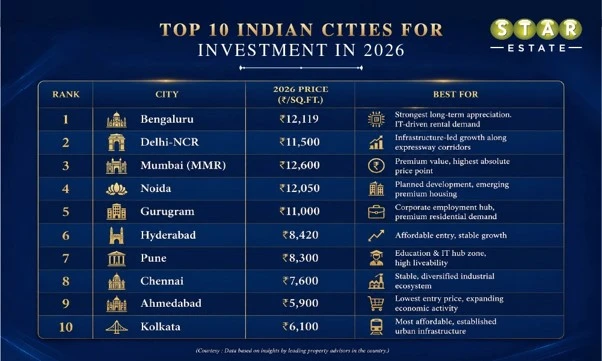
Bengaluru – Strong Employment Growth and Long-Term Appreciation
Bengaluru’s average rates have moved from about ₹6,800 per sq. ft. in 2021 to roughly ₹12,119 per sq. ft. in 2026. Nearly 80 percent price appreciation in five years, among the sharpest gains of any city on this list. It is backed by strong fundamentals, including a deep base of IT, technology, and start-up employment, which keeps rental demand strong all through the year.
The corporate corridors here keep expanding outward, pulling development along with them. Buyers considering Sarjapur Road, Whitefield, North Bengaluru, West Bengaluru or Central Bengaluru get a mix of continuous rental income and capital appreciation. Thus, Bengaluru remains the top pick for investors tracking housing prices in India in 2026.
Delhi-NCR – Infrastructure-Led Growth across Emerging Corridors
Property along the Dwarka Expressway has risen from around ₹6,900 per sq. ft. in 2021 to about ₹11,500 per sq. ft. in 2026. A sharp rise driven by infrastructure catching up with demand rather than speculation.
New expressways, metro connectivity and airport-linked development along the Dwarka and Yamuna Expressway corridors have opened up large, well-planned residential pockets.
For buyers, that means new commercial activity feeding housing demand, a steady pipeline of premium and luxury launches, and improving connectivity across NCR, including key employment hubs, hinting at further possibility for price appreciation in the Delhi-NCR region.
Mumbai Metropolitan Region – Premium Value and Strong Rental Demand
Mumbai continues to be the most expensive real estate market in India. Among property rates in top Indian cities, its average rates have risen from ₹9,800 per sq. ft. in 2021 to ₹12,600 per sq. ft. in 2026, remains highest.
South Mumbai, Bandra, Juhu, Worli, and Cuffe Parade attract HNIs, NRIs, and other premium buyers. While Thane and Navi Mumbai offer affordable entry points into the same metropolitan area, making Mumbai a market built for long-term investment rather than for short-term players.
Noida – Planned Development and Emerging Premium Housing
In Noida’s Sector 150, prices have grown from about ₹8,200 per sq. ft. in 2021 to ₹12,050 per sq. ft. in 2026. These sectors draw strong demand for premium housing from corporate professionals, HNIs and luxury buyers, supported by healthcare, education and lifestyle infrastructure that has matured quickly alongside the housing stock.
Wide roads, expressway access, upcoming metro links and a fast-growing base of commercial activity have turned this stretch – along with Noida Expressway, Sector 137, Sector 143 and Greater Noida West – into one of NCR’s more consistent performers, and a market to watch for housing prices in India in 2026.
Gurugram – Corporate Employment and Premium Residential Demand
Gurugram’s average prices have climbed from ₹7,200 per sq. ft. in 2021 to ₹11,000 per sq. ft. in 2026, underpinned by its status as one of North India’s largest corporate hubs.
A rich concentration of multinational companies keeps both rental and ownership demand elevated, while newer premium supply along Golf Course Road, Dwarka Expressway, Southern Peripheral Road and New Gurugram continues to attract buyers who want proximity to work without giving up on lifestyle. Strong professional rental demand paired with steady premium launches makes Gurugram considerable for price appreciation in top Indian cities.
Hyderabad – Affordable Entry and Stable Residential Growth
Hyderabad’s rates have risen from ₹6,200 per sq. ft. in 2021 to ₹8,420 per sq. ft. in 2026. Steady employment growth around the Financial District, Gachibowli, Kokapet, Nanakramguda and HITEC City, combined with that relatively lower entry price. It keeps investment demand consistent, thus offering steady housing prices in India in 2026.
Pune – Education, Technology and High Liveability
Pune has moved from ₹5,800 per sq. ft. in 2021 to ₹8,300 per sq. ft. in 2026, a gain built on its technology sector. A large student and professional-driven population, and a lifestyle that keeps drawing families away from costlier metros.
End users and investors can explore Hinjawadi, Kharadi, Baner, Wakad, and Viman Nagar for end-use and consistent rental values. The city equates balanced profile for buyers who want reasonable entry costs without giving up on long-term liveability.
Chennai – Stable Growth and Industrial Employment
Chennai’s average prices have grown from ₹5,300 per sq. ft. in 2021 to ₹7,600 per sq. ft. in 2026, supported by a diversified employment base spanning technology, automobile manufacturing and engineering.
That diversity tends to make Chennai’s growth steadier and less prone to sharp swings than markets concentrated purely in IT, a pattern that mirrors broader property price trends in India. OMR, ECR, Porur, Pallavaram and North Chennai continue to see consistent rental demand from working professionals, helped along by metro expansion and ongoing road upgrades.
Ahmedabad – Lower Entry Prices and Expanding Economic Activity
Ahmedabad remains one of the more value-oriented options on this list, with rates moving from ₹4,300 per sq. ft. in 2021 to ₹5,900 per sq. ft. in 2026. Its comparatively low acquisition cost, combined with expanding industrial and business activity and rising NRI interest, gives the city genuine potential for long-term price appreciation in Indian cities – particularly around SG Highway, Satellite, Bodakdev and Prahlad Nagar, where infrastructure is expanding fastest.
Kolkata – Affordable Housing and Established Urban Infrastructure
The regime change in West Bengal has impacted Kolkata real estate too. The city of joy has seen the most gradual movement on this list, with prices rising from ₹4,600 per sq. ft. in 2021 to ₹6,100 per sq. ft. in 2026.
The slow growth, however, is a concern for instability. However, established neighbourhoods, mature healthcare and education infrastructure, and growing commercial pockets like New Town and Rajarhat support both end-use buying and long-term rental income. Even at this gentler pace, Kolkata is part of the broader real estate price rise in India, and these localities have some of the most affordable property rates among India’s top ten cities.
Buyer’s Takeaway - But no matter which city fits your budget and goals, the pattern is simple. The better roads and metro links, steady demand for rental homes, and more people getting jobs in these cities are really pushing housing prices up in India in 2026.
Why Discuss Investment with Star Estate
Star Estate helps you make sense of property price trends in India as a RERA-registered consultant that works exclusively with RERA-verified residential and commercial projects across India.
Use our EMI calculator to estimate your home loan and plan a budget that lines up with the purpose of your purchase – whether that’s end-use or investment.
The Bottom Line
Property price trends in India mirror what’s actually happening in the market, which makes them a far better guide than opinion alone. Talk to a Star Estate advisor today for a free consultation on RERA-verified projects across India, or fill out our enquiry form to consult a seasoned professional who can help you find the right property deal.