A Step-Wise Guide on How to build a diversified Real Estate Portfolio
The proverb, don’t put all your eggs in one basket, is apt for property investors. With multiple options to explore, real estate portfolio diversification is a strategic way for wealth creation. While carrying benefit potential, the risk involved in the market can’t be ignored. However, insightful property research can define long-term positive results. This blog post educates about the real estate investment strategy to reap high returns while considering safety nets.
An investment in a non-liquid asset is amongst best options to empower life financially. However, counting only on one property type, location, and budget is more likely to be a suicidal framework. Therefore, investors must know the importance of real estate portfolio diversification in today’s time.
What is real estate portfolio diversification?
The property diversification is a process to park your money in multiple immovable assets under different verticals. It is a wise strategy to defer mitigation risk in the short term and ensure maximum profitability in the long run.
The idea behind multiple property investment is to grow on the profit trajectory even if one asset underperforms.
Why does Real Estate Portfolio Diversification matter?
The multiple property investment is an appropriate way to create a financial safety net for families. Also, the human approach to strengthening social status with a wealthy legacy is possible through the segregated concentration of property ownership.
Interestingly, the calibre of understanding one investment vehicle can lower the possibility of reaping high returns via diversified property investment.
The property market embraces several risks, including price volatility, investment duration, and market conditions. The impact of global and domestic economic developments makes real estate portfolio diversification a crucial investment vehicle.
Checklist to Consider Real Estate Portfolio Diversification
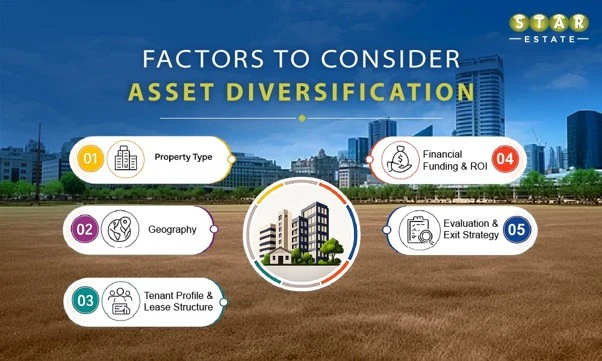
Asset Segment
It is a primary factor to assess the involvement of potential benefits and risks in multiple property investments. Explore residential, commercial, and mixed-use immovable assets to choose your pick. These verticals expand manifold in apartments, villas, penthouses, retail shops, and office spaces.
Structure
It calls for investment vehicles like REITs, Fractional Ownership, Sole Ownership, and partnerships. The new-age real estate portfolio diversification combats the larger risk of loss from investment.
Strategies
The real estate investment strategies involve leasing commercial spaces and lending. The idea is to capitalize on possibilities to increase wealth bandwidth and lower the risk of loss via ownership.
The way to diversify a real estate portfolio like an informed investor is to choose a property type. Such a selection demands profound wisdom, analysis, and understanding of distinguished immovable assets.
Step-by-Step Guide to Effectively Diversify Property Investment
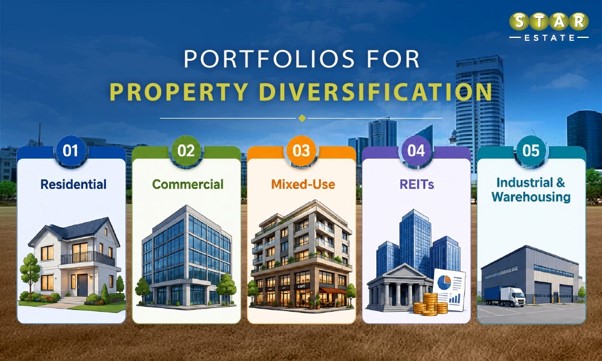
Step 1 – Diversify via Classified Property
The real estate market is beyond housing units and retail shops. Here is the list of non-liquid assets to consider for meritorious results from investment.
Residential Properties
The apartments, villas, and independent homes are in demand and are a steady source of income with less risk.
Commercial Properties
This property type inclines towards higher risk, as mobility, market conditions, and inflation-like factors influence market activity.
Real Estate Investment Trust (REITs)
These Government-backed investment vehicles are ideal for experiencing high returns and ownership without stressing over property maintenance, tenants, and rental issues.
Industrial Warehousing
The segment is gaining popularity as expressways like DMIC (Delhi Mumbai Industrial Corridor) increase demand for logistics and warehousing facilities. These asset types are ideal for long-term investment even while other portfolios log a profit downturn.
Step 2 – Real Estate Portfolio Diversification via Geography
The effective way to diversify property investment is to explore micro-markets in the domestic market. It is essential to understand rental and demand patterns across cities and states, as local markets behave in a distinguished way.
Each locality has its own challenges and risk factors; therefore, it is important to build an effective real estate investment strategy. A roadmap which traverse through situations where ROI downturns from one sphere can be manageable from other portfolio in the locality.
For example, a closure of a company in the area will hit rentals, while property portfolios in other areas will continue to reap the same.
Step 3 – Tenant and Lease | A Viable Real Estate Portfolio Diversification
This is an important factor when it comes to building a real estate portfolio in India. A single-segment investment can reap fair returns if tenancy diversification is taken care of. A gated community with distinguished floor plans works for multi-generational families, nuclear families, and couple-only tenant lower the risk of vacant space ownership.
A commercial lease agreement is a thing to consider. The short- and long-term lease agreements and their timely renewal favour investors. Likewise, hiring a new tenant is also a way to reap high ROI from diverse property investments in India.
Step 4 – Watch your Finances for effective Real Estate Portfolio Diversification
The mindful use of financial leverage works best to make multiple property investments in India. Dependency on a single lender and uncheck interest rate structure is a bit risky. Therefore, investors must keep a tab on financial variables to ensure easy finance options at their disposal.
Step 5 – Evaluation of Real Estate Investment Strategy for Smooth Exit
Building a real estate portfolio isn’t a one-time task; rather, creation is just the beginning of a wealthy future. Interestingly, the market also embraces changes, leading to highs and lows, ultimately accounting for profit and loss.
Therefore, make assessment and actionable decisions a ritual to follow every quarter, half-yearly, or annually. Conduct evaluation based on parameters including –
Present allocation of property types and locations
Compare property performance with targeted goals.
Explore possibilities to resell underperforming assets to increase the chance of profitability
Check for refinancing options to ease the financial obligations.
It is an effective way to build and maintain a balanced real estate portfolio diversification.
The Bottom Line
Early investors must not rush to own multiple assets across locations. Commence real estate portfolio building with one property, assess and evaluate to reinvest the profit from the same. Diversify property investment via this approach to increase the portfolio.