How Expressways Impact Indian Real Estate: Things Property Buyers Must Know in 2026
Cities grow, and individuals’ expectations also evolve with them. Also, last-mile connectivity has become a deciding factor. This is why expressways are impacting Indian real estate massively and optimistically. Today, buying a property near an expressway is not a statement but a smart decision. Many see an expressway-connected address as a way to earn strong returns. Others feel it is a comfortable residential address. Star Estate, in this blog post, explains the impact of expressways on real estate in India in 2026. From what factors behind property price movements, where, and what to check before you buy a property. It also covers real estate appreciation near highways and expressway corridor investment across the country.
AI Powered Summary
Reasons for real estate appreciation near highways in India
Expressways curtail travel time, thus giving individuals more time to live, relax, and celebrate.
The expressway connectivity to real estate across States leads to timely arrivals.
An expressway corridor investment like Delhi-Dehradun reaps rental income.
Expressways unlock new growth zones, turning once-remote land into thriving urban avenues.
Better connectivity draws industries and commercial hubs, creating jobs and housing demand.
Expressway Impact on Real Estate in India: How Expressway Corridor Investment Is Taking Shape in 2026
Think of an expressway as a thread that pulls distant land into a city's orbit. Once the thread tightens, builders, retailers, and employers follow, and quiet farmland becomes a corridor. This is the impact of expressways on Indian real estate in its simplest form. The Dwarka Expressway in Gurugram is the textbook case, and our guide on why Dwarka Expressway is called India's fastest-growing real estate corridor shows how it unfolded.
Capital Gains: The Bigger Half of the Story
A report by one of the real estate analysts shows average residential prices on the Dwarka Expressway at ₹14,180 per sq. ft. in H1 2026, up 135% from about ₹6,032 in 2021. This is now higher than Gurugram's overall average of ₹13,350.
Along the Yamuna Expressway, market data reported by The Realty Today shows plots up 536% and apartments up 158% over five years. The Noida International Airport began commercial flights on 15th June 2026, which has added fresh momentum.
Haryana has also raised circle rates on key Dwarka Expressway sectors by roughly 67%, from about ₹40,000 to ₹70,000 per sq. yard, according to an April 2026 trade report. That is an official nod to rising values. It also means higher property registration costs.
These figures are enough to show how expressway connectivity to real estate investment options is key to profitability.
Expressway Connectivity and Real Estate Micro-Markets across India (2026)
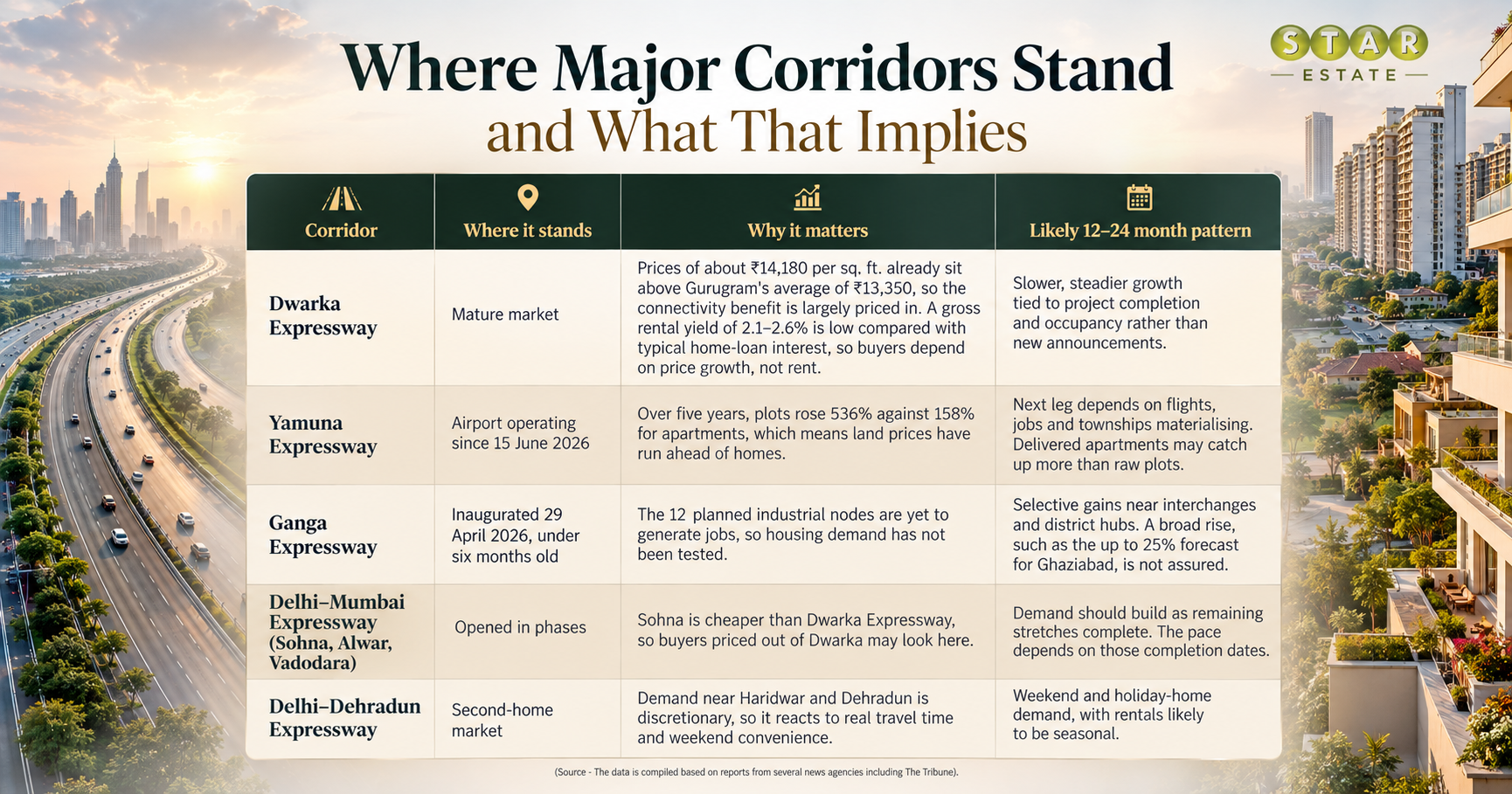
Dwarka Expressway (about 29 km): This corridor links Dwarka and IGI Airport to Gurugram, which gives residents quick access to the airport. Followed by Gurugram’s corporate hubs and the Delhi metro network. Strong expressway connectivity and a steady flow of high-rise residential projects have made it a premium market. Property buyers are drawn by its capital appreciation and rental demand from working professionals. Read why investors call it a goldmine.
Yamuna Expressway (165 km): Running from Greater Noida to Agra, this expressway is anchored by Jewar and the new airport. Tech parks, educational institutions, and industrial zones are growing alongside it. Thus, creating jobs and demand for residential accommodation. Properties neighbouring the expressway, including plots and residential projects, suit long-term investors who expect early entry in a developing region.
Delhi-Mumbai Expressway (roughly 1,350 km): The Sohna-Dausa stretch opened in February 2023, and other sections have opened in phases, with full completion targeted around 2026. Sohna, Alwar and Vadodara are the micro-markets to watch for in the future. The better expressway connectivity from here to Delhi-NCR and western India will boost demand for homes, warehousing, and commercial space. Sohna remains more affordable than Dwarka Expressway, which makes it attractive for buyers who want NCR connectivity at lower entry prices.
Eastern and Western Peripheral Expressways: These ring roads let traffic bypass central Delhi, which cuts congestion and travel time. Kundli, Sonipat and Ghaziabad benefit from faster access to Gurugram, Noida and the wider NCR. This improves their appeal for homebuyers, logistics players and industrial users. Thus, listing as one of the best property investment options near expressways in India.
Delhi-Dehradun Expressway (210 km, about ₹13,000 crore): This corridor shortens the journey between Delhi and Uttarakhand and links markets like Ghaziabad and Saharanpur. It also adds second-home appeal near Haridwar and Dehradun. This makes expressway corridor investment an ideal option in 2026.
North India Expressway Network
The 594 km Ganga Expressway was inaugurated on 29th April 2026 at a cost of about ₹36,230 crore. It links Meerut and Prayagraj across 12 districts and cuts the journey to roughly 6–7 hours. Meerut, Hapur, Bulandshahr, Hardoi and Prayagraj are popular property investment destinations near the expressway. Tribune, a leading news daily, reports that experts predict the possibility of Ghaziabad rates rising by up to 25%. However, property buyers must not take it as a confirmation, as the market can change anytime.
Further along, the 302 km Lucknow–Agra Expressway is lifting Unnao, Kannauj, Mohanlalganj, and Sultanpur Road real estate.
West and Central India Expressway Network
On the Mumbai–Pune Expressway, Lonavala, Khopoli and Talegaon offer affordable alternatives to Mumbai. The Nagpur–Mumbai Expressway is building logistics hubs. Colliers India's January 2025 report ranks Nagpur first among 30 emerging cities, followed by Jaipur and Lucknow, with land prices along expressway micro-markets potentially increasing to 5.2 times by 2035.
Things NRIs Must Check Before Investing in Expressway Corridors in India
Not every expressway delivers, and not every property near an expressway is a good buy. Before you commit, run through this checklist:
RERA registration: Verify the project and promoter on the state RERA portal.
Expressway status: Is it operational, under construction, or only announced? Announcement-stage pricing carries the most risk.
Land type: Under FEMA rules, NRIs cannot buy agricultural land, farmhouses, or plantation property. Many roadside plots fall in this category.
Master plan and zoning: Confirm the plot sits in a residential or commercial zone.
Circle rates and stamp duty: Rising circle rates raise your registration costs.
A second growth driver: Look for an airport, metro, or job hub nearby.
Exit and repatriation: Check resale liquidity and tax rules with an advisor.
Are you a first-time NRI investor? Star Estate’s NRI investment page details how to invest in Indian real estate.
Real Estate Appreciation near Highway: What to Expect in the Next 12–24 Months
Real estate appreciation near highways does not arrive in one jump. It moves in stages, and the stage a corridor has reached says more about property near an expressway over the next 12 to 24 months than any headline growth figure. The reasoning below is an expectation based on that pattern, not an obligation.
The Four Stages of Real Estate Appreciation near Highways
Announcement: Prices rise on expectation alone, before a road exists. These gains are speculative and the most fragile.
Construction: Land acquisition and visible progress firm up values, but buyers still carry the risk of delay.
Opening: Travel time actually falls, end-users start buying, and prices adjust to the real commuting benefit.
Maturity: Value now depends on what the corridor hosts, such as jobs, schools, retail, and rental demand. Growth becomes slower and steadier.
Three Things That Will Decide the Next 12–24 Months
Occupancy over launches: A corridor full of completed, lived-in homes can sustain prices. One with mostly unsold launches cannot, however good the road is.
Jobs arriving on time: Housing demand follows employment opportunities. What matters is whether industrial nodes, tech parks and the airport ecosystem actually begin operating, not whether they are planned.
Entry cost against expected gain: When circle rates rise, as by about 67% in key Dwarka Expressway sectors, the price must climb further before a buyer breaks even. This naturally limits speculative buying.
Taken together, expect the expressway impact on real estate to be moderate and steady where an expressway is established, and uneven but potentially larger where jobs and airports are still arriving. Treat any percentage forecast as a scenario that depends on delivery, not as a promise.
Conclusion: Weigh the Expressway Impact on Real Estate Before You Buy
Expressways are reshaping the landscape of Indian real estate. Prices on proven corridors such as the Dwarka and Yamuna Expressways have climbed sharply, new corridors like the Ganga Expressway are opening fresh markets, and rents are rising, though yields remain modest. Faster expressway connectivity, new airports, industrial nodes and planned townships continue to push demand beyond the city core.
The gains from real estate appreciation near highways in India are real. But so is the risk of buying too early or without checking the basics. The smartest approach to expressway corridor investment is to match the corridor to your goal: capital growth, a home to live in, or a second home. Before you buy property near an expressway, verify RERA registration, land type, zoning, circle rates, and the status of the expressway, and look for a second growth driver nearby. For NRIs, FEMA rules on land type are equally important.
Want a second opinion? Talk to a Star Estate advisor today for a free, no-obligation consultation. We are RERA-registered (RERA No. UPRERAAGT10202) and also know these corridors on the ground, and will shortlist new launches that match your budget. Fill in the enquiry form, and we will get back to you soon.