Buying a Home in 2026? Know how home loan interest rates in India may impact the decision
Every time the RBI meets, homebuyers in India feel their heart skip a beat. Why? Because a single repo rate decision realigns home-buying budget for 2026. When the RBI cuts the repo rate, banks pass on lower borrowing costs, dropping your EMI, thus bringing your dream home within reach. A hike does the opposite, as it tightens affordability, even if property prices stay the same. This is why understanding changes in home loan interest rates matters more than ever right now. With the RBI holding the repo rate steady at 5.25% through 2026, home loan interest rates have settled into one of their most stable, buyer-friendly zones in five years. Here, Star Estate breaks down what this stability means for end-users and investors and also why 2026 could be the best year to buy a home.
What is Home Loan Interest Rate? How does it affect home-buying decisions in 2026?
A home loan interest rate in India is the cost a homebuyer pays to borrow money from a bank to buy a home. It is a percentage of the outstanding loan amount, which is charged annually until the loan is paid in full.
The interest rate determines three things: how much loan you're eligible to borrow, the total interest you'll pay over the principal, and your monthly EMI amount.
Home loan interest rates are directly tied to the RBI's repo rate. When the RBI cuts the repo rate, your EMI comes down; when it hikes the rate, your EMI goes up. The Reserve Bank of India reviews and resets this rate every two months at its bi-monthly Monetary Policy Committee meeting.
The Present Scenario: Where Home Loan Interest Rates Stand in 2026
In its August 2026 Monetary Policy Committee meeting, the Reserve Bank of India held the repo rate steady at 5.25%. It continues to signal a rate cut in 2025. This stability gave borrowers confidence to plan home buying in 2026.
Alongside this, PMAY-linked interest subsidies continue to ease the entry cost for eligible first-time buyers. It supports buyers in the affordable and mid-income brackets, effectively diminishing the impact of home loan interest rates on Indian buyers’ budgets.
Home Loan Interest Rate in India — 2021- 2026 Price and Rate Trend
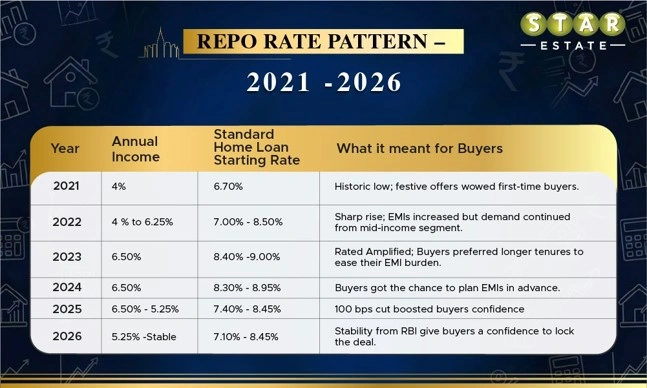
Home loan interest rates have trended in a non-linear pattern since 2021. What hit a low during the pandemic recovered sharply in 2022-23. With the RBI combating inflation with a 2x increase in the repo rate in 2024, it set the stage for an easy 2025.
Reserve Bank of India's pivoted growth support during the last two years has made homebuyers more confident.
By mid-January 2026, home loan interest rates are offered from 7.10% to 8.45%. The steady home loan interest rates impact investors and first-time home buyers positively.
Here’s how the rate changes shaped the housing market in India between 2021 and 2026.
Even the slightest change in home loan interest rates impacts Indian buyers massively. Especially those in the mid-income bracket. What was once cheap and affordable in 2021 transformed into an expensive and cautious investment in 2023. Comparing these to 2026, today’s maximum rate of up to 8.45% against 9% in 2023 makes homebuying affordable.
Buyers’ Takeaway – The repo rate lowers home loan interest rates, thus lowering loan EMIs in India.
Types of Home Loan Interest Rates in India Buyers Must Know
There isn’t only one home loan interest rate in India. Therefore, before signing the loan agreement, buyers must understand how the bank calculates and revises the rate. The change in this calculation shifts your EMIs and loan tenure to newer timelines.
Fixed Interest Rate
A fixed home loan interest rate stays the same for the entire tenure or an agreed lock-in period, regardless of how the RBI repo rate moves. It gives buyers a predictable EMI, which helps to build an EMI corpus. That said, fixed rates are usually priced higher than floating rates at the start.
Floating (Variable) Interest Rate
Most home loans in India today are floating, linked to an external benchmark such as the Repo Linked Lending Rate (RLLR). When the RBI revises the repo rate, banks pass on the change to borrowers, usually within a quarter, adjusting the EMI or the remaining tenure. Floating rates tend to be lower than fixed rates and work in the buyer’s favour. When the RBI cuts the repo rate, EMIs are lowered, while they shoot up as the repo rate increases.
Hybrid (Fixed-cum-Floating) Interest Rate
It is a combination of both fixed for an initial period. Traditionally, two to five years, before converting to floating for the rest of the tenure. It suits buyers who want short-term EMI certainty while staying open to benefiting from future repo rate cuts.
Fixed: Predictable EMI, but a higher starting rate.
Floating: Moves with the repo rate, usually cheaper over the loan’s full tenure.
Hybrid: Fixed initially, floating later, balancing certainty with long-term savings.
Buyers’ Takeaway – With the RBI holding a neutral repo stance in 2026, most first-time buyers are leaning toward RLLR-linked floating rates, since they currently offer the lower starting cost of the three options.
Is 2026 a good time to buy a home in India?
The recent trends show how home loan interest rates affect buying decisions. Industry veterans call for a cautious move even if the rates are stable. According to a leading property market analyst, housing demand has grown in H1, 2025. It is seen as a result of a 100 bps cut by the RBI.
The top housing metro markets in India are growing at a fast pace. So is the loan volume and the loan borrowing potential. Assessing which reputed developers are introducing new inventory to cater to buyers across segments.
A massive shift in the affordability quotient makes 2026 a good time to buy a home in India.
The Impact of Home Loan Interest Rate in Delhi-NCR
In NCR, Noida’s sectors neighbouring Yamuna Expressway have witnessed high demand for residential properties. Also, Dwarka Expressway and Sector 113 in Gurugram are experiencing massive housing demand.
The infrastructure development and employment opportunities here fuel property prices. Thus, combined with home loan interest rates, EMI values remain considerable.
Buyers evaluating options in these corridors can run their numbers on Star Estate's Home Loan EMI Calculator before shortlisting a project, and explore live inventory through Star Estate's guide to sector-wise property investment in Gurugram.
(EMI Calculator shows tentative data)
Home Loan Subsidy and Home Loan Interest Rates
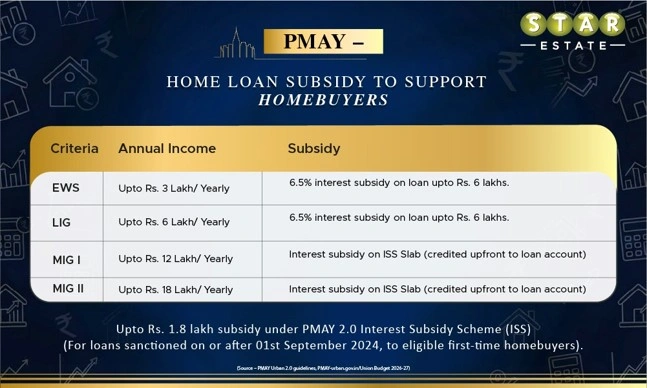
PMAY, the Pradhan Mantri Awas Yojana (PMAY), strengthens home ownership for Indian families in 2026. The scheme provides financial support based on financial and buying capacity across income brackets.
EWS (Economically Weaker Section): Households earning up to Rs. 3 lakh/year get a 6.5% interest subsidy on loans up to Rs. 6 lakh.
LIG (Low Income Group): Households earning up to Rs. 6 lakh/year also get a 6.5% interest subsidy on loans up to Rs. 6 lakh.
MIG I (Middle Income Group I): Households earning up to Rs. 12 lakh/year receive a subsidy based on the applicable ISS slab, credited upfront to the loan account.
MIG II (Middle Income Group II): Households earning up to Rs. 18 lakh/year also receive a slab-based subsidy, credited upfront to the loan account.
Overall, borrowers can avail a subsidy of up to Rs. 1.8 lakh under the PMAY 2.0 ISS.
This benefit applies to loans sanctioned on or after 1st September 2024 and only for eligible first-time homebuyers.
The Union Budget for 2026–27 allocated over ₹18,625 crore toward PMAY-Urban, with a significant share earmarked for PMAY-U 2.0. If you're a first-time buyer and haven't checked your eligibility, it's worth doing the maths on both the subsidy and today's loan rate together.
Talk to Star Estate before Applying for Loan
Repo rate and housing loan interest rate alone won’t make an impact. Rather, picking up a RERA-verified project at an appropriate price calculates accurate EMI math.
Star Estate's professional guidance offers RERA-verified properties paired with loan options from the best lenders across the country.
Connect with us for a free consultation and know how an accurate property valuation can make a home loan interest rate work for you.