India Office Market Leasing in 2026: GCCs, Vacant Office Space and What It Means for REIT Investors
Global capability centres (GCCs) keep landing in India. Bengaluru and Hyderabad continue to sign office leasing deals. And yet, vacant office space hasn't disappeared in several cities. So what's really going on with India office market leasing in 2026? It matters because the India office market drives listed office REITs, the easiest way for investors to own Grade A offices without buying one floor outright. At Star Estate, we frequently get this question from NRIs and first-time commercial investors, as REITs are a simple investment tool these days. So, here's the clear answer.
AI Powered Summary
India Office Leasing and REITs in FY2026-27
GCCs lead the India office market. They leased 15.8 million sq ft in H1 2026, up 14.2% from last year. That's 41.7% of all leasing.
Vacant office space is shrinking. Pan-India vacancy is 14.5%, a five-year low, even though total office leasing dipped 3.9%.
Green is the new default. Roughly 70% of Grade A stock in the top seven cities is green-certified, says Colliers India.
Bengaluru and Hyderabad, two stories. Hyderabad leasing grew 17.6%, while Bengaluru fell 20.5% but still leads net absorption.
REITs are still early. Only about 16% of Grade A office stock is listed, and Colliers sees room for far more.
Why are investors looking at office REITs in 2026?
India office market leasing in 2026 is strong but uneven. JLL reports 37.9 million sq ft leased in H1 2026, with GCCs taking 41.7%. Vacancy has fallen to 14.5%, a five-year low. For REIT investors, that means steady rent potential from Grade A assets, though city-wise performance varies.
Rent-backed income, without buying a whole office
A REIT pools Grade A office buildings and pays out most of the rental income to unitholders. You buy units on the stock exchange, much like a share. No floor-plate to buy, no tenant hunting, no property tax paperwork.
Payouts are catching attention. Six listed REITs distributed ₹3,136 crore to over 4.85 lakh unitholders in Q1 FY27, more than double the ₹1,559 crore four REITs paid a year earlier, according to the Indian REITs Association. Part of that jump comes from two newer REITs joining the list.
How office leasing activity helps a REIT investor
REIT income follows tenants. When office leasing picks up, occupancy rises, rents hold, and distributions look safer. Colliers India notes that occupancy above 86% in existing office REIT portfolios signals strong premium-office demand.
Higher occupancy usually means more stable distributions.
Long leases to blue-chip tenants smooth out income.
Less vacant office space gives landlords more pricing power at renewal.
For NRIs, units are rupee-denominated and trade on Indian exchanges. Check your account and tax position with your bank or advisor first.
India Office Market Leasing in 2026: What the JLL H1 Report Says
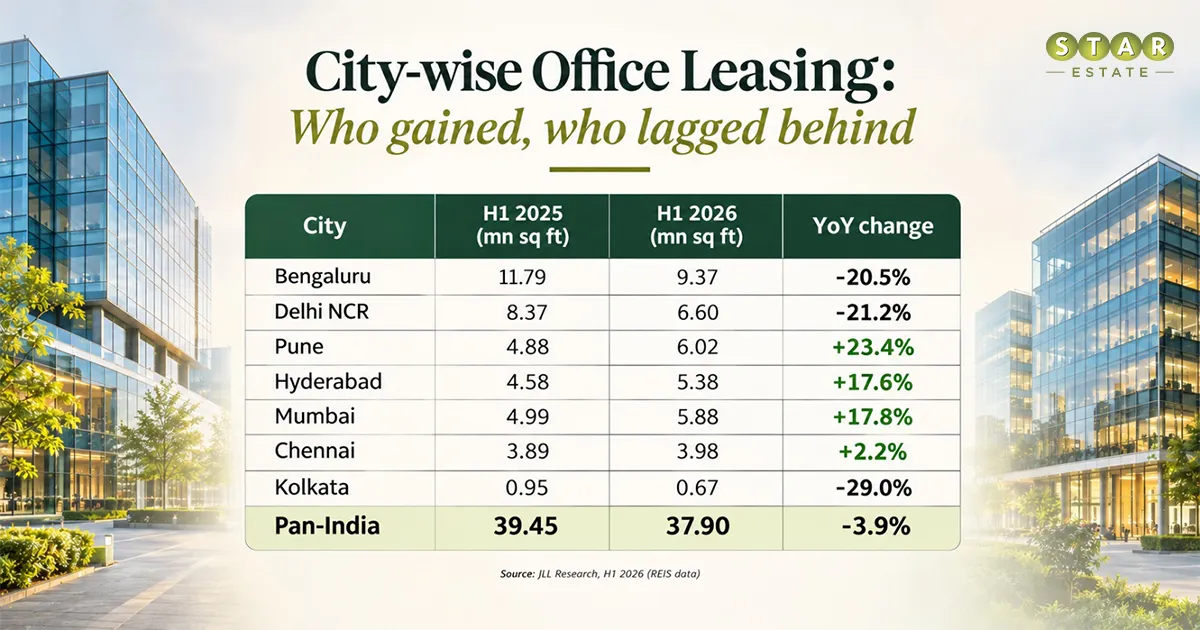
The table above explains that India’s office market leasing in 2026 hasn't weakened across the board. Pune, Hyderabad, and Mumbai grew by double digits. Bengaluru and Delhi NCR dipped, partly because foreign non-GCC occupiers pulled back 43.9%. Investors should look at the building and tenant mix, not just the national total.
The headline numbers
JLL's H1 2026 data shows 37.9 million sq ft of gross leasing across India's top cities, down 3.9% from last year's 39.45 million. It's still the second-best first half on record.
Net absorption tells a stronger story. It hit 26.88 million sq ft, up 11.6% and the highest for any first half. JLL India CEO Radha Dhir expects India to cross 100 million sq ft of annual leasing within two years.
How do GCC back offices drive REIT income?
From cost centres to capability hubs
GCCs started as back offices for global firms. Today they shape the India office market by building products, running analytics, and handling AI and data engineering from India. JLL notes that tech and BFSI lead GCC demand, followed by manufacturing.
These tenants sign multi-year leases, fit out heavily and rarely move. That's exactly the kind of sticky occupancy a REIT likes.
Why this matters for unitholders
GCCs took 15.8 million sq ft in H1 2026, up 14.2% (JLL).
Global firms held 55.2% of all H1 2026 leasing (JLL).
Tenant stickiness supports rent collection, which Shirish Godbole of Knowledge Realty Trust credits for the latest payout resilience.
Green Workplaces and REIT Investment in India in 2026
Green is no longer a premium; it is the baseline.
Colliers India estimates that about 70% of Grade A stock in the top seven cities is green-certified by the end-2026, and green buildings captured 76% of leasing in 2025. Their projection for 2026 is 80–85%.
In existing REIT portfolios, 86% of operational office space is already green-certified. Colliers' Arpit Mehrotra links green assets to higher valuations, better rentals, and stronger occupancy.
Global tenants often have ESG mandates that rule out non-certified buildings.
Green buildings can cut utility costs for tenants.
Older, uncertified assets risk longer vacancies.
REIT Investment, Office Leasing, Bengaluru and Hyderabad: A Tale of Two Cities
Bengaluru: the big anchor catching its breath
Bengaluru still leads the India office market. It posted 8.30 million sq ft of net absorption in H1 2026 (up 24.2%) and holds about 24% of future REIT-able Grade A stock, according to Colliers. Gross leasing fell 20.5%, though, so watch pre-commitments closely.
Hyderabad: the fast mover
In Hyderabad, office leasing is the fast mover: net absorption jumped 31.5% to 5.04 million sq ft, and vacancy sits at a two-year low (JLL). Colliers puts its share of future REIT-able stock at 19%. Its secondary business districts hold a large part of that.
Curious to know a local view? Connect with us at www.starestate.com as our team walks you through micro-markets and tenant profiles in both cities.
How can Artificial Intelligence affect Office Leasing Demand in India in FY2026-27?
Caution now, capability later
JLL cites AI-led business transformation as one reason some occupiers are cautious about taking space. Companies are rethinking headcount and floor plans before they commit.
But the same AI wave is pulling GCCs into talent-heavy hubs like Bengaluru and Hyderabad, where AI, data science and digital engineering teams cluster. Net effect: expect slower, more selective deals now, and stronger demand for quality buildings later.
Why does heavy office leasing still leave vacant office space in India in FY2026-27?
Strong demand doesn't mean every building wins.
Vacancy is 14.5% nationally, a five-year low. Yet vacant office space persists in the Indian office market. Here's why:
Flex operators took 10.23 million sq ft in H1 2026, but older buildings don't always suit them.
Many tenants want Grade A, green-certified space, leaving older stock behind.
Delhi NCR, Chennai and Kolkata have seen weaker net absorption than Bengaluru and Hyderabad.
Foreign non-GCC leasing dropped 43.9% year on year.
So vacant office space is a quality-and-location story, not a sign of weak demand everywhere. REITs hold the premium end of the market, which is why they tend to hold up better than a random older building.
Will more GCCs in India lead to higher REIT investment? Outlook 2027
Colliers sees REIT penetration rising from about 16% of Grade A stock to 25–30% by 2030, with about 371 million sq ft of additional stock eligible for REIT listing. Existing REITs also have around 34 million sq ft under construction, due in 12–24 months.
If GCC growth continues, India office market leasing in 2026 and 2027 should keep supporting that pipeline, and office leasing in Bengaluru and Hyderabad will likely lead it. JLL expects annual leasing to cross 100 million sq ft in two years. We'd call it a positive outlook, not a guaranteed one.
What to check before you invest in 2027
Tenant mix: GCCs and blue-chips versus a single big tenant.
Green certification and the age of the buildings.
Lease expiry schedule over the next three years.
City exposure: spread across Bengaluru, Hyderabad and other hubs, and check how much vacant office space each asset carries.
Your tax position and exchange-rate risk, especially if you're an NRI.
REIT units can fall as well as rise, and past payouts don't promise future ones. If you're weighing REITs against buying a pre-leased office or shop, talk to a Star Estate advisor today for a free, no-obligation consultation. Fill in our enquiry form, and we'll compare options for your budget and city.