Investing in Pre-Launch Property in India in 2026? Risks vs Perks You Must Know
Property prices in India are climbing faster than ever. That’s exactly why pre-launch property investment in India is drawing investors’ attention right now. An early booking can lock in a price well below than what the same unit costs once the project officially launches. But it also means paying for an apartment that exists on paper, with approvals still under process.
This blog by Star Estate breaks down what a pre-launch really is and how it compares with other real estate investment options. Also, it educates investors on whether pre-launch booking safety is enough for individual’s risk appetite. Before getting caught up in the fear of missing out on early pricing, walk through the legal checks, benefits, and risk which comes with pre-launch project investment in 2026.
What Is Pre-Launch Property in India?
Pre-launch property in India means booking a unit before the developer obtains complete approvals for the project. In some cases, the pre-launch is initiated even before construction starts. For buyers, it is a strategic way to enter at the lowest possible price point. For developers, it is a way to raise interest-free capital to fund the project's early stages. Also, lucrative offers are here to avail. Therefore, here are the things to consider before investing in a pre-launch property in India.
Legal Checklist for Investors to Consider Pre-Launch Property Investment in India
RERA registration: Section 3 of the RERA Act states that a builder cannot advertise a project without a RERA registration number.
Land Title – Investors must check with the Government authority if the developer owns the right to develop a project on the land. Also check if the land on which the project is proposed is dispute-free.
Layout and Building Plan Approval – Ask the developer to share the building plan and blueprint layout submitted for approval to the Government agencies.
Payment and Cancellation Policy – Review the payment plan and Cancellation policy clause thoroughly to avoid monetary loss.
Legal Assistance – Hire a real estate expert to verify paperwork before investing in a pre-launch property in India.
Along with perks, pre-launch property investment in India involves risk if investors turn a blind eye to delays and skip legal aspects. A pre-launch project may not yet hold a RERA number. Also, no safeguard measures are set by default at this stage. Therefore, assess the property based on current and future scenarios to restrict loss of time and money.
Is it safe to invest in pre-launch property in India?
Is pre-launch booking safe, or should you simply wait for the official launch? The honest answer is that it depends on how much of the legal groundwork is already in place. The Real Estate (Regulation and Development) Act, 2016, protects buyers from the risks that pre-launch projects carry.
Under the Act, the State-wise statutory body monitor the market. Explore real estate portfolio diversification options, as each has distinguished features.
Benefits of Investing in Pre-Launch Property in India in 2026
Discounted Price - Builders typically price pre-launch units 10–30% below what they'll sell for later, alongside cashback offers or free amenities to make the deal more lucrative.
High Appreciation Potential - Early entry means investors gain value at every construction milestone. Additionally, it reflects the value of infrastructure development in the surrounding locality.
Unit Option - Corner apartments, higher floors, and unobstructed views go to the earliest bookings, before inventory narrows.
Customization Options - Some builders let early buyers choose tiles, paint, electrical layouts, and kitchen fittings according to their taste.
Flexible Payment Plans - Construction-linked or special payment schedules and other options give investors more time to pool funds.
These are the benefits of investing in pre-launch property in India that draw attention from investors.
Know the Difference between Pre-Launch Property Investment vs Other Real Estate Options in 2026
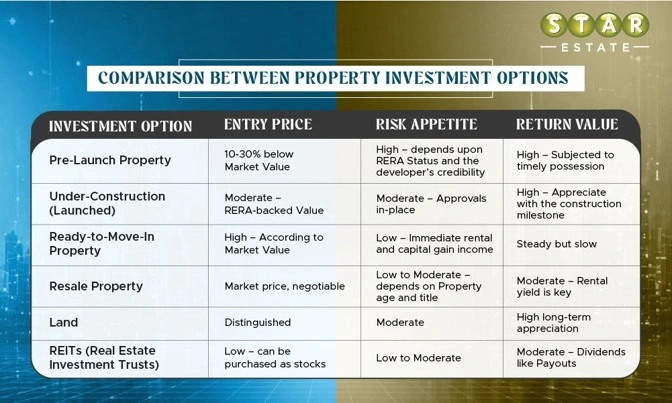
Pre-launch property — It is the lowest entry price with high risk potential in Indian real estate. An investment option without RERA, escrow protection, or a payment plan, possession remains a key concern for investors.
Launched Under-Construction Property — Post official launch, RERA registration, structured payment plans, and an escrow account to regulate fund safeguard buyers’ interests. Thus, lowering the risk involved in property investment in India in 2026. In the meantime, the price rise will bridge the profit ratio between under-construction and ready-to-move-in properties.
Ready-to-move Property — A finished property with a ready-to-move-in option works for investors. Buy and rent the asset to reap rental income immediately after possession. It has a high purchase value and a waiting period for capital appreciation.
Resale Property — Priced below pre-launch property in India, resale property purchase is an expense sheet. From title verification to the property's age and existing loan or maintenance dues, resale property purchases need deeper scrutiny than a new property.
Plots and Land — The most profitable real estate investment in India, but it has competitive pricing. It is the strongest option for appreciation as growth corridors run along it. However, it is an investment to reap better capital appreciation than other immovable assets.
REITs — The lowest-effort, most liquid way to hold real estate exposure as you buy and sell units like a stock, with professional managers handling the underlying properties. Returns are steadier but capped compared with a successful direct property bet.
Each option has a combination of cost, liquidity, and estimated return potential. A pre-launch booking is highly feasible, leaving all other options behind in the race for income growth. An investment in pre-launch property in India is a good decision in 2026 for those seeking high ROI from a real estate portfolio.
Pre-Launch vs Launch Price: Who Wins the Deal?
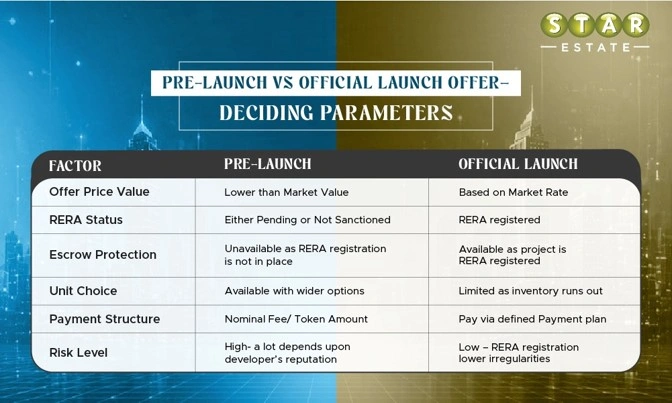
Paperwork is the primary difference between pre-launch and launch price investors eventually have to weigh. Pre-launch pricing is lower and estimated to rise by 20% or more; however, it comes without a legal tag, RERA registration, and an escrow account for the project. Launch price is higher, but is backed by documentation, RERA, approvals, and a defined payment plan.
RERA registration has broadened the divide between pre-launch and launch prices. It is also a reason for a jump in property prices.
Early pre-launch buyers get first pick of corner units, higher floors, and better views. These perks are lost by the time a project officially launches, as the inventory runs out quickly.
Payment is nominal and upfront for pre-launch property investment in India, while launched prices are up with structured payment plans.
Neither is a clear winner. A pre-launch project carries more legal risk in exchange for price and choice; a launched, RERA-registered project is safer and gives buyers legal recourse if promises aren't kept.
Pre-Launch Project Risks Investors in Indian Real Estate Shouldn't Ignore in 2026
Missing RERA number — The unavailability of RERA registration is an important vulnerability to buyers’ interests. The developer is not accountable for not having an escrow account or payment plans in place.
Pending Approvals — The yet-to-be-sanctioned clearances, including civic, environmental, and more, can ruin the project development. There is no assurance that the developer will get through all the checks.
No Free Exit — Buyers submit a token cheque to express interest. Once the project officially launches, they must either pay the balance to lock in the unit or walk away, sometimes forfeiting the token amount.
Delayed Possession— The case of delayed possession can’t be heard in the RERA tribunal, and investors may have to deal with the developer for the same.
Check for these due diligence and developer’s credibility to avoid challenges when investing in pre-launch property in India in 2026.
The Bottom Line
Like every real estate transaction, a pre-launch property comes with both risks and perks. An informed investor considers investment goals, expected return, risk, and the developer's track record. Rather than weighing the discount against the legal gaps before he/she commit.
To explore RERA-verified pre-launch and launched projects across India's metro cities, talk to a Star Estate advisor today.