Under-Construction vs Ready to Move Residential Property: Which is a better way to Ownership
Homebuying is no less than a future fate-decider. Thus, compare under construction vs ready-to-move-in homes before signing the deal. With strong advocacy for both, what matters most is the intent to buy an immovable asset. This blog post breaks down fundamentals, benefits, and profitability potential for each of these types. Thus, be an informed buyer and find the best residential properties for sale in India.,
Get the Basics Right | Under-construction vs Ready-to-Move-in Property
What is Under-construction Property?
It is a structure where construction, including brick-and-mortar tasks, is still ongoing. Also, the electrical panels, water, and gas connections are yet to be implemented or are only partially in place.
What is a ready to move in property?
It is a fully completed structure in ready-to-move-in condition, and it holds a completion and/or occupancy certificate from the RERA authority.
Quizzed, which is a better way to property ownership between under-construction vs ready-to-move-in? Here are three parameters to evaluate price, possession, and return on investment. Therefore, it is crucial to understand each perspective.
Benefits of buying Under-Construction against Ready-to-Move-in Property
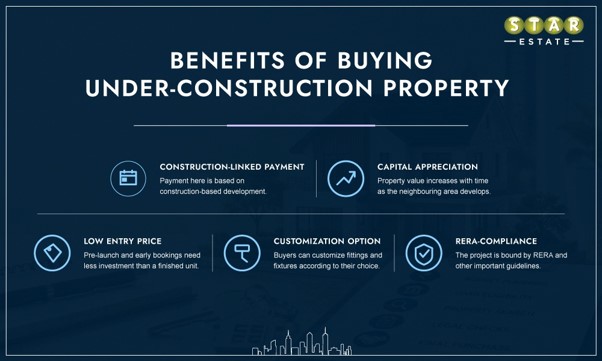
Low Entry Price
Such a property is more affordable than a finished unit, as developers at this stage focus on cash inflow. The lower asset value lures investors and even first-time homebuyers as it sounds feasible.
The developers prefer to strengthen the corpus for project completion, which they either have by themselves or took from the lender. The initial payments from buyers are logged as ancillary to complete the project on time.
Also, the early bird offer and rebate on existing prices are some lucrative offers rolled out by developers.
Easy Payment Plans – Flexible and Subvention Payment Options
The two flexible payment plans answer which is the better way to buy property in India. One is a flexible payment plan, and the second is a subvention payment plan. For investors and home buyers, it is important to understand the difference between the two.
Flexible Payment Plan strengthen buyer’s financial capability to pay for the property purchase. Under this, the payment is made upon completion of the slabs. Therefore, it is a benefit of buying under-construction property vs ready to move home. Buyers are at an advantage in maintaining a home budget, including expenses, savings, and other investments.
Subvention Payment Plan includes a developer, buyer, and bank. Here, the buyer pays a token amount to the developer, and then the bank disburses the remaining amount directly to the developer. A considerable point to discuss in under-construction vs ready to move in, which is a better way to buy property?
The benefit of buying a property under a subvention payment plan is building a financial corpus. While the bank lends a loan to the developer, the entity is required to pay pre-EMIs until the property possession is tendered to the buyer. The buyer is eligible to start EMI payment only when he/she gets the unit keys.
Customization Option
While the structure is being prepared, you can suggest changes in floor tile colour, fitting brands, and more. The flexibility to match property design with your personality is among the many benefits of buying under-construction property in India.
High Capital Appreciation
This type of property purchase amplifies the chance of return on investment. Here, the low price value and development work around the asset impact prices. An under-construction project by a reputed developer in a premium locality witnesses a price rise with the completion of every stage.
The reason is the quick absorption of inventory as the neighbourhood has robust infrastructure. Therefore, making life seamless for every resident, from kids to senior citizens. An investment in under-construction property is an ideal way to reap high rental and capital appreciation in the future. Over time, the asset is ready for possession and will be complemented with better amenities that make life comfortable.
Broader Selection Range
The liberty to choose the floor and unit size depending upon the view from the same. Here, buyers can explore options as inventory is fresh, unlike ready-to-move-in, where options get limited.
Cons of buying Under-Construction Property in India
Along with benefits come a few risks, like no rental income from day one. Also, GST eligibility is an additional cost to the property value. Discuss it with legal professionals to understand the issue. Another thing to be apprehensive about is a delay in property possession, as a lot depends upon the developer’s financial capabilities.
Benefits of buying Ready-to-Move -In Property against Under-Construction Homes
Immediate Possession
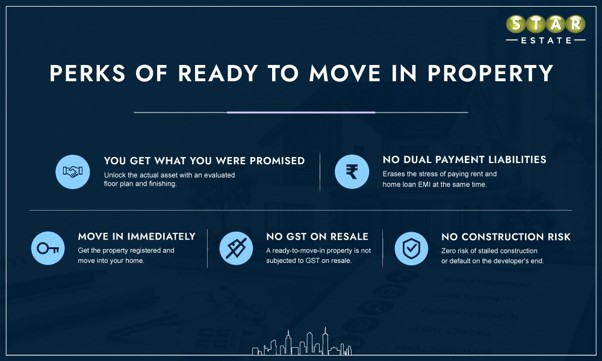
Register the property and step into your dream home without delay. One of the biggest benefits of buying a ready-to-move-in home is prompt shifting to the new place. It is the best property purchase option for tenants.
Also, those relocating to a new place find ready-to-move-in home buying a convenient option.
Own an Actual Property
The ready-to-move-in property has no room for foul implications, as you get what you see. Along with the floor plan, neighbourhood, and amenities, the daylight and night are easy to evaluate. Therefore, you can come to an appropriate conclusion.
Zero GST Charge
The possession-ready residential properties in India, attached with a completion certificate from RERA exempts from GST. Thus, the property value has no add-on price to bear for homebuyers. It is one of the benefits of buying a ready-to-move-in property against an under-construction one.
Rental from Day One
You might have heard, but it isn’t only a phrase. It is possible, as many reputed developers in India offer rentals from day one on ready-to-move-in properties.
Quick Loan Sanction
The minimal risk involved in a construction-linked plan isn’t a thing to worry about for banks. Therefore, loan sanction and disbursal become a less time-consuming task. It is another important benefit to consider a ready-to-move-in home against an under-construction property.
Cons of buying ready to move in homes
With immediate possession comes the high EMI premium and fewer options to customize the unit. Also, the property age affects rental yield and capital appreciation. Additionally, the renovation of the unit plan requires the owner to pay a hefty amount.
RTM vs UC Tax – Here’s what buyers need to know
GST on Under-construction property is bifurcated into two segments. The GST values at 5% for non-affordable homes. While the same drops to 1% for the affordable segment in the category.
GST is not applicable to a ready-to-move-in property in case the developer receives a completion certificate from the RERA. Therefore, no additional cost is added to the property price.
Stamp duty and registration charges are applicable for under-construction and ready-to-move-in properties. The rate for the same varies according to State Government policies.
Home loan interest rate deduction is applicable immediately on a ready-to-move-in property. However, in the case of an under-construction property, the buyer has to wait until he/she receives possession.
Amidst options ready to move in property as an edge. It renders a direct tax benefit and zero added value cost to the asset.
The Bottom Line
The under-construction vs ready-to-move-in property holds the potential to grow in terms of ROI. However, the choice made while considering factors like budget, time, location, and RERA verification plays a pivotal role. Therefore, research and understand your property purchase requirements to find the best properties for sale in India.