Power of Attorney Property Guide: Legal Risks, Rules, and Safeguards in India
Registering a property is the biggest moment in any buyer’s journey. But how the deal is done legally matters as much as the price you negotiate. And this is where a power of attorney property arrangement often trips people up. A Power of Attorney (PoA) lets someone act on your behalf in a property transaction. It’s common in India, especially when owners are abroad, unwell, or simply busy. Yet this one document covers far more than most people realize: sale, purchase, rent, registration, even loan formalities. This Star Estate guide walks you through every important aspect of POA property registration in India: the types, the rules, the risks, the documents, and what NRIs must watch out for.
AI Powered Summary
Power of Attorney Property Transaction in India at a Glance
A PoA is an authority to act, not a transfer of title. Ownership changes only through a registered sale deed.
A general PoA covers wide powers; a special PoA covers one defined task. For property, the narrower one is safer.
Proper POA property registration and correct stamp duty make a PoA stronger. Rules vary by state.
The biggest risks of power of attorney use include misuse, fake documents, and the PoA ending when the owner dies or revokes it.
NRIs can use a PoA, but it must be attested abroad and stamped in India within three months.
What Is a Power of Attorney (PoA)?
A power of attorney is a legal authorization in which the owner authorizes a person to act for them in a property matter, such as selling, buying, renting, or registering. The agent acts within the powers written in the document, and nothing beyond the written powers. A PoA doesn’t transfer ownership; only a registered sale deed does.
The Legal Backbone
PoAs in India are governed by the Powers of Attorney Act, 1882, read with the Indian Contract Act, 1872 (agency provisions) and the Registration Act, 1908. Stamp duty is a state subject, so the amount depends on where you execute it.
A Simple Example
Say you live in Dubai and own a flat in Pune. You can’t fly down for a sale registration. With a valid PoA, your brother signs the papers for you. You remain the owner until the sale deed is registered.
Types of Power of Attorney for Property Buyers You Must Know in India
Indian practice mainly uses three types of Power of Attorney. Knowing which one you’re signing is half the battle won.
General Power of Attorney (GPA): Broad powers to handle multiple matters.
Special Power of Attorney (SPA): Powers for one specific act, like selling a specific property.
Durable or Irrevocable PoA: Continues despite the principal’s incapacity or can’t be cancelled at will (when coupled with an interest).
General Power of Attorney Property vs Special Power of Attorney: Key Differences
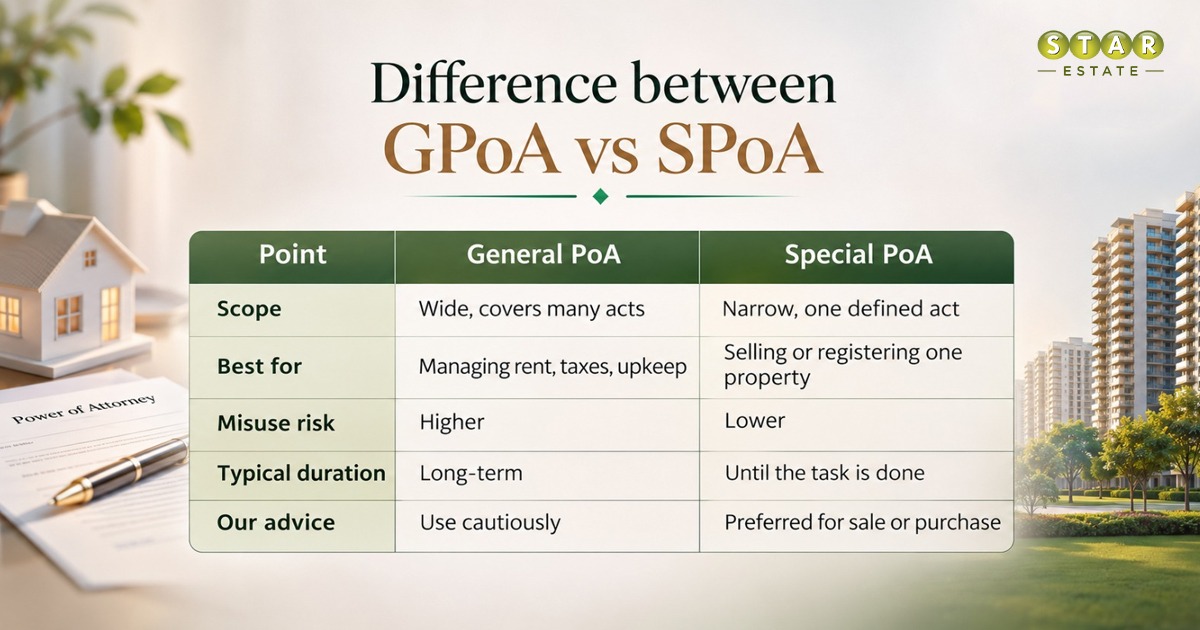
A general power of attorney document lets the agent do many things. With an SPA, the agent can do just one.
Here’s how they compare.
Scope
A General PoA gives the agent wide powers across many matters, such as managing, renting, and handling paperwork for your property.
A Special PoA lets the agent do one defined thing, such as signing a particular sale deed.
Best for
Use a General PoA for ongoing management: collecting rent, paying property taxes, and looking after upkeep.
Use a Special PoA for a one-time transaction, such as selling or registering one named property.
Misuse risk
The risk is higher with a General PoA because the agent can do many things, and vague wording can let them act beyond what you intended.
The risk is lower with a Special PoA because the agent can only do the one act the document names.
Typical duration
A General PoA usually stays in force for the long term, until you revoke it or it ends by law (for example upon the owner’s death).
A Special PoA ends once the task is done, and you can also set a validity period in the document.
Buyer’s Takeaway
Use a General PoA cautiously, and only with someone you trust completely.
A Special PoA is the preferred choice for buying or selling a property.
Why Is POA Property Registration Important in India?
The law doesn’t make registration mandatory for every PoA. But if the PoA authorizes the agent to sell or transfer immovable property, registration and proper stamping are strongly advised, and the sub-registrar will often insist on them.
Why Registration of PoA Matters in Property Transactions in India
Legal proof that the owner actually signed it
Lower chance of forgery or later denial
Smoother acceptance by sub-registrar offices and banks
A permanent, traceable record
The Suraj Lamp Ruling You Can’t Ignore
In Suraj Lamp & Industries v. State of Haryana (2011), the Supreme Court said that sale through a GPA, agreement to sell, and Will doesn’t validly transfer title to immovable property. Title passes only through a registered conveyance deed. So a PoA can help you execute a sale. It can’t be the sale.
What Are the Risks of Power of Attorney Without Registration in India?
The risks of power of attorney arrangements are real, mostly because you’re trusting one person with a valuable asset.
Common Legal and Financial Risks
Misuse of authority: An agent may sell below market price or pocket the money.
Forged or fake PoAs: Especially in resale deals and disputed plots.
Automatic termination: A PoA generally ends on the principal’s death, insanity, or revocation. A sale done afterwards can be void.
Vague wording: Broad language invites disputes.
Incorrect stamping: Insufficient stamp duty can trigger penalties and complications at registration.
How to Safeguard Your Interest when Dealing With a Property Transaction via PoA
Prefer a Special PoA with a clearly named property.
Choose someone you trust, preferably a relative or family member.
Register it and pay the correct state stamp duty.
Fix a validity period and state the price floor if you wish
As a buyer, verify the PoA holder’s ID and that the owner is alive and hasn’t revoked it.
Check the title, encumbrance certificate, and RERA registration before paying.
Benefits of Power of Attorney Property Arrangements in India (2026)
When used cautiously, a POA for property sale in India has several benefits.
Convenience: Close the deal without travelling, especially for NRIs and senior citizens.
Speed: The agent can attend registration, collect documents, and follow up with offices.
Continuity: A trusted person can manage rent, tax, and maintenance.
Flexibility: You decide the scope, from one task to complete management.
Cost savings: Fewer trips and fewer delays.
List of Documents Required to Prepare a Power of Attorney in India
Exact requirements vary by state and sub-registrar office. Most deals need the following.
Documents From the Principal (Owner)
Aadhaar and PAN card
Passport-size photographs
Proof of ownership: sale deed, allotment letter, or title documents
Property tax receipt and latest utility bill
Documents From the Agent and Witnesses
Aadhaar and PAN of the agent
Address proof and photographs
Two witnesses with ID proofs
Stamp paper of the correct value, as per your state
Power of Attorney: Property Rules for NRI Buyers in India
NRIs and OCIs can buy residential and commercial property in India. Agricultural land, plantations, and farmhouses are off-limits under FEMA rules. A PoA lets a relative or trusted individual complete the paperwork while you stay abroad.
Executing the PoA Abroad
Sign before a notary public or before the Indian embassy or consulate.
If the country is part of the Apostille Convention, get an apostille.
Bring it to India and pay the stamp duty within three months of receipt (Indian Stamp Act)
Complete POA property registration where your state requires
Safeguards for NRI Buyers
Keep the PoA limited to the purchase of a named unit.
Pay through banking channels from your NRE/NRO account.
Check RERA registration and the developer’s track record.
Don’t hand a General PoA to someone you barely know.
POA for Property Sale: Guide for NRI Sellers in India
Selling from abroad is where PoAs are used most, and where most disputes start.
Selling Through a PoA Holder
The assigned individual can sign the sale deed and appear before the sub-registrar. The deed should say clearly that the agent signs for the owner, quoting the PoA’s registration details.
Tax and Repatriation Points
Buyers must deduct TDS under Section 195 when paying an NRI seller. A lower-deduction certificate can reduce it.
Repatriation of sale proceeds is allowed within RBI/FEMA limits (generally up to USD 1 million per financial year, with documents).
Capital gains tax applies. Speak to a chartered accountant before you sign.
Revoke the PoA in writing once the sale is complete.
Should You Use a PoA for Property Transactions in India or Not?
Use it when distance or health makes it necessary, and keep it tight. A registered Special PoA, a trusted individual, and a clean title check make a power of attorney property deal workable. If you can sign the sale deed yourself, even with a short trip or video-assisted process where permitted, that’s always safer.
Still unsure? Talk to a Star Estate advisor today. We verify titles, check RERA status, and guide you through the paperwork. Fill in our enquiry form for a free, no-obligation consultation.