Rental Yield Vs Capital Appreciation: Which Is Better for Property Investors in India?
The real estate investment goals differ for every investor. Some prefer monthly rental as it is a steady income stream. Others prefer capital appreciation, a one-time long-term gain. Interestingly, rental yield is a property’s value today; capital appreciation is what investors expect that value to become tomorrow — which is why yield is the foundation, and appreciation is what gets built on top of it. Thus, a whole debate rages between timely income and a one-time lump-sum value. If this same question annoys you, continue reading. This Star Estate blog educates you on all aspects of rental yield and capital appreciation to draw a logical map of which investment strategy is better in 2026.
Introduction
From where to park my money to how my money will work for me? The struggle for domestic and NRI investors is inevitable. However, the confusion, doubt, and apprehension everything calms down as Star Estate defines the best real estate investment strategy in India to choose between rental yield vs capital appreciation in 2026.
What Is Rental Yield in Indian Real Estate?
Rental yield is the annual rent a property earns; it reflects a certain percentage of the property’s value. It tells you how hard your asset is working for you every month. Whether its price increase or make a nosedive. Investors inclined towards a stable and regular income count on rental yield as the best real estate investment strategy in 2026.
However, only an informed investor can reap maximum benefits from this approach. As, one must understand the logic to calculate it. Also, know the types of rental yield in India.
Gross Rental vs Net Rental Yield
Gross rental yield is the rental value an investor collects, excluding maintenance costs, property tax, etc. Whereas, the net rental yield subtracts maintenance fees, society charges, property tax, insurance, and vacancy months. Thus, offering the actual value that is credited to your account as monthly rent.
How to Calculate Rental Yield in India
Formula to calculate Gross Rental Yield
Gross Rental Yield = (annual rental income / property value) x 100
Formula to calculate Net Rental Yield
Net Rental Yield = [(Annual Rental Income – Annual Expense)/ Property value] x 100
Our detailed walkthrough on how to calculate rental yield in India covers city-wise benchmarks, read it for a deeper understanding of the subject.
How to Maximise Rental Yield in India in 2026
The detailed analysis of property, location, and real estate price trends makes a big difference in rental yield. Thus, the points listed below answers to how to choose a property investment option in India in 2026.
Invest near employment avenues – Amenities aren’t sufficient to attract end-users, as they won’t help if commuting to work isn’t easy from home. Therefore, explore residential properties neighbouring IT corridors and business parks to attract the maximum number of tenants. Also, the property won’t remain vacant for long, as migrant professionals demand quality residential properties near the workplace.
Budget-friendly Units – If rental yield is your final goal, then settle for a budget-friendly property purchase. A compact 1BHK or 2BHK apartment yields better rental instead of a penthouse or a luxury apartment. The workforce or end-users seeking rental accommodation prefer budget-friendly housing options. Therefore, investing your money in affordable housing property can reap high rental yields over time.
Furnish Property — Instead of offering a bare shell structure, offer a semi-furnished home for rent. Such property attracts professionals as it makes life easy. Despite the higher rental value for these units, tenants prefer them over bare-shell units.
What are the disadvantages of rental yield in India in 2026?
Historically, rental yields haven’t been impressive enough, as it rarely floats above 4 percent. Rather, a fixed deposit offers anything between 6.5-.7.5 percent. Therefore, holding onto a monthly income without it amplifying the investment cost is a concern in 2026.
Along with the percentage gap, the monthly maintenance and vacant tenure result in a poor income outcome. Therefore, think wisely before choosing rental yield as the best real estate investment strategy in 2026.
What Is Capital Appreciation?
Capital appreciation is the rise in property price over a period of time. It is the monetary gap between what was paid to buy the asset and what it costs at the present time. The location, infrastructure, income rise, and the supply-demand balance. Capital appreciation is a one-time benefit on property, unlike rent, which is annual or monthly.
Types of Capital Appreciation
Short-term Capital Gains
The price growth is driven in a short span of time by the owner. The short-term capital gains are framed under 2 years in India Tax provision. It may be the result of imbalanced demand and supply. Or a price rise of an under-construction property.
Under the Income Tax Act, short-term gains aren’t very beneficial as the income slab rate is up to 30%.
Long-term Capital Gains
The price growth here is held for a long duration by the owner. The usual duration for long-term capital gains in India is 5+ years. Factors like income growth, development, and continuous demand for housing accommodation are behind this gain.
Under the Income Tax Act, long-term capital gains are highly favourable for property owners. The asset is taxed at a flat 12.5% LTCG rate.
Rental Yield vs Capital Appreciation in India — 2021–2026
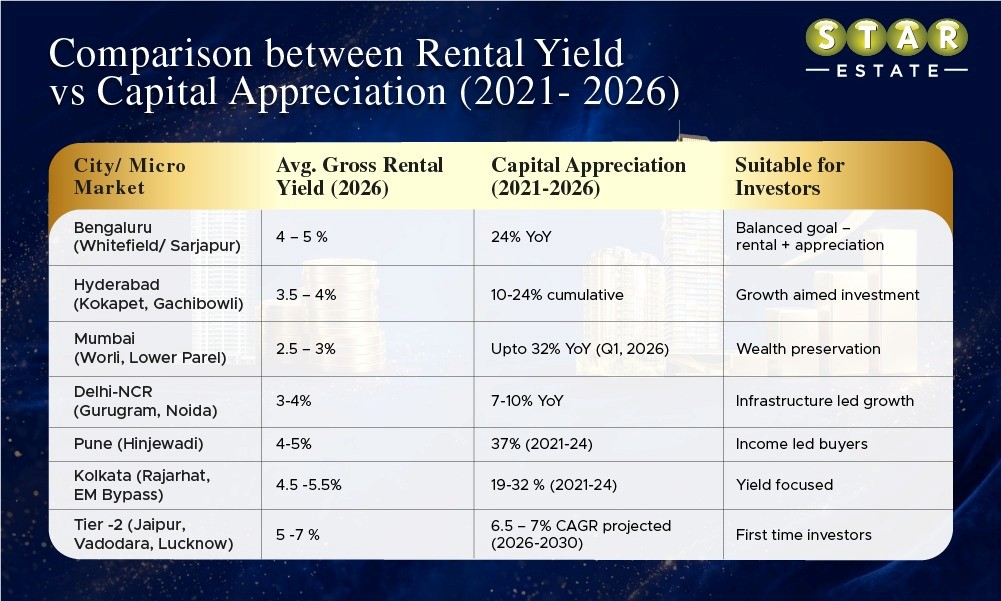
The data table signals a mixed trend when it comes to rental yield vs capital appreciation. Mumbai focused on buying resale and selling assets for capital appreciation. Kolkata preferred rental yield. In fact, tier 2 cities too gave fixed deposits tough competition by yielding rental yields between 5-7 percent. For a full national breakdown, read our blog on property price trends in India.
What are the benefits of capital appreciation in 2026?
Development and growth are the biggest factors behind property price rises. Once the metro corridors and expressways are operational, property value manifold. As, these infrastructure developments ease connectivity to workplaces, airports, and other destinations.
Why Property Investment suits every Buyer in India |Property Income and Growth
Affordable Loan – Home loan rates are swinging within an affordable budget as the RBI maintains lower repo rates. Thus, boosting investors’ confidence to invest in Indian real estate.
RERA Regulates – Certified properties make developers accountable; thus, there is a minimum risk of poor quality, unapproved layouts, and missed timelines.
Rupee Advantage – Favourable rupee dynamics mean overseas investors often earn more in their home currency even before appreciation is counted.
The Bottom Line
Amidst different opinions, understand one simple math - rental yield is a stable income-generating option. Capital appreciation builds wealth over a longer duration and offers a lump-sum profit once the property is sold.
Honestly, the property that amplifies potential for both is a winner, and nothing can be better than a RERA-verified property in India. The sanctioned plans, and timely possession create an ecosystem for better tenancy and price appreciation. Therefore, a discussion with a Star Estate advisor before you buy an immovable asset in India is a wise idea.