Retail Leasing in India 2026: JLL Data Shows Where to Invest
Is the Indian retail market gaining gigantic momentum? JLL India’s latest numbers say yes. Retail leasing in India touched 9.36 million sq ft across the top seven cities between January and September 2026, up 5.6% from 8.86 million sq ft a year ago. That is the strongest nine-month run in four years. In this blog, we break down which cities led, which brands are expanding, what it means for investors, and what could come next. Star Estate’s advisors track this market closely, so you get the practical view, not just the headline.
AI Powered Summary
India Retail Leasing Hits a Four-Year High: 9.36 Million Sq Ft in 9M 2026
Record momentum: Leasing across the top seven cities rose 5.6% year-on-year to 9.36 million sq ft, per JLL India. It is the best nine-month run in four years.
Metros lead, new markets surge: Delhi-NCR, Mumbai and Bengaluru hold nearly 72% of leasing. Pune (+80.6%) and Kolkata (+55.9%) grew fastest on new malls.
Experiences and global brands rise: Entertainment’s share climbed from 11% to 15%, and international retailers grew 38.8%. 24 new global brands entered India in 2026.
Tight supply favours owners: Mall vacancy has eased to 11.15% and prime high-street rents are rising. Demand is outpacing quality space.
Outlook stays positive: JLL India expects 2026 leasing to beat 2025’s 12.5 million sq ft. New supply is slow, so competition for prime locations should continue.
What Is the Retail Leasing Figure in India for 2026?
Retail leasing in India reached 9.36 million sq ft between January and September 2026, up 5.6% year-on-year, according to JLL India. Delhi-NCR led with a 26% share, followed by Mumbai (25%) and Bengaluru (21%). Fashion and apparel took 31% of all retail space leased.
Retail Leasing in India 2026: What the JLL India Report Says
Nine months, one four-year high
The first nine months of 2026 were encouraging for commercial real estate. Retail leasing touched 9.36 million sq ft, ahead of the 8.86 million sq ft recorded in the same period of 2025. The report covers the top seven cities: Bengaluru, Chennai, Delhi-NCR, Hyderabad, Kolkata, Mumbai and Pune.
The momentum was already visible at the half-year mark. JLL India’s H1 2026 data showed 6.27 million sq ft of gross leasing, up 10.5% year-on-year, with Q2 (3.18 million sq ft) edging past Q1 (3.09 million sq ft).
Malls gain popularity amongst investors
Quality retail space is still scarce, so many retailers turned to high streets to expand. High streets took 46.3% of gross leasing in January to September 2026, though that is lower than a year ago.
Malls are catching up. They logged 45.9% of gross leasing, up from 44% last year, as more malls and retail developments became operational. Other retail developments rose from 5.6% to 7.8%, which shows steady appetite for premium formats.
Which Cities Led the Indian Retail Market in 9M 2026?
Delhi-NCR, Mumbai and Bengaluru dominate
Delhi-NCR took the top spot with a 26% share of gross leasing, followed by Mumbai (25%) and Bengaluru (21%). Together, these three markets contributed nearly 72% of India’s retail leasing.
The pattern is simple. Retailers still prefer established urban centres with large consumer catchments and mature retail ecosystems.
Pune and Kolkata evolve rapidly
Pune recorded the fastest year-on-year growth at 80.6%, followed by Kolkata at 55.9%. JLL India says new mall completions in 2026 helped retailers expand in both cities. The remaining shares were Hyderabad (10%), Kolkata (8%), Chennai (6%) and Pune (4%). Hyderabad and Bengaluru saw leasing moderate compared with last year.
Where the rent pressure is real
Numbers on a page are one thing; the street is another. Cushman & Wakefield's Q2, 2026 retail report shows prime high-street rents rising fastest on Mumbai’s Linking Road (+22% year-on-year), Bengaluru’s Indiranagar 100 Feet Road (+12%), Chennai’s Anna Nagar 2nd Avenue (+11%), Ahmedabad’s CG Road (+11%), and Delhi’s Khan Market (+9%).
Retail Space Demand: Which Categories Are Winning?
Fashion and apparel led with a 31% share of gross leasing. Food and beverage followed at 18%, and entertainment at 15%.
Entertainment is the one to watch. Its share rose from 11% in 9M 2025 to 15% in 9M 2026, backed by a 39.1% jump in space take-up, mostly from family entertainment centres. Experience-led retail is clearly pulling footfall.
Are Domestic or International Brands Driving Retail Leasing in India?
Domestic retailers still dominate, with 79.2% of gross leasing in January to September 2026. Their share, though, slipped from 84.1% a year ago.
International retailers are catching up fast. Their leasing grew 38.8% year-on-year, lifting their share from 15.9% to 20.8%. In 2026, 24 new international brands entered India, equal to 83% of all new entrants recorded in the whole of 2025.
Retail Leasing in India 2026: Why Investors Should Act Now
Leasing is at a four-year high, so tenant demand is real and broad-based. For anyone weighing retail space as an investment, here is what stands out:
Demand is broad: Fashion, food and beverage, and entertainment are all leasing actively, so your tenant pool is not tied to one category.
Supply is tight: JLL India reports mall vacancy in the top seven cities easing from 11.60% to 11.15% in H1 2026, and Cushman & Wakefield saw no new Grade A mall supply in H1. Scarcity supports rentals.
Global brands are arriving: 24 new international entrants in 2026 means more demand for premium locations.
New growth pockets: Pune and Kolkata grew 80.6% and 55.9% as new malls opened, which is where early movers may find better entry points.
Organized retail is gaining share: Malls and premium developments are taking leasing share from unorganized high streets.
Curious what is available right now? Browse commercial properties on Star Estate or check the latest new launches. Investing from overseas? See our guide to NRI investment.
Retail Leasing in India So Far...
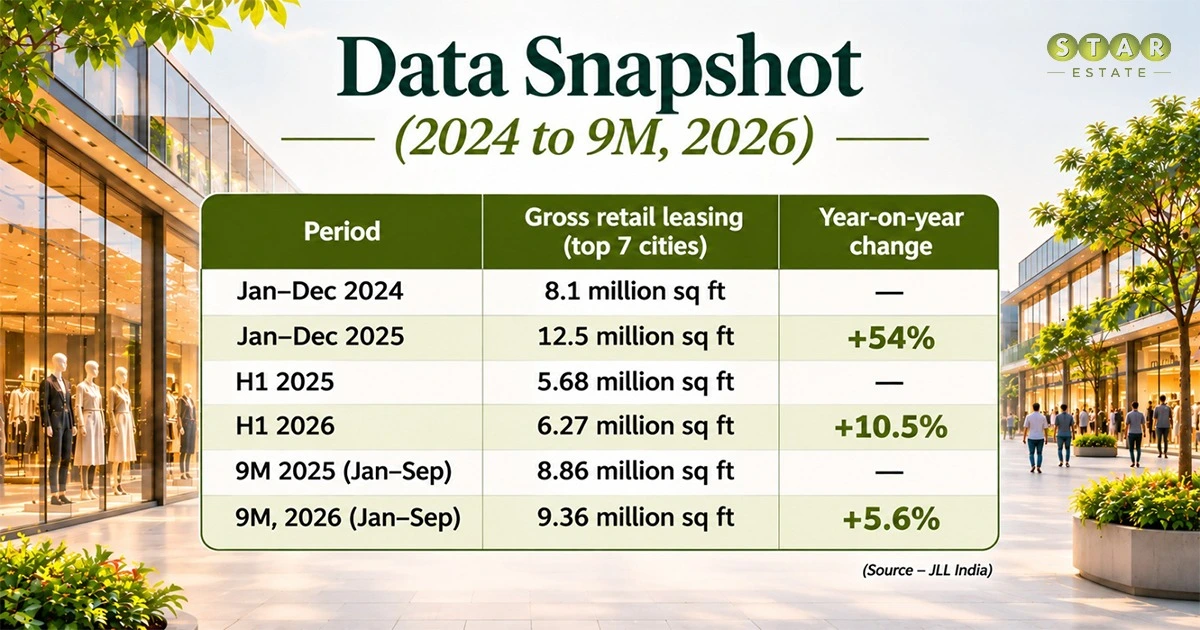
Put simply, retail leasing in India has moved from 8.1 million sq ft in 2024 to 12.5 million sq ft in 2025, and 2026 is tracking ahead of that pace. Growth is slower than the 2025 jump because last year’s base was already high, but the direction is clearly positive for the Indian retail market.
What Do Experts Say About the Indian Retail Market?
Saket Amrit, Head of Retail Services at JLL India, has described the sector as being in a resilient growth phase, with leasing at record levels. That matches what the 9M data shows.
Cushman & Wakefield adds the landlord’s side of the story: demand is outpacing quality space, which is pushing some retailers towards select Grade B developments and giving owners the upper hand on rents. CBRE India’s H1 2026 numbers point the same way, with leasing up roughly 20% year-on-year and metro expansion and ring roads expected to speed up retail growth further.
Note: each firm tracks a different set of cities and defines leasing differently, so their volumes will not match. The direction, however, is consistent.
What Does This Mean for Buyers and Retailers?
Before committing, run your numbers with Star Estate’s EMI calculator and read the buyer guide so you know the RERA, carpet area, and documentation checks that matter. You can also get a property valuation and walk through our reality check before buying before you sign.
What Is the Outlook for India’s Retail Leasing Market?
JLL India expects full-year gross retail leasing to surpass the 12.5 million sq ft recorded in 2025, supported by demand from both domestic and international retailers.
Looking further, JLL India’s projection is for about 43.7 million sq ft of additional retail space across the top seven cities by 2030 (its H1 note put mall space under construction at roughly 45.5 million sq ft). Since fresh supply is slow to arrive, tight conditions are likely to continue through the next 12 to 24 months.
Talk to Star Estate before You Lease or Buy Retail Space
Reading a report is easy. Picking the right shop, mall unit, or corridor is the hard part. Star Estate shortlists RERA-verified commercial listings, checks catchments on the ground and walks you through every step, from pricing to paperwork. Don’t wait for the next quarterly report to confirm what the market is already telling you. Fill in our enquiry form today for a free, no-obligation consultation on the best-performing retail and commercial projects.