Retrofitting in India: How It Will Redefine the India Office Market in FY2026-27
Your office building is twelve years old. The tenants love the location, but the lifts are slow, the air-conditioning guzzles power, and the lobby looks dated. Do you sell, wait, or fix it? This question is shaping the India office market, and the wider real estate industry in India, right now. Roughly one in four sq. ft. of office space in eight major cities is old enough to need a serious upgrade. This Star Estate guide explains what retrofitting means, what it's worth, and where the money sits.
AI Powered Summary
Old Offices Are the India Office Market’s Next Big Value Pocket
Scale: Knight Frank India puts retrofit-eligible stock at about 301 million sq. ft., around 28% of office inventory across eight cities.
Value: The same report says upgrading it can lift asset value by 76%, adding roughly ₹3.76 lakh crore.
Where: NCR has the most eligible stock (about 81 million sq. ft.). Mumbai (MMR) shows the sharpest percentage gain at 96%.
Returns: JLL and CBRE estimate rent premiums of 15–35% for upgraded buildings, with payback in roughly 3–5 years.
Why now: Tenants are demanding green, tech-ready space, and ageing buildings that don’t deliver risk losing them.
What Is Office Retrofitting, and Why Does It Matter for the India Office Market?
Office retrofitting means upgrading an existing building’s systems, façade, lifts, safety, and amenities instead of tearing it down. In the India office market, it lets owners lift rents and asset value on ageing buildings at a fraction of the cost and time of new construction.
What Does A Retrofit Actually Include?
It’s rarely cosmetic. A serious upgrade usually covers:
Energy-efficient HVAC, LED lighting, and smart metering
New lifts, lobbies, and common areas
Fire safety, structural, and seismic strengthening
Better air quality, water recycling, and green certification
Digital infrastructure, parking, and EV charging
Why Are Ageing Buildings A Problem Now?
CBRE’s May 2025 report found that about half of the 882 million sq. ft. of office stock in India’s top seven cities is more than ten years old. GRI Institute (January 2026) flags roughly 437 million sq. ft. as drifting toward obsolescence.
Multinational occupiers and global capability centres (GCCs) want ESG-compliant, wellness-ready space. A tired building loses them to a newer one down the road.
India Office Market 2026: What the Latest Retrofit Numbers Say
How Big Is The Opportunity, As per Knight Frank India?
Knight Frank India’s Age to Advantage report covers about 1,076 million sq. ft. of office stock, of which 56% is Grade A. It flags around 301 million sq. ft. as eligible for retrofitting.
Eligible stock is worth about ₹4.96 lakh crore today. After upgrades, that rises to roughly ₹8.72 lakh crore, an extra ₹3.76 lakh crore.
Which cities Lead The India Office market Upgrade Wave?
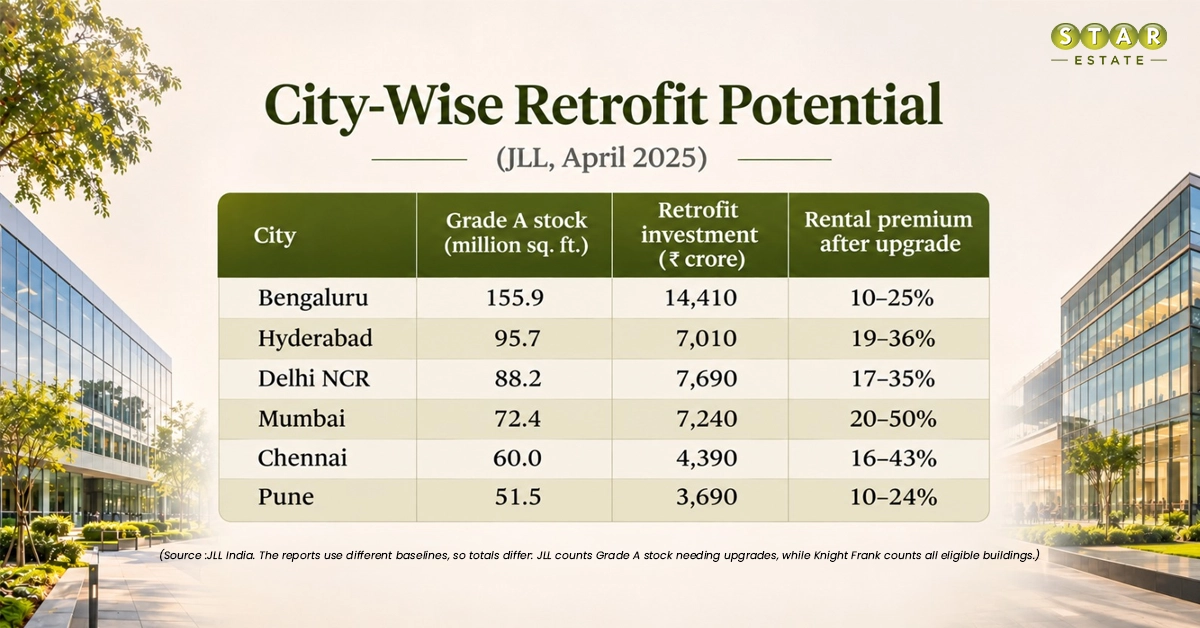
NCR: About 81 million sq. ft. eligible (39% of its stock); value up 82%, from ₹1.31 to ₹2.38 lakh crore.
MMR (Mumbai): About 68 million sq. ft. eligible; value up 96%, from ₹1.86 to ₹3.63 lakh crore.
Ahmedabad: Over 60% of office stock counts as ageing and eligible.
Bengaluru: About 12% of inventory is eligible.
Retrofit-eligible Office Stock in NCR valued at 1.31 lakh Crore: Why Does It Matter?
Knight Frank India's report values retrofit-eligible office stock in NCR at ₹1.31 lakh crore. This covers about 81 million sq. ft., the largest eligible pool of the eight cities studied. Real estate news has been quoting the figure widely.
After upgrades, the same stock could be worth ₹2.38 lakh crore. For anyone following realty news, that’s the clearest sign of where the value gap sits in the real estate industry today.
How Did Last Five Years Look in Gurugram?
CBRE data reported by Business Today (July 2026) shows Gurugram holds over 100 million sq. ft. of completed office stock. About 59 million sq. ft. is green-certified.
Between 2021 and Q1 2026, nearly 40 million sq. ft. was leased, against only about 21 million sq. ft. of new supply. Demand is outrunning fresh space, which is exactly why older buildings are getting a second look.
What does this mean for you? In the Indian office market, Mumbai and Chennai show the widest rent premiums, while Bengaluru needs the biggest cheque. Large space isn’t always spacious. The premium tells you how much a tenant will pay for a better building.
Why Is Retrofitting a Smart Bet for NRI Investors in FY2026-27?
What returns can you realistically expect?
CBRE estimates retrofits cost ₹30,000–40,000 crore nationally and can unlock ₹1.2–1.6 lakh crore in capital value. It puts rental growth at 15–35% and payback at roughly 3–5 years for well-executed projects.
These are market-level estimates, not guarantees. Your building’s location, tenant mix, and scope of work decide the real number.
Why act now?
Rent gap: Upgraded buildings earn 15–30% more than non-retrofitted ones, according to JLL. Some submarkets, like Mumbai’s BKC and Western Suburbs, reach 40–50%.
Tenant pull: Gurugram already has about 59 million sq. ft. of green-certified space. Older buildings compete against it every day.
Cheaper entry: Ageing commercial properties in good locations often price below new Grade A. The upgrade is where the value gets made.
Faster than building new: A retrofit usually takes months, not the years a ground-up project needs.
Prime locations: Old buildings sit in CBDs and established business districts where new land is scarce or expensive.
What should NRIs Check First?
Under FEMA, NRIs can generally buy commercial property in India, but rules on rent and sale-proceed repatriation apply. Speak to a chartered accountant before you commit.
Also ask for the structural audit, fire NOC, title history, and tenant lease terms. A cheap building with a weak lease isn’t a bargain. Star Estate’s NRI guidelines and NRI investment resources are a good place to start on documentation and process.
India Office Market Micro-Markets to Watch: Gurugram, Mumbai, Bengaluru, and Chennai
Where is the retrofit potential concentrated?
CBRE names specific corridors. In Gurugram, it’s DLF Cybercity, Golf Course Road, Extended Golf Course Road, and NH8. In Bengaluru, it’s the Outer Ring Road, Whitefield, and the East Business District.
In Chennai, look at OMR Zones 1 and 2 and Mount Poonamallee High Road. CBRE estimates Gurugram alone has 45–50 million sq. ft. of upgrade-candidate space out of 95 million sq. ft.
Knight Frank adds a useful split. Secondary business districts hold ₹2.31 lakh crore of the incremental value (+80%), while central business districts hold ₹1.45 lakh crore (+70%). Mumbai’s secondary districts lead with about ₹1.42 lakh crore.
What are the experts saying?
Knight Frank India: Chairman and MD Shishir Baijal says retrofitting could drive the next phase of office growth, as occupiers want efficient, sustainable, tech-enabled workplaces.
JLL India: Aditya Desai calls upgrading older buildings “a strategic imperative”, not just modernization.
CBRE: Chairman and CEO Anshuman Magazine says retrofits are a vital way to meet strong demand for modern, high-performance workspaces.
What does the next 12–24 months look like?
Expect retrofit announcements to appear more often in real estate industry news through FY2026-27, led by NCR and Mumbai, where the value gap is widest. In realty, green certification will increasingly decide which buildings keep their tenants.
Buildings that don’t upgrade will likely see rents stall, while upgraded neighbours pull ahead. The gap between the two is what Knight Frank’s 76% figure is really measuring.
India Office Market in FY2026-27: Retrofit an Old Building or Buy New Grade A?
Both routes can work, and the right one depends on your goals. Here’s the case for each.
The case for retrofitting
Lower entry price and a prime, established location
Rent and value gains of 15–35% are possible once the upgrade is done
Payback of about 3–5 years, per CBRE
Works well if you have capital, patience, and a good project manager
The case for new Grade A
Ready, certified space with fewer surprises on structure and compliance
No construction or tenant-disruption risk
Easier to lease to MNCs and GCCs on day one
Often a higher entry price, and thinner choice in core locations
Neither is automatically better. A well-chosen retrofit can outperform, and a poorly chosen one can drain cash. Match the route to your budget, timeline and appetite for execution risk.
Choosing between a retrofit and new Grade A is easier with the right advice. Star Estate is a real estate consultancy company in India that helps investors and end users evaluate residential and commercial properties, including new launches. Tell us your city and budget, and an advisor will shortlist office options for you. Fill in the enquiry form on starestate.com for a free, no-obligation consultation.