SEBI Opens Real Estate Investment Trusts to Global Investors: Here is Everything You Need to Know About It
SEBI has cleared a framework for SEBI depository receipts for REITs and InvITs, announced on 2nd November 2026. It gives global investors a direct, regulated way into Indian offices, malls, and infrastructure assets. Now, the question is: why should a domestic property buyer or an NRI investor care? The reason to care is that money flowing into REITs shapes rents, valuations, and how quickly new Grade A buildings come online. At Star Estate, we’ve broken down the decision in simple terms so you can see what it means for your investments.
AI Powered Summary
SEBI opens Indian REITs and InvITs to Global Investors through Depository Receipts (DR)
SEBI has cleared a framework letting REITs and InvITs issue foreign-currency receipts backed by their units, listed on GIFT City exchanges.
Depository receipts work in three steps: a custodian in India holds the units, a foreign depositary issues the receipts, and overseas investors trade them.
It covers the key rules: a 75% unitholder vote, a pricing floor, and 24-hour disclosures.
It shows why the timing matters, with market size, payouts, and the forecast for foreign inflows by 2030.
Resident Indians can’t hold the receipts, but they still gain indirectly through deeper demand, fresh capital for acquisitions, and protection from cheap dilution.
What are Depositary Receipts (DR) and how do they work for REITs?
A depository receipt (DR) is a certificate that represents real units but trades somewhere else. Think of it as a passport for a security. The units stay in India. The receipt travels abroad.
SEBI depositary receipts for REITs and InvITs let overseas investors buy foreign-currency receipts backed by Indian REIT or InvIT units, listed on GIFT City exchanges. They widen the buyer base, improve liquidity, and give Indian assets a global shopfront. Indian residents cannot hold the receipts themselves.
How the flow works
REIT or InvIT units are held with a custodian in India.
A foreign depositary issues DRs against those units.
The DRs are priced in foreign currency and listed on GIFT City exchanges, namely India INX and NSE International Exchange.
Overseas investors trade them. DR holders and their beneficial owners must be Non-Residents of India.
Earlier, the Depository Receipts Scheme, 2014 and the FEMA rules already allowed DRs against REIT and InvIT units. But now the gap in the same has been closed. Now there is an enabling provision in SEBI's own REIT and InvIT regulations. The provision is now proposed in SEBI's August consultation paper.
SEBI depository receipts for REITs and InvITs: What changes in India in 2026
The rules that matter
The framework comes with guardrails, and they're the interesting part:
Unitholder vote: A fresh DR issue needs at least 75% of votes cast in favour. Exceptions apply to an initial domestic offer with a simultaneous DR issue, and to later offerings within an already approved limit.
Pricing floor: Units behind DRs cannot be priced below the corresponding domestic price.
Fast disclosure: Anything disclosed on an international exchange must reach Indian exchanges within 24 hours.
Oversight: A merchant banker monitors compliance and reports to the manager's board.
Understand it in simple terms. The existing unitholders get a vote and a price floor, so they aren't diluted by the lower value.
Why the Timing Works
India's REIT market is no longer small. Six REITs are listed, with gross assets above ₹3.17 lakh crore across more than 214 million sq ft, and a market cap above ₹2.17 lakh crore as of 11 August 2026, per Business Today.
Payouts have doubled too. REITs distributed ₹3,136 crore in Q1 FY27 (April to June 2026), against ₹1,559 crore a year earlier.
Now the gap. An Avendus report sees ₹11.6 lakh crore of fresh capital coming by 2030, yet foreign investors are penciled in for only about ₹30,000 crore of it. DRs are built to change that number.
What are the benefits of depository receipts for medium and long-term investors?
Better liquidity
A secondary market means more buyers. When a REIT's units can be bought in Mumbai and through DRs in GIFT City, trading gets deeper. Deeper trading usually means tighter pricing and easier exits, which long-term holders value more than they admit.
Global visibility
Many global funds can't simply open a rupee account. A DR listed on an international exchange lands on their radar and inside their existing processes. For a REIT, that means being compared with Singapore and Hong Kong trusts, not just domestic ones. India's REIT market already rivals Hong Kong's in scale.
Stronger REIT platform
More demand lets REITs raise money to buy more assets. Larger portfolios tend to mean steadier distributions, since one vacant tower hurts less. It also makes the REIT route more credible for developers and sponsors deciding whether to list their rent-yielding assets.
Currency Convenience
Foreign investors can transact in their own currency. That removes the paperwork of rupee conversion at entry. It doesn't remove rupee risk, though. The underlying rents are still earned in rupees, so the currency view still matters.
How SEBI depository receipts for REITs and InvITs help investors in India, 2026
Indian investors
As a regular resident, you can't buy these DRs. You'll keep buying REIT units on NSE or BSE as before. But you still gain indirectly:
More demand for the same pool of units can support price stability.
Fresh capital can fund acquisitions that lift future distributions.
The 75% vote and pricing floor protect your stake from cheap dilution.
A hotter REIT market tends to bring more listings, so you get more choice.
Foreign Investors, including NRIs
For global funds, this is a regulated, listed, foreign-currency route into Indian commercial real estate. No direct property purchase, no local entity.
NRIs are non-residents, so the DR route should be relevant to you. Confirm eligibility, taxes, and repatriation with your advisor before acting. Note that NRIs can generally buy REIT units in India already, so the DR is another option, not the only one.
REITs, Direct Commercial Property or DRs: which suits you?
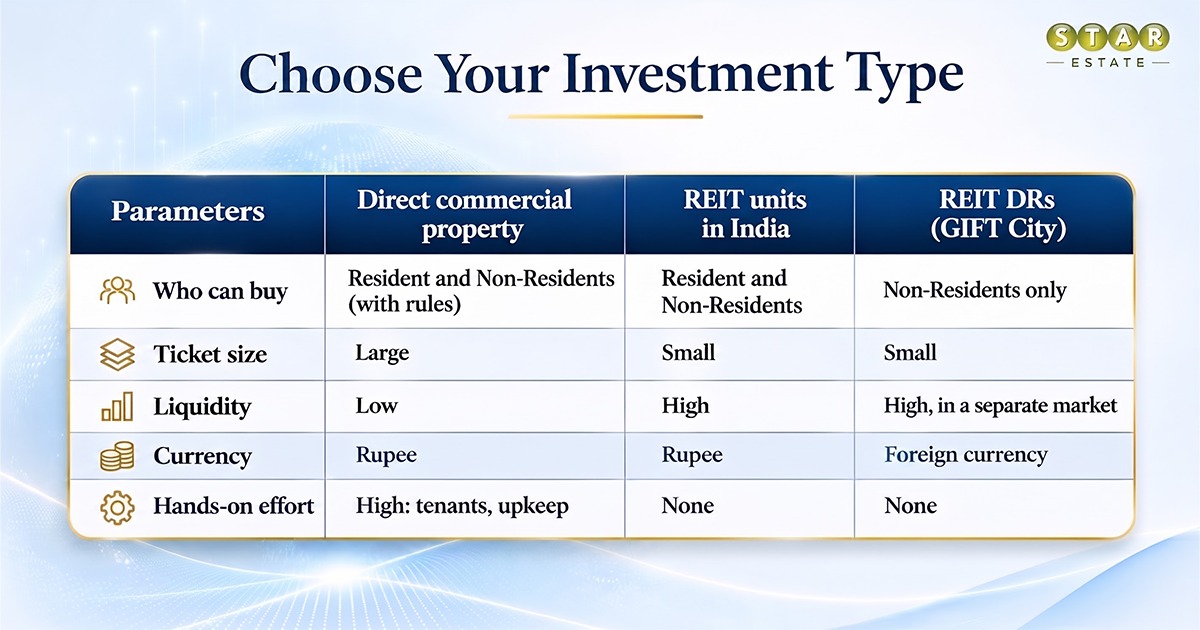
This table compares three ways of investing in commercial real estate: buying a property directly, buying REIT units in India, or buying REIT depository receipts (DRs) in GIFT City. Direct commercial property is open to both residents and non-residents (subject to rules), but it needs a large ticket size, has low liquidity, is priced in rupees, and demands high hands-on effort in managing tenants and upkeep.
REIT units in India are also open to residents and non-residents, but they need only a small investment, trade with high liquidity, are denominated in rupees, and require no hands-on involvement. REIT DRs in GIFT City are restricted to non-residents, share the small ticket size and zero management effort of regular REITs, and offer high liquidity, but only within a separate market and in foreign currency.
In short, direct property suits investors who want full control and can commit large capital, while REIT units and REIT DRs suit those who prefer a passive, easily tradable investment, with the choice between the two mainly depending on residency status and preferred currency.
Not sure which route fits your goals? Star Estate's advisors can walk you through the yield, appreciation, and effort trade-offs of each, so talk to the team at www.starestate.com before you commit.
Conclusion: A bigger Opportunity awaits, but a win is not guaranteed
The new framework gives Indian REITs and InvITs a global audience, and gives global investors a clean way in. For long-term holders, that can mean deeper liquidity and stronger platforms.
It doesn't remove market, or rental or currency risk, and no REIT has announced a DR issue in the reports we checked. Watch for the first one. Meanwhile, compare REITs with direct property honestly, with numbers.
This article is for information only and isn't investment advice.