Site Visit Checklist for Property Buyers in India: Know What Actually Matters in 2026
Price discussed over the call. Brochure read. Walkthrough video watched. So why give up a Saturday to see the property in person? Because a proper site visit checklist is the cheapest insurance you’ll ever buy. With so many projects and so many pitches, one missed crack or missing certificate can cost you more than the visit ever will. This Star Estate guide covers what to check during a site visit, the things to inspect before buying a property, and the site visit questions to ask so that you can buy with confidence in India in 2026.
AI Powered Summary
Here's All You Need to Know About Property Site Visit Checklist in India in 2026
Why visit in person: Photos and videos gives an overview. Only a site visit shows natural light, ventilation, noise, waterlogging, and the real build quality.
What to check on site: Verify RERA registration and the sanctioned plan. Inspect the approach road, neighbourhood at night, common areas, and actual layout of the property.
Know your property type: Under-construction homes, resale flats, and plots each need their own checks, from RERA timelines and the occupancy certificate to title and land-use approvals.
Documents, questions and red flags: Carry appropriate documents, ask about pricing, possession and disputes, and walk away if pushed to pay a token amount before documents are verified.
Compare and decide: Use the scorecard to rate each shortlisted property on facts, not brochure impressions. A calm, thorough visit gives you leverage to negotiate and the confidence to walk away.
Why Does a Property Site Visit Still Matter in 2026?
Photos and videos are engaging. But they won’t show poor natural light, weak ventilation, traffic noise, waterlogging, or the gap between the brochure and reality. A good site visit checklist for property buyers covers exactly these gaps on the ground.
What a visit helps to verify is -
A sanctioned plan, brochure, sample flat, and real-time progress
Construction quality, approvals, and amenities that are really being delivered
Light, noise, water supply, and connectivity
Buyer’s Takeaway - If you are investing in an under-construction property, then go back every three to four months to track the progress. One of the most useful property site visit tips: take dated photos and videos on every visit, so you have a record to compare against.
What to Check During a Property Site Visit in India in 2026?
Not sure what to check during a site visit when buying property in India? Start with these four things to inspect before buying a property. The more questions you ask before the deal is done, the more peace of mind you’ll have as an owner. Our Reality Check before buying guide covers the wider due-diligence picture.
Firstly, verify the RERA registration details for the developer, project, and seller.
Secondly, check with the municipal authority about the sanctioned plan.
Thirdly, compare the actual construction with the brochure; inspect walls, plumbing, light, and ventilation
Fourthly, test the approach road at peak hours and after dark, and ask for the occupancy certificate. Have a lawyer to independently verify every document.
Site Visit Checklist for Property Buyers in India
Documents to Carry
For a new launch: Brochure, floor plan, cost sheet, payment plan, and carpet-area breakdown (browse current new launch projects for reference),RERA number, sanctioned plan, and commencement certificate
For resale or ready homes: Occupancy certificate (OC), completion certificate, sale deed, encumbrance certificate, tax receipts, society records, utility bills
For All Property Buyers – A list of questions
Research to Finish Beforehand
Check the project on your state’s official RERA portal (such as MahaRERA, K-RERA, or the TNRERA portal): promoter, approved plans, possession date, and complaints.
Ask about waterlogging history and verify any “upcoming metro” claims.
Request documents in advance. Don’t rely on verbal assurances.
NRIs: if you can’t fly in, appoint a trusted local representative or property lawyer and join the visit on a video call. Our NRI guidelines explain the paperwork.
What Should I Check on Location and Approach Roads?
Visit the exact site, not just the nearest landmark. Prices swing widely by city. Knight Frank’s H1 2026 data shows 12-month price growth of 3% in Ahmedabad, 5% in Mumbai, Pune, Chennai and Kolkata, 7% in Hyderabad and 9% in Bengaluru. In NCR, it ranges from 6% in Gurugram to 18% in Faridabad and Delhi (Knight Frank India H1 2026) reports. Even within one city, a few kilometres can change the rate, the commute, and the flooding risk, whether you’re looking at OMR in Chennai, Whitefield in Bengaluru, Hinjewadi in Pune, or Gachibowli in Hyderabad, or any other city in the country.
Commute and Connectivity
Drive to the project site during peak hours and test the trip to your office, school, airport, railway station, metro, and hospital.
Check approach-road width, street lighting, drainage, and last-mile access.
Confirm any “proposed infrastructure” claims with official announcements.
Neighbourhood after Sunset
Visit by day and again at night to judge safety, noise, lighting, and activity
Note grocery stores, pharmacies, police patrols, and bus stops within walking distance
Ask residents and shopkeepers about water supply, power cuts, and sewage.
Property Site Visit Checklist in India in 2026 - Every Buyer Must Consider
Common Areas and Construction Quality
Compare the real layout with the sanctioned plan: tower positions, open spaces, internal roads,
Check cracks, dampness, seepage, uneven flooring and poor plastering
Inspect bathrooms, balconies, terrace edges, and window joints for leaks
Check lifts, fire exits, extinguishers, sprinklers and fire NOC status
Look at CCTV, gate access control, guards and the boundary wall
Confirm parking (covered or open, visitor, EV charging) is written into your agreement
Property Layout: Things to Inspect Before You Buy
Check natural light in every room at the actual time of day, not just in the sample flat.
Open windows to test cross-ventilation, especially in kitchens and bathrooms
Measure rooms and compare with the RERA carpet area, built-up and super built-up area
Run taps and showers for water pressure and drainage speed.
Test switches, MCB box, fans, geysers, locks, and balcony railings
Ask what power backup covers: common areas only, or the complete property which includes ACs
In Under-construction projects
Confirm your tower, floor, and unit are in the approved plan and RERA registration.
Compare progress with the RERA timeline and payment milestones.
Ask about delay penalties, refund terms, and escalation clauses.
Visit an earlier completed project by the same builder and speak to residents.
Photograph everything with dates and keep the record.
In Resale and Ready-to-Move Homes
Verify the OC and completion certificate, the chain of title, the encumbrance status, and any loan-closure or society NOC
Visit in the daytime and evening, and listen for noise from roads, markets, or construction
Ask neighbours and society staff about maintenance charges, water shortages, and parking disputes
In Case of Plots
Walk the boundary and confirm plot number, dimensions, and demarcation stones
Match location and road width with the sanctioned layout
Verify land-use classification and conversion approval if the land was agricultural
Check approach road, storm-water drains, electricity poles, and water lines
Get the layout approval number, encumbrance certificate, and survey number before paying any booking amount
Which Documents Should You Verify During a Property Site Visit?
Legal checks
RERA number, promoter name, approved plans, and declared possession date
Title deed, mother deed, chain of ownership, encumbrance certificate, and patta/EC records
Approved building plan, commencement certificate, completion certificate and OC
Property-tax receipts, utility bills, society dues and any litigation or mortgage details
A sales team’s assurance isn’t proof. Get every document independently verified by a property lawyer and the relevant authority. Our Buyer Guide walks through details.
Site Visit Questions to Ask the Builder or Seller in India in 2026
Is my exact unit in the RERA registration and sanctioned plan?
What’s in the base price, and what are the one-time and recurring charges?
What’s the possession date, and what compensation applies if it slips?
What does maintenance cover, and who manages the society after handover?
Any pending disputes, encumbrances, or approvals awaited?
For resale: why is the seller selling?
Property Site Visit Tips in India in 2026 : Red Flags to Spot Before Finalizing a Deal
Pressure to pay a token amount before documents are verified
Brochure, sample flat, sanctioned plan, and real construction don’t match.
No OC for a ready home, or a vague possession date for an under-construction one
Waterlogging, poor drainage, weak mobile network, or inadequate power backup
Amenities promised that aren’t in the approved plan or RERA disclosures
Reluctance to share original documents, the RERA number, or past project references
Site Visit Checklist for Property Buyers in India 2026: Reusable Scorecard
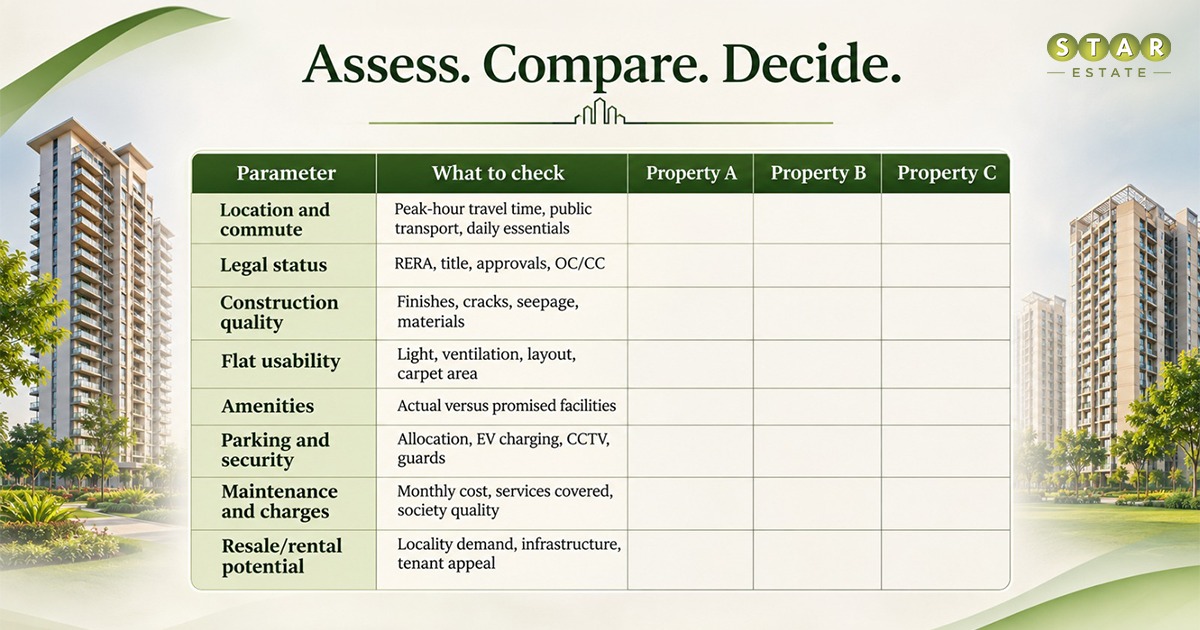
The table helps you assess, compare, and decide between Property A, B, and C by scoring each one on the same eight parameters.
Location and commute: Check peak-hour travel time, public transport access, and how close daily essentials are.
Legal status: Verify RERA registration, clear title, government approvals, and the Occupancy Certificate (OC) and Completion Certificate (CC).
Construction quality: Inspect the finishes, look for cracks or seepage, and check the quality of materials used.
Flat usability: Look at natural light, ventilation, the layout, and the actual carpet area you get.
Amenities: Compare the facilities actually available against what was promised by the builder.
Parking and security: Confirm parking allocation, EV charging availability, CCTV coverage, and security guards.
Maintenance and charges: Understand the monthly cost, what services it covers, and the quality of the housing society.
Resale and rental potential: Consider demand in the locality, nearby infrastructure, and how appealing the property is to tenants.
How to use it: Fill in the blank Property A, B, and C columns with your findings for each parameter, then compare to choose the best option.
What Does the Next 12 to 24 Months Look Like for Indian Property Buyers?
Across the top eight cities, sales rose just 1% in H1 2026, launches rose 4%, and unsold inventory grew 4% to 525,695 units, Knight Frank India H1 2026 report shows. Markets differ: Chennai and Kolkata need only 4.4 quarters to sell their stock, while NCR needs 7.9 and Ahmedabad 8.1. Where stock moves fast, sales teams may push you to book quickly. Where it piles up, expect sharper pitches. Either way, a calm, thorough site visit is your leverage. To check whether the asking price is fair, get an independent property valuation report.
Ready for Property Site Visit With Confidence?
Star Estate’s advisors can help you shortlist RERA-registered residential and commercial projects across India, and walk the site with you using this property site visit checklist. Fill in the enquiry form on www.starestate.com today for a free, no-obligation property due-diligence consultation, or ask for our free 2026 Property Site Visit Checklist.