Capital Gains Tax - Everything Property Sellers in India Must Know in 2026
The joy of reaping profits on a property sale vanishes as soon as you hear the word TAX! However, capital gains tax on property in India isn’t a black hole; rather a subject knowledge of the same kills apprehensions. Once you know what short-term vs long-term capital gains is, and the formula to calculate the same, discomfort lessens. Star Estate in this guide walks investors, resale sellers, and first-time flippers through exactly how capital gains tax on property works in India in 2026. Understand the difference, calculation and what changed after the new Income Tax Act, 2025 to simplify profit assessment on sale of property.
AI Powered Summary
Things Property Sellers in India Must Know About Capital Gains Tax in 2026
24-month tenure differentiates short-term and Long-term Capital Gains.
Income Tax Act, 2025, replaced the decades-old Income Tax Act, 1961.
Section 54 and Section 54EC both offer exemption by reinvesting Long-Term Capital Gains.
The Grandfather Clause protects property sellers from unfair monetary loss during a specific tenure.
Indexation and Non-Indexation are ways to calculate and tax capital gains in India.
What Is Capital Gains Tax on Property in India?
A sale of residential property for more than what you paid to purchase it- that extra value alias profit, is your capital gain. In India, it is taxable income under the Income Tax Act. It doesn’t matter whether you’re a salaried professional who sold an inherited flat or a full-time property investor; capital gains tax applies if there’s a profit on the sale.
The tax isn’t charged on the sale price directly. It’s charged on the profit reaped on the sale value. The sale price minus what you originally paid, minus eligible costs like brokerage, stamp duty, and the cost of any improvements you made. Get that base number right, because everything else, including tax exemptions you can claim, depends upon it.
Important Things to Know About Capital Gains Tax on Property in India in 2026
The Union Government of India amended the act. The Income Tax Act, 2025 replaced the six-decade-old Income Tax Act of 1961, effective from 1st April 2026. If you’re selling property in FY 2026-27, then this Act applies to you as well.
A major relief for property sellers in India is that the fundamental rules on property gains haven’t been rewritten from scratch. Rather, they have just been renumbered and polished:
The charging provision for capital gains now falls under Section 67 of the new Act (previously Section 45).
Exemption provisions, the ones that let you skip taxation by reinvesting, are now under Sections 82 to 88 (previously Sections 54, 54B, 54EC, 54F).
Holding-period thresholds and tax rates for property remain unchanged from the amendments introduced in 2024.
Seller’s Takeaway – The same math aligns with the new sections. Your CA’s calculations from last year remain valuable. However, verify that they’re quoting the right clause when explaining your exemption.
What are Types of Capital Gains Tax on Property in India Sellers Must Know in 2026
In India, the sale of property falls under two sections. Interestingly, the only difference between the two is 24 months.
Short-term capital gains (STCG): If you sell the property within 24 months of buying it, the profit is short-term. It gets added to your total income for the year and taxed at your regular income tax slab rate. However, it can be taxed at up to 30%, plus surcharge and cess.
Long-term capital gains (LTCG): Hold the property for more than 24 months, and the gain qualifies as long-term. This tenure holds the highest tax-saving option. LTCG on property is taxed at a flat, usually much lower, rate than your slab rate.
Therefore, patient sellers almost always emerge as winners. A property flipped in 18 months for a quick profit can lose a third of that gain to tax. The same gain, booked after 25 months calculated for easy taxation.
Impact of Union Budget on LTCG on Property in India in FY 2026-27
The rules currently in force trace back to the Union Budget of July 2024, and they’ve carried forward unchanged into the Income-tax Act, 2025 framework for FY 2026-27.
The holding period for property to qualify as long-term was cut from 36 months to 24 months, letting sellers access the LTCG rate sooner.
The LTCG rate was set at a flat 12.5% without indexation — down from the earlier 20% with an indexation regime.
A grandfathering clause protects existing owners: if you bought your property before 23rd July 2024, you can choose between 12.5% without indexation and 20% with indexation, and pay whichever is lower.
What is a grandfather clause in the Income Tax Act?
A grandfather clause in the Income Tax Act is a transitional provision that shields gains or assets acquired before a specified date from the impact of a new tax rule. It ensures that taxpayers who invested under the old law are not unfairly penalised when the law changes, and that the new rule applies only prospectively.
The grandfather clause matters greatly if you bought a property years ago in a city where prices have risen sharply, like Yamuna Expressway and Gurugram. Indexation adjusts your original purchase price for inflation using the Cost Inflation Index, which can shrink your taxable gain considerably on an older purchase.
Short-Term vs Long-Term Capital Gains on Property: The Key Differences
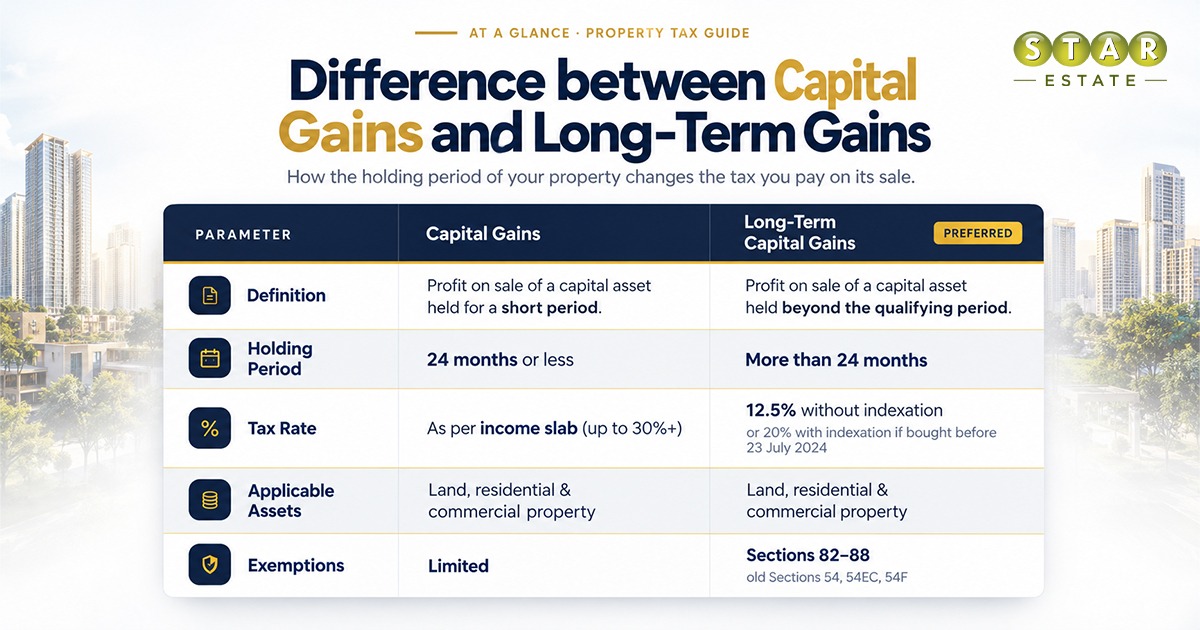
The dividing line between short-term capital gains vs long-term capital gains in India is the holding period.
If you sell within 24 months of buying, the profit counts as (short-term) capital gains and gets taxed at your regular income slab rate, which can run as high as 30% or more. Hold the property for longer than 24 months, though, and the gain shifts to long-term status — marked "Preferred" on the chart — where it's taxed at a flat 12.5% without indexation, or 20% with indexation if you bought before 23rd July 2024.
Both categories apply to the same range of assets (land, residential, and commercial property), but they differ sharply on exemptions.
The short-term gains have very limited relief options. Long-term gains can tap into Sections 82–88 (the old Sections 54, 54EC, and 54F), giving sellers much more room to reduce their tax bill through reinvestment.
Property Seller’s Takeaway - The overall takeaway the graphic drives home is that patience pays waiting past the 24-month mark unlocks a lower flat tax rate and far more ways to save.
How to Calculate Short-Term Capital Gains Tax on Property in 2026
Here is the formula to calculate short-term capital gains (STCG) on property in India in 2026
STCG = Full Sale Consideration − (Cost of Acquisition + Cost of Improvement + Expenses on Transfer)
The resulting gain is added to your total taxable income and taxed at your slab rate. No special short-term rate exists for property, unlike for listed shares.
Example: Suppose you bought a flat in Gurugram for ₹80 lakh in January 2025 and sold it in June 2026 for ₹95 lakh, spending ₹1 lakh on brokerage. Your gain is ₹95L − ₹80L − ₹1L = ₹14 lakh. Since you held it for just 17 months, this entire ₹14 lakh gets added to your annual income and taxed at your applicable slab rate.
How to Calculate Long-Term Capital Gains Tax on Property in 2026
Formula to calculate long-term capital gains (LTCG) on property in India in 2026 | (without indexation, the default under the new Act)
LTCG = Full Sale Consideration − (Cost of Acquisition + Cost of Improvement + Expenses on Transfer); Tax = 12.5% of LTCG
Formula (With Indexation, Grandfathered option for Pre-23rd July 2024 Purchases)-
Indexed Cost of Acquisition = Original Cost × (CII of year of sale ÷ CII of year of purchase); LTCG = Sale Consideration − Indexed Cost − Expenses on Transfer; Tax = 20% of LTCG
Example: Say you bought a plot in Noida for ₹40 lakh in 2015 and sold it in 2026 for ₹1.1 crore. Without indexation, your gain is ₹70 lakh, taxed at 12.5% = ₹8.75 lakh. With indexation (assuming a rough CII adjustment pushes your indexed cost to ₹68 lakh), your gain drops to ₹42 lakh, taxed at 20% = ₹8.4 lakh. Here, indexation wins, which is exactly why the grandfathered choice matters for older purchases.
If you plan to reinvest your gain into a new purchase, Star Estate’s EMI calculator can help you work out the loan and cash-flow side of the deal alongside the tax numbers above.
What are the Exemptions on Capital Gains Tax on Property in India in 2026
Under Sections 82 to 88 of the Income-tax Act, 2025 (the renumbered equivalents of the old Sections 54, 54B, 54EC, and 54F):
Reinvestment in residential property — full exemption if the entire LTCG is reinvested in one new house within the prescribed window.
Investment in capital gains bonds — exemption on amounts invested in NHAI/REC bonds, subject to the ₹50 lakh cap.
Reinvestment in agricultural land — available for sellers who redirect gains into farmland, under specified conditions.
Capital Gains Account Scheme (CGAS) — if you can’t reinvest immediately, park the gain in a CGAS (Capital Gains Account Scheme) account before your ITR filing deadline to keep the exemption alive while you find the right property.
Looking Ahead: What Property Sellers in India Should Expect Over the Next 12–24 Months
With the Income-tax Act, 2025 now effective and rates stable since the 2024 amendments, sellers over the next couple of years are unlikely to see another sweeping rate change. However, the sections and reporting formats will continue to be scrutinized as tax authorities refine data integration across property registries and bank records.
Practically, that means fewer opportunities to under-report, and a stronger reason to plan your exemptions properly rather than hope a gain goes unnoticed. Combine that with continued price momentum in markets like Noida, Gurugram, and Mumbai’s peripheral corridors, and the sellers who benefit most will be the ones who plan the sale and the tax simultaneously.
Conclusion: Carefully Plan Sale of Property to Exempt Capital Gains Tax in India
The capital gains tax on property in India is important to assess before signing the sale deed. Knowing property sale tax exemptions before proceeding with a real estate transaction works in the seller’s favour. However, once the deal is official, there isn’t a way to roll back. Knowing whether your gain is short-term or long-term, understanding the 12.5% vs. 20% choice, and lining up your Section 82–88 exemptions in advance can be the difference between a good sale and a genuinely great one.
For personalised guidance on structuring your sale, browsing the Star Estate buyer guide or reaching out to a Star Estate advisor can help you time the sale and line up the right exemptions.