What is Encumbrance Certificate: Importance, Types and How it Protect Homebuyers in 2026
AI Powered Summary
Things Homebuyers in India Must Know About Encumbrance Certificate in 2026
An Encumbrance Certificate reveals any legal disputes over the immovable asset in the last 30 years.
Visit the SRO (Sub-Registrar Office) to apply for an Encumbrance Certificate
Application submission for an Encumbrance Certificate is available online and offline, depending upon the state
An Encumbrance Certificate from 13 to 30 Years is effective to consider the property
Banks consider an Encumbrance Certificate an important document to hold property as collateral for a home loan
What Is an Encumbrance Certificate?
An Encumbrance Certificate (EC) is a document issued by a sub-registrar's office. It confirms whether the property carries any registered mortgage, loan, or lien. Also, it lists whether there is any legal dispute over the property for a specific tenure, like 30 years. Homebuyers must check this document before initiating payment for property purchase in 2026.
Why is an Encumbrance Certificate important for Indian Homebuyers in 2026?
For home loan applicants, the EC is non-negotiable. Banks and other financial lenders ask for an EC for the property before sanctioning a home loan. The document is important to clarify that the immovable asset isn’t involved in any other financial or legal obligation. Also, the document’s trustworthiness remains unquestioned as it is issued by a Government office.
For buyers, an EC on a property is important, as it uncovers the hidden truth. A property that looks perfect on paper can still carry an old mortgage, a pending court case, or an unresolved family dispute.
What Does an Encumbrance Certificate Actually Cover in 2026?
Every registered transaction on the property for the period the lender specifies. Particularly, 13 to 30 years.
Loan details, leases, mortgages, or other legal obligations pulled directly from sub-registrar records.
A risk snapshot that the bank uses to decide whether the property is safe to hold as collateral.
However, an EC for a property will not tell the homebuyer in 2026 about pending municipal tax dues, occupancy certificate status, or disputes that were never formally registered. There are separate documents to obtain these details.
Types of Encumbrance Certificate in India
Every EC issued by a sub-registrar's office (SRO) falls into one of two forms, and knowing which one you're holding tells you everything about a property's transaction history.
Form 15 (Encumbrance Certificate) – It is issued when the SRO finds registered transactions against the property for the requested period. Such as a sale, mortgage, lease, gift, inheritance, relinquishment, or partition.
Form 16 (Nil Encumbrance Certificate) – It is issued when the search turns up no transactions recorded against the property for the requested time period.
Usually, buyers expect a Form 16 type of EC when buying a property.
Encumbrance Certificate vs Non-Encumbrance Certificate - What's the Difference?
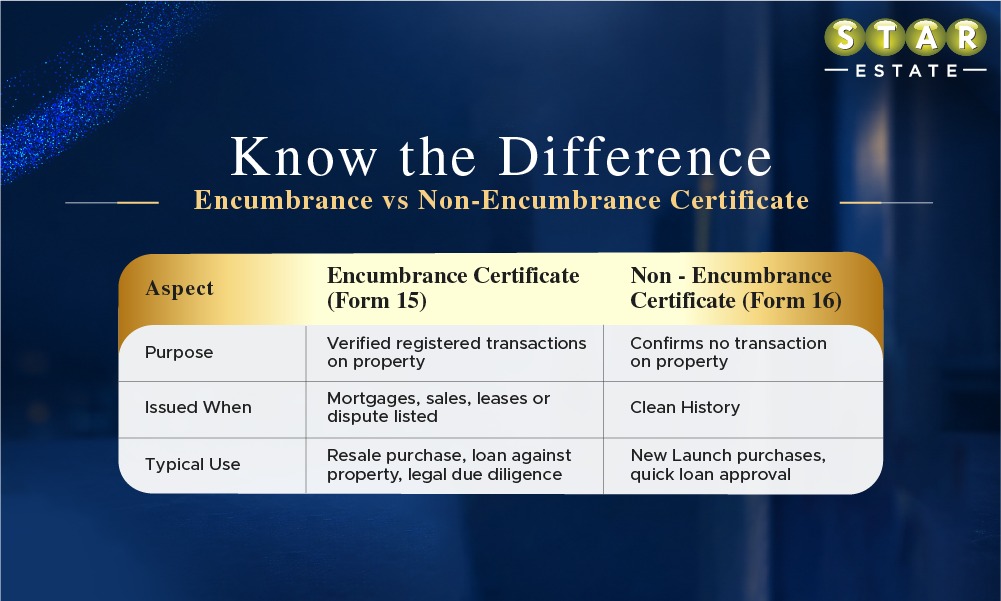
The two are often confused, but the distinction is straightforward: one confirms activity, the other confirms the absence of it. Once you know what an encumbrance certificate is, the next question homebuyers usually ask is: how is it different from a non-encumbrance certificate? Both are issued from the same sub-registrar records, but they tell very different stories about a property.
An Encumbrance Certificate (Form 15) is issued when the property has registered transactions against it — a mortgage, a sale, a lease, or a pending legal dispute. It's the document you'd typically pull up during a resale purchase, when applying for a loan against the property, or as part of standard legal due diligence, since it verifies exactly what's been registered on the property over the years.
A Non-Encumbrance Certificate (Form 16), on the other hand, confirms that there's no transaction recorded against the property at all — essentially a clean-history document. This is the certificate you'll usually encounter with new-launch purchases, where the land hasn't changed hands or been mortgaged before, and it tends to speed up loan approvals since there's nothing for the lender to untangle.
Steps to Check Encumbrance Certificate Online in India in 2026
Only a few Indian States have fully operational online EC portals. It includes Andhra Pradesh, Maharashtra, Tamil Nadu, Telangana, Karnataka, and Delhi. Elsewhere, a homebuyer is required to personally visit the sub-registrar's office.
Karnataka's Kaveri 2.0 has restored digital access after the earlier system was rolled back. The process to check the Encumbrance Certificate Online in India in 2026 is as follows –
● Visit your state's official property registration portal (for example, TNREGINET in Tamil Nadu or IGR Maharashtra's e-Search).
● Register or log in with your credentials.
● Fill out Form 22 with buyer, seller, and property details, plus the period you want searched.
● Upload the required documents — property papers and identification.
● Pay the applicable processing fee online.
● Wait for the sub-registrar's office to verify records and issue Form 15 or Form 16.
● Download and save the certificate for your records.
(Maharashtra buyers should note that the free IGR e-Search is a preliminary, non-certified snapshot — the legally valid EC still needs a Form 22 application at the SRO.)
Documents Checklist Property Buyers Need to Know When Applying for an Encumbrance Certificate in 2026
If you are planning to buy a residential property in 2026, then keep the following documents ready for submission with the application for an EC for property in Indian States:
Property registration document
Possession or title deed
Sale deed, gift deed, or partition deed if the property has changed hands before
A copy of the respective letter of authority
Valid address proof
A duly filled Form 22 application
Encumbrance Certificate Fees across Indian States in 2026
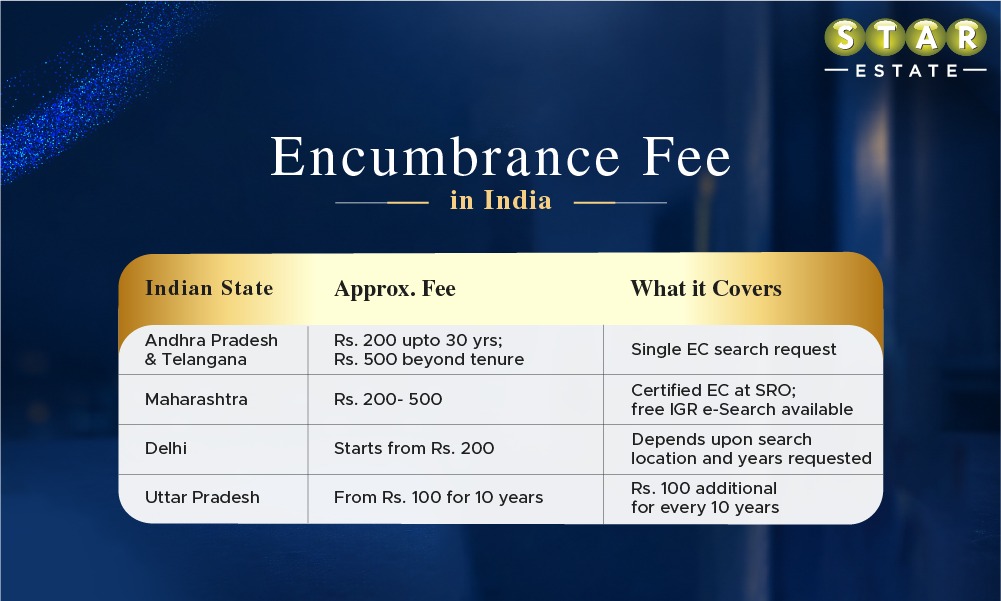
The fees for requesting an Encumbrance Certificate online in India vary from State to state, as it depends upon the number of years requested. In South India, two States apply a charge of Rs. 200 for requesting an EC for 30 years. The same fee becomes a little over twofold in case of an increase in tenure. Similarly, in Maharashtra, the fee for requesting an EC for property starts from Rs. 200, going up to Rs. 500. Also, conditions differ in the State.
Delhi also applies a Rs. 200 fee for requesting an Encumbrance Certificate online; however, it differs according to location and the number of years requested. Uttar Pradesh (UP) charges Rs.100 as a fee for requesting an EC for property up to 10 years. It costs an additional Rs. 100 for every additional 10 years.
How Can I Track My EC Application Status?
You receive an acknowledgement or reference number after your application for EC for property is accepted by the sub-registrar's office. The acceptance can be done either online or offline. Use it to track the application status of EC for property on the same portal you applied through.
How Long Does It Take to Receive an Encumbrance Certificate in India?
In States with online applications, it takes roughly 2 to 3 working days to reflect.
In States with offline applications, it usually takes 15 to 30 days to reflect, as a physical inspection often follows submission.
Home Buyers’ Takeaway – In case of a time-bound home loan process, check with your bank if they will accept a provisional online EC for the property, while the verified copy for the same remains in process.
What if I Miss Checking the Encumbrance Certificate in 2026?
Legal disputes: multiple ownership claims can surface after you've already paid.
Inherited financial liabilities: an old, unpaid mortgage can attach itself to your new purchase.
Loan rejection: most banks simply won't sanction a home loan without a clear EC.
Ownership headaches: proving clean title becomes far harder at resale without one.