What is RERA Act in India? How Does RERA Protect Property Buyers in 2026
The property purchase in India has transformed entirely, 360 degrees, since 2016. Before that, real estate transactions sometimes meant the payment of high-value money purely based on trust. Sometimes, builders sold flats on paper. Even delayed possession gave the buyers and investors sleepless nights. But there wasn’t a door to knock on until the Modi-led Union Government took measures to fix this broken system.
In 2016, the Parliament of India passed the Real Estate (Regulation and Development) Act. What is RERA, and how did it change the property business in India? Star Estate in this blog breaks down the Act, rules, and its benefits. It also covers the rights Act gives to the developers and buyers.
What Is RERA? The 2016 Act That Changed Real Estate in India
RERA Act or the Real Estate (Regulation and Development) Act, 2016, is the law that governs activities in Indian real estate. It obligates developers, sellers, and agents to register under the respective State statutory body. The Act explains legal recourse for delays in possession and promises from the builder’s side.
The Act, passed in March 2016 by the Parliament came in to affect under two phases. While the first 59 Sections came into effect from May 2016, the remaining provisions became active from May 2017. The second phase included penalty provisions, which strengthened norms for business operations in the Indian property market.
Salient Features of RERA Act, 2016 | Important Things Property Buyers in India Must Know
The Act, formulated in 2016, regulates residential and commercial real estate in India.
It protects buyers from dealing with stalled projects, indefinite delays, and diversion of buyer money.
Each State and Union Territory has its own RERA Authority. However, the rulebook follows the law passed by the Parliament of India in 2016.
The Act explains penalty provisions to make the builder accountable in case of delayed possession or in case of fraudulent activity with the buyer. The clause brings financial and legal repercussions, which certainly impact the builder’s reputation and business.
RERA Rules for Builders and Agents: Things Every Seller Must Know to Experience Ease of Doing Business in 2026
The Act protects buyers by abiding builder with the compulsion to register itself with the state statutory body. Here is the checklist developers have to follow to ensure they are eligible for the legal sale of an immovable asset in the city.
Registration Requirements
Under Section 3, the builder must register the project with the state RERA before advertising, marketing, booking, or selling any unit.
Compulsory registration for real estate agents who facilitate the sale. An unregistered agent cannot legally broker a RERA project.
Compulsory disclosure of project details on the State RERA portal. It includes layout plans, government approvals, land title status, and the promoter's past project track record.
Only projects larger than 500 sq. m., or with more than eight apartments, fall under mandatory RERA registration.
The Act explains the inclusion of distinguished properties for registration under residential and commercial properties. It includes residential apartments, villas, and plotted developments, and commercial projects. The registration is also important for under-construction and new-launch inventory.
The 70:30 escrow account rule
This provision of the Act protects buyers’ interests to the maximum extent.
Builders must deposit 70% of the money collected from buyers into a separate escrow account. It should only be used for the construction of the particular project and to pay land costs. The diversion of funds for any other purpose shall be considered contempt of law.
The remaining 30% is released to the promoter for other expenses. However, it is possible only after an engineer, architect, and chartered accountant confirm that work has actually progressed. The clause protects buyers’ interest by prohibiting the old practice of using one project’s funds for another project.
RERA Rules to Benefits Home Buyers in 2026
The rulebook for builders, sellers, and agents is halfway to a fair property purchase experience in India. However, as an informed buyer, you must also check for RERA compliance before booking a property in 2026. Here is the due-diligence checklist; considering it, Star Estate lists verified projects for sale in India.
Project registration details – Under the RERA Act, 2016, every registered project gets a unique registration number. It is valid only for that specific project and phase.
Project timeline details - It has a date of commencement, an expected date of completion, and a promised possession date, listed on the State RERA portal.
Super built-up area vs. carpet area — RERA directs builders to quote and sell on carpet area, so cross-check the same with the builder before finalizing the deal. Star Estate’s Buyer's Guide breaks down these documentation checks step by step before you sign anything.
Check for the real estate agent's RERA registration number if you are buying from an entity other than the builder.
If you plan to buy a property in Mumbai, it's worth understanding how to vet a RERA-registered real estate consultant before you sign anything. Also, their registration number should match what's listed against the project on the State RERA portal.
Penalty Clause under the RERA Act — What happens if the builder Default?
RERA has a provision to levy a penalty of 10% of the estimated project cost on a builder if he/she fails to register a project under Section 3 of the RERA Act, 2016.
The continued non-compliance can lead to imprisonment of up to three years, on top of a further fine of up to 10% of the project cost. The submission of false information at the time of registration, under Section 4, attracts a penalty of up to 5% of the project cost.
In case of failed possession timelines specifically, Section 18 entitles the buyer to either a full refund of the amount paid, including interest or monthly interest as compensation for every month of delay, for as long as they choose to stay invested in the project.
Builders who forfeit a buyer's booking amount without valid cause, or who ignore a direct order from the RERA Authority or Appellate Tribunal, face daily penalties that can cumulatively run up to 5–10% of the project cost, plus possible imprisonment for repeated non-cooperation.
Step-Wise Guide to Check RERA Registration Details in India
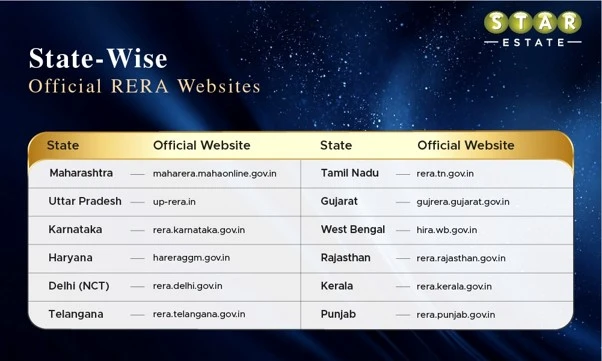
The RERA Act, 2016, is a uniform law in India with a separate regulatory body for each State. Visit the respective State website to check builder, agent, and project details along with the registration number for them.
Visit the official RERA website of the state.
Open the 'Registered Projects', or 'Project Search' section on the website.
Search using the project name, promoter's name, or the RERA registration number.
Cross-check the registration status, sanctioned layout, commencement and possession dates, and any pending complaints against the project.
Verify the promoter's and agent's registration numbers separately if you're buying through a consultant.
Star Estate has verified listings and you can browse properties under RERA-registered projects in Noida.
Impact of RERA on Property Buyers and Sellers in Indian Real Estate
In its decade-long existence, the RERA Act has brought real evolution to the property business. The numbers show it has genuinely shifted the market, not just added paperwork.
Quick Grievance Redressal – According to the report by Hindustan Times, a leading national daily, MahaRERA alone resolved 6,945 buyer complaints in 2025, up sharply from 3,824 in 2024.
Increase in Buyer Awareness - MahaRERA also recorded 5,039 fresh complaints in 2025, a 29% rise over 2024. The complaint clause under the RERA Act, 2016, empowers buyers as they become aware of their rights in Indian real estate.
Increase in PE Inflow - Post-RERA, private equity inflows into Indian real estate rose to $26 billion between 2017 and 2020. A massive increase from $17.5 billion is a clear indication that the Act brought transparency to property market operations in India.
Accountability Matters - For sellers, the Act raised the cost of doing business. Including mandatory disclosures, escrow compliance, and quarterly reporting. However, these rules have strengthened trust in genuine players in the real estate sector in India.
RERA Authority vs. RERA Appellate Tribunal: What's the Difference?
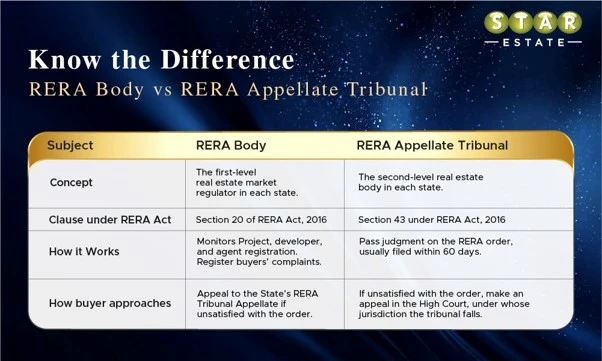
The term RERA grabs attention from buyers and investors in the Indian real estate. However, the RERA has two separate bodies with distinct operational authority.
The RERA Authority accepts your primary complaint against project registration and tracks RERA compliance. It also gives judgment on refunds, interest, and compensation. If either party disagrees with that order, they can appeal to the RERA Appellate Tribunal.
A RERA Appellate Tribunal is another separate body under the RERA Act. It reviews the judgment given by the RERA authority. If either party disagrees with the decision here, then they can appeal to the High Court, which oversees the jurisdiction in which the Tribunal comes.
The Bottom Line
RERA has made Indian real estate far more accountable than it was a decade ago. The registration compulsion, escrow compliance, and possession timelines make buyers more confident about property purchases. Easing the burden for end-users and investors exploring verified property searches, Star Estate lists projects only from verified developers.
Talk to a Star Estate advisor today for a free, consultation on RERA-verified projects. Use Star Estate's EMI Calculator to plan your budget before you start shortlisting properties.