Why NRIs Are Investing in Indian Real Estate in 2026: Rupee, Rules and Returns
“Homesickness hits hardest in the middle of a crowd in a large, alien city,” an award-winning author once said. For many overseas Indians, owning property back in India is why NRIs are investing in Indian real estate in 2026. A property here is an asset, a rental income stream, and, with a depreciating rupee, a good deal in dollar or dirham terms. This Star Estate guide covers the FEMA rules, five years of data, the Budget 2026 TDS change, capital gains, and the property types that suit NRI investors’ best.
AI Powered Summary
Reasons Why NRIs Are Returning to the Indian Property Market
A depreciating rupee offers an opportunity to buy large-sized properties.
A property in India acts as an additional source of income.
FEMA Rules ensure liquidity is regulated in a channelized manner.
An opportunity for wealth creation with the possibility of higher capital gains.
Who is an NRI? How do FEMA Guidelines make NRI Real Estate Investment in India Easy?
An NRI is, simply, an Indian citizen living outside India. For tax, the usual test is fewer than 182 days in India in a financial year (120 days in some higher-income cases). OCI cardholders are treated like NRIs for property purchases.
What types of property can an NRI buy in India?
Allowed: Residential and commercial property, with no prior RBI approval.
Not Allowed: Agricultural land, plantation property, and farmhouses.
Payment: Through inward remittance or your NRE, NRO, or FCNR (B) accounts. Cash transactions for property purchase in India are not permitted in rupees or any foreign currency.
How can an NRI use Rupee to buy Property in India?
Up to US$1 million per financial year can be repatriated from your NRO account, with Forms 15CA/15CB, once taxes are paid.
Where the purchase was funded from NRE or inward remittance, the principal is repatriable for up to two residential properties.
NRI Investment Trend in India (2021–2026) – The Numbers Says It All
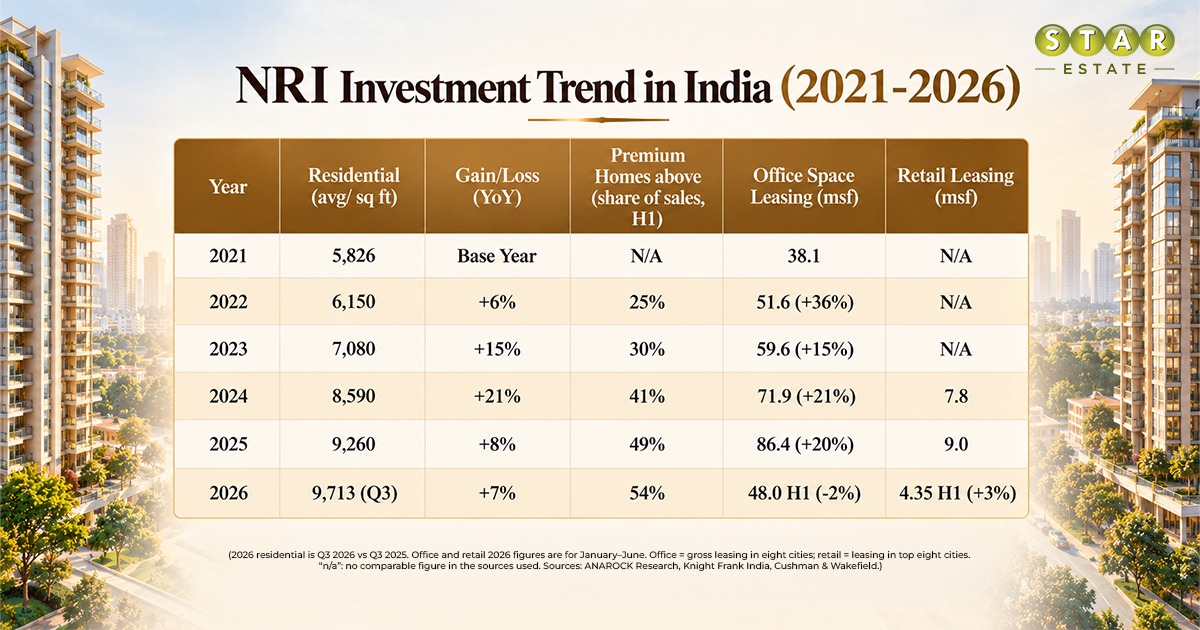
India’s residential prices rose from ₹5,826 per sq ft in 2021 to ₹9,713 in Q3 2026, roughly a two-thirds gain, with growth peaking at 21% in 2024 before cooling to 8% in 2025 and 7% in 2026. Premium homes now account for 54% of H1 sales, up from 25% in 2022, showing a clear shift toward higher-value, branded developments that suit NRI buyers.
Commercial demand has been just as strong: office leasing more than doubled from 38.1 msf in 2021 to 86.4 msf in 2025, and retail leasing grew from 7.8 msf to 9.0 msf between 2024 and 2025. The H1 2026 office figure dipped 2% year on year (retail rose 3%), but this looks like a pause rather than a reversal. Overall, the market has moved from fast, momentum-driven gains to steadier growth, with premium residential remaining the standout opportunity for NRIs.
Why are NRIs buying property in India in 2026?
A depreciating Rupee: Against dollars, pounds, or dirhams, buy more.
More space against Rupees: A ₹2 crore budget is roughly US$210,000 at ₹95, enough for a premium apartment in several metro cities.
Asset Creation: A tangible asset in a market where prices are up about 67% since 2021.
Income Generation: Rent, plus a 24-month holding for lower capital gains tax.
Resale Value: Budget 2026 made buying from an NRI easier. Price to today’s market, though. Remitter says anchoring to old purchase prices stretches selling time.
Tax deductions: On rent and home-loan interest.
NRI property in Rupee: Understand the Arithmetic
The rupee began 2026 near ₹90 per dollar and crossed ₹95 in spring, hit by an oil shock. A ₹2 crore flat cost about US$222,000 at ₹90 and about US$210,500 at ₹95. That is roughly US$11,700 saved on the same flat. The rupee has recovered some ground since, so don’t treat the discount as permanent.
How Budget 2026’s TDS Reform Shapes Why NRIs Are Investing in Indian Real Estate
On 1st February 2026, Union Finance Minister Nirmala Sitharaman announced that resident buyers purchasing property from NRIs no longer need a TAN to deduct TDS. They can deposit it using a PAN-based challan. Several sources date the change to 1st October 2026; therefore, the process is live now.
Understand it clearly. Don’t think of it as zero TDS. Rates are unchanged, and TDS still applies to the full sale price unless you get a lower-deduction certificate (Form 13).
Quick Closings: The buyer skips TAN registration, a step that often caused delays.
Easier Exits: NRI sellers become more attractive to resident buyers, which supports resale liquidity.
Fewer Buyer Errors: TAN and quarterly-return mistakes were a common source of non-compliance.
Same Tax Value: Plan with a CA and consider Form 13 to avoid over-deduction.
How do Capital Gains Rules affect NRI Return to Indian Property Market?
Short Term vs Long Term
Held for over 24 months: Long-term gains are taxed at 12.5% without indexation. The 20% indexed option is for resident individuals only.
Held for 24 months or less: Short-term gains are taxed at slab rates, up to 30% plus surcharge and cess.
Tax Deduction at Source (TDS): Roughly 13–14.95% of the full price on long-term sales, adjusted by Form 13.
Cutting the Bill
Reinvest the gain in another residential house (Section 54) or in specified bonds up to ₹50 lakh within six months (Section 54EC). The Income-tax Act 2025, in force since 1 April 2026, renumbers these as Sections 82 and 85.
Example: a ₹1 crore sale on a ₹60 lakh cost gives a ₹40 lakh gain and about ₹5 lakh tax at 12.5%, before surcharge and cess. Informed holding is what turns a good purchase into a better exit.
Income Tax Rebate: An Important Reason behind an Indian NRI Returning to Indian Real Estate in 2026
India has no special “NRI rebate”, but several deductions work in your favour.
Buying: No income tax on purchase. Stamp duty and registration are state levies. Home-loan principal can qualify under Section 80C (up to ₹1.5 lakh, old regime only).
Renting: Tenants deduct 30% TDS, but your actual tax falls after the 30% standard deduction and home-loan interest. Claim any refund through your Indian return, and use DTAA credit back home.
Selling: see the capital gains rules above.
Which property types do NRI buyers prefer to invest in India?
Residential: NRI bookings cluster in Mumbai, Bengaluru and NCR at ₹1–5 crore, per developers quoted by Business Standard. Mumbai Metropolitan Region sold 31,750 homes in Q3 2026 (a leading real estate analyst), and NCR led price growth at 12%. Look at Gurugram, Noida and Greater Noida in particular.
Commercial: Typically longer leases and professional tenants, which suits investors managing from abroad.
Retail shops: Prime high-street rents rose 5.1% YoY in Q2 2026. Mumbai’s Linking Road was up 22%, and Bengaluru’s Indiranagar 100 Feet Road was up 12% (Cushman & Wakefield).
Office space: Leasing hit a record 86.4 msf in 2025, and rents rose in all eight major markets in H1 2026. Hyderabad logged a record 7.5 msf, at an average of ₹80 per sq ft per month (Knight Frank).
Premium property: Homes above ₹1 crore are now 54% of sales. NRI money is concentrating here, while the mid-market NRI buyer is pulling back.
Where is the NRI investment trend in India heading by 2028?
Here is today’s picture. A leading real estate analyst report shows prices up 7% on the year but only 1% on the quarter. Unsold stock rose 12% to about 6.31 lakh units, and launches jumped 18%. That means more choice and room to negotiate for buyers, and quick flips look harder.
Three things to watch
Currency and geopolitics: Lodha’s MD says about ₹35,000 crore flowed from India into Dubai property last year, and some may now stay home. The real estate analyst cautions it isn’t a broad-based shift.
Portfolio thinking: From one sentimental flat to a mix of premium, rental-yielding and commercial assets.
Supply: Cushman & Wakefield sees 12.7 msf of retail supply due between 2026 and 2028, with office demand led by global capability centres.
Conclusion
Ready to build your India portfolio from abroad? Star Estate has helped over 1 lakh customers, with about ₹7,000 crore in sales in FY 2024–25, across Noida, Gurugram, Mumbai, Pune, Bengaluru and Hyderabad. Our advisers will compare projects, check title and RERA status, and walk you through FEMA and tax steps.
Fill out the enquiry form for a free consutlation on NRI invstent options in Indian real estate.