Fully Operational RRTS – A booming Signal in Ghaziabad-Meerut Property Prices
 Fully Operational RRTS – A booming Signal in Ghaziabad-Meerut Property Prices
 Earlier this week, Prime Minister Narendra Modi flagged Green signal to the 5 km stretch of RRTS. The ceremony marked the full-scale operation of RRTS (Namo Bharat Regional Rapid Transit System) between Delhi and Meerut.
The opening of the last leg on the RRTS route commences from Sarai Kale Khan to Ashok Nagar in Delhi. It is the nation’s maiden RRTS, a part of Transit Oriented Development (TOD), and eases travel between tier II cities in Uttar Pradesh with the Delhi-NCR region.
With full-scale operations of the Regional Rapid Transit System, real estate experts feel optimistic about property price appreciation. The reason is an equivalent demand from occupier and supply side in Ghaziabad-Meerut real estate after the flagging off of a 55-km stretch on the route earlier in 2025.
Such a large route eliminates travel woes for professionals to reach Delhi-NCR within 60 minutes ETA. The curtailing of the possibility to live away from home brought a bull rush to property prices in key Tier II areas of Uttar Pradesh State.
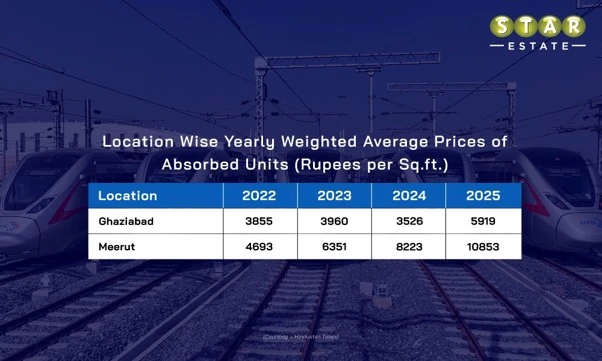
Also, the demand for residential properties touched new heights in several cities through which the RRTS cross by. Like Meerut, Ghaziabad, Muradnagar, and Modinagar witnessed a jump in property prices. The values escalated from Rs. 8,000 – 12,000 per sq yard to Rs. 12,000-20,000 per sq yard in these locations. The data is as published in leading news portal, Hindustan Times.
Developers prefer investment in Transit Oriented Development
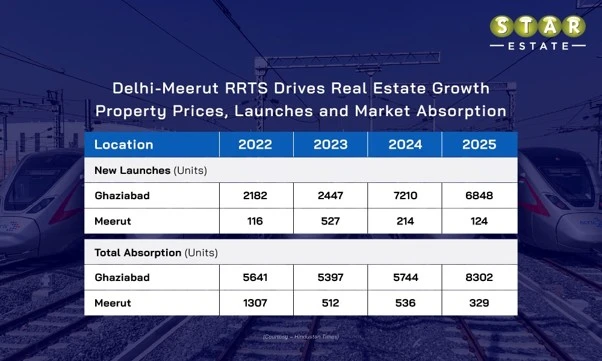
The evolution of the real estate market largely depends on TOD (Transit-Oriented Development). The RRTS and metro accessibility play a pivotal role in enhancing demand for residential properties in Meerut. Market veterans feel that the infrastructure boost via metro and rapid rail transit system is a major push for Meerut and other tier II cities next to Ghaziabad.
Its fully operational Namo Bharat Rapid Rail Transit System (RRTS) will make way for dealing with a larger land bank.
Ankita Sood, National Director, Research, Knight Frank India, said, “Faster travel times to Delhi and other NCR Centers are expected to reshape buyer preferences. For many homebuyers, shorter commuted outweigh higher property prices, making projects along the corridor increasingly attractive.”
“Having said that, price movement will largely depend on the pace of new supply entering the market. In the near team, residential and retail segments are expected to benefit the most, while commercial real estate may see a more gradual impact over the long run,” she said.
The ease of commuting is a blessing for families working in NCR and prefers living back home due to higher property prices in Delhi.
RRTS to Upraise Property Market beyond Ghaziabad
The less than 60-minute travel from Meerut to the national capital brings back the shine to Meerut real estate. The existence of RRTS from Sarai Kale Khan, Delhi, to the city is eliminating travel woes. Thus, offering investors and locals a chance to buy residential properties in Meerut’s periphery.
An increase of 30 percent to 60 percent is already visible close to RRTS stations like Modipuram and Shatabdi Nagar.
Why do reputed developers in India find smaller cities with developing infrastructure a perfect investment option?
A real estate expert said, “We can expect steady capital growth and a significant shift towards upscale gated townships as Meerut develops into a feasible ‘bedroom community’ for Delhi professionals.” Particularly, when it is based on Transit-oriented development (ToD).
Both Modipuram and Pallavpuram are expected to witness a rise of 30-40 percent as beneficial hubs from RRTS. Also, the leading investment destinations are Shatabdi Nagar, Partapur, and Shastri Nagar.
Which top developers are investing in Meerut?
Understanding demand for end-use, Paras Buildtech bought a project for plotted development near Meerut Bypass Road. It is proposed to have 220 premium residential plots, in 271 sq. yards.