Indian Institutional Investment rises in Q2 2026; GCCs and Data Centers are key Growth Drivers
 Indian Institutional Investment rises in Q2 2026
In Q2 2026, Indian real estate witnessed strong activity from institutional investors. There is a 16 percent increase, i.e., $ 1.9 billion, in reported activity, according to Cushman & Wakefield. It is an America-based global property management firm.
Global Capability Centers and Data Centers are the key metrics for accelerating institutional investments in the country. The investment activity stood at a moderate level, while domestic investors made a significant contribution to the Indian property market. Followed by a stable choice for income-generating immovable assets.
In H1 2026, institutional investments totalled $3.5 billion, which is 6% higher than in 2025. The continuous growth mirrors investors’ confidence in the Indian real estate market, while global economy continue to swing.
Global Capability Centers dominate Institutional Investment in Q2, 2026
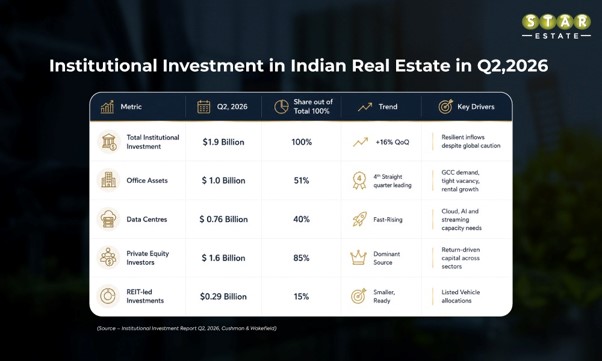
The GCCs, in the office sector, accounted for approximately 51 percent of the $1 billion in overall institutional investment in Q2 2026. It is the fifth year in a row that the office sector dominated investment in Indian real estate.
Why GCCs are top choice amongst Institutional Investors in Indian Real Estate
Consolidated vacancy rates across major office markets signal healthier supply-demand balance.
Rising rentals in premium micro-markets, reflecting genuine occupier demand rather than speculative charm
Multinational companies continuing to scale in India based GCCs for engineering, R&D, and shared services
Investors preference for long-term, stable income assets over higher risk development plays
Data centres capture about $0.76 billion, or 40 percent of investment, as cloud, AI, and streaming needs push up capacity requirements.
Followed by private equity firms, which remained the dominant source of capital, contributing around $1.6 billion (85 percent), while REIT-led investments added a smaller but steady $0.29 billion (15 percent) through listed vehicle allocations.
Data Centers – The second largest occupier in Indian Real Estate in Q2, 2026
The report by Cushman and Wakefield shows data centres as 40% of occupiers for institutional investment in India. The growth is a reflection of investors' accelerating interest in digital infrastructure assets. It is driven by high demand for AI adaptability, cloud expansion, and the requirement for data localisation.
“Capital allocation is becoming increasingly differentiated across asset classes. While office continues to attract a broad spectrum of investors owning to its maturity, liquidity and stable income profile, we are also seeing growing interest in the data centre segment as investors seek to capitalise on India’s expanding digital infrastructure ecosystem. This diversification of capital is contributing to a deeper and more resilient investment landscape.” said Somy Thomas, Executive Managing Director, capital Markets, Cushman & Wakefield.
He further said, “At the same time, investors are increasingly pursuing portfolio and multi-city opportunities to achieve greater scale and diversification. With domestic fundraising remaining healthy and significant capital available for deployment, we expect investment activity to remain resilient through the second half of 2026, with domestic investors continuing to anchor market momentum.”
In Q2, 2026, Indian Real Estate witness strong Money influx from Domestic Investors
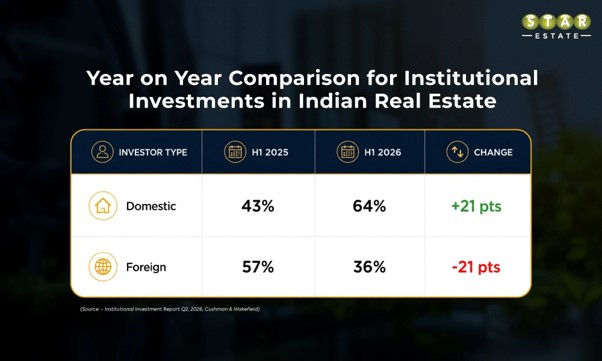
Domestic investors hold a significant position in the Indian real estate business in Q2, 2026. They account for 54 percent of total investment in Q2, 2026. It is a considerable jump from 46 percent by foreign investors.
The domestic investment in H1, 2026 stood at $2.2 billion, which is 64% of the total investment activity. The share stood at 43% for the same period in H1, 2025.
However, foreign investment accounts for a total of $3.1 billion, which represents the remaining 36%. It is less than 57 percent of the previous year.
What this means if you’re investing in Indian Real Estate in Q3, 2026
For individuals and institutional investors alike, the Q2, 2026 data points to a few clear takeaways:
Office space anchored by GCC demand remains one of the safest long-term commercial real estate bets in India.
Data centres are a genuine emerging asset class, not a passing trend, backed by structural digital demand
Domestic capital is now driving the market, reducing India’s historical dependence on foreign institutional flow
Income-generating, stabilized assets are being prioritized over speculative development – a sign of a maturing market
Q2 2026 witnessed domestic investors backing Indian real estate with real conviction, as GCCs and data centres are the backbone of institutional demand. For investors and homebuyers watching from the sidelines, it is a green signal to explore commercial properties for sale in India in 2026.
Indian Real Estate Outlook 2026: What to expect in H2, 2026
Based on current momentum, institutional investment activity in Indian real estate looks set to stay resilient in H2 2026. Domestic investors are likely to continue anchoring deal volumes, GCC-led office absorption should remain steady given consolidated vacancy levels, and data centre investment is expected to surge as AI and Cloud infrastructure needs scale further.