Commercial Real Estate Investment for Beginners: How to Invest in Shops, Offices & Pre-Leased Property in India (2026 Guide)
Most young professionals today plan their financial future early. Many start with fixed deposits and mutual funds. A few take a bolder route and buy their first commercial property in India. If you’re in the second group, then don’t feel lost. Commercial real estate investment for beginners in India isn’t complicated; it follows a few golden rules. Skip them, and a good shop can become a dull, empty asset. Star Estate's commercial real estate guide explains how to invest in commercial property in India, from shops and offices to pre-leased units.
AI Powered Summary
Commercial Real Estate Investment for Beginners in India (2026): Buy Smart, Check the Tenant, and Know Your Yield
Start with the right property. Pre-leased or nearing-possession units earn rent from day one, and kiosks or small shops offer the lowest entry ticket.
Location and tenant drive returns. Choose micro-markets with metro access and corporate demand; check lease length and lock-in before buying.
Yield is your scoreboard. Banks quote 5–11% for commercial against 2–4% for homes, so calculate net yield after costs. A ₹1.2 crore shop rented at ₹80,000 a month nets about 7.5%.
Know the tax and paperwork. Rent gets a 30% standard deduction, plus TDS and 18% GST, and gains after 24 months are taxed at 12.5%. Verify the title and RERA registration first.
Risk plan. Vacancy, slow resale, and continuing EMIs are the main risks. Keep a three- to six-month cash buffer.
Commercial Real Estate Investment for Beginners in India: The 2026 Summary
Buy a RERA-registered shop, office, or pre-leased unit in a proven micro-market, check the tenant and lease, compute net rental yield, and plan your taxes before signing. Commercial property usually pays more rent than residential assets, but it needs more due diligence.
Start early, start small. A pre-leased unit gives you rent from day one.
Yield is the scoreboard. Annual rent ÷ price × 100, net of costs.
Location beats the building. Footfall, metro access, and tenant demand drive rent.
Tax is different here. 18% GST on rent, TDS, and capital gains rules apply.
Paperwork protects you. Title, RERA, lease, and registration come first.
How Early Should You Invest in Commercial Property in India?
Your age and your goal
Start when you have a stable income and a financial cushion. In your late 20s or 30s, a loan runs longer, and rent can repay part of the EMI. In your 40s or 50s, you may prefer a ready, rent-paying unit for retirement income. Use our EMI calculator to vet your budget.
The property’s stage
Each stage trades risk for return:
Pre-launch: Lowest price, highest risk. Check the developer’s track record and RERA registration.
Under construction: Staged payments, possible delays. Good if you can wait.
Nearing possession: Less uncertainty, price already up.
Ready-to-move / pre-leased: Costs the most, but you get rent immediately.
For beginners, nearing possession or pre-leased is usually a better option to consider.
Why Commercial Property in India Makes Sense in FY2026-27: A Beginner’s View
Rents are moving, and that matters for commercial real estate investment for beginners in India. Knight Frank’s Q3 2026 report shows prime office rents in Bengaluru up 11.5% year-on-year, Delhi-NCR up 5.4%, and Mumbai up 4%. Here’s why investors keep coming back:
Higher rental income. Banks such as Kotak Mahindra put office rental yields at about 5–11% against 2–4% for homes, though they don’t name a source. Check yields yourself.
Long leases. Commercial leases often run 3 to 9 years, with annual escalation.
Corporate demand. Global capability centres account for nearly half of Bengaluru’s office demand, as per Knight Frank.
Tax deduction. A flat 30% deduction is allowed on net rental income.
Capital appreciation. Well-located assets gain as rents rise.
Want a closer look at one market? Read why Gurugram commercial property is a strong bet.
Which Shops and Office Investment Options Can You Choose in India?
Office space: In business parks or standalone buildings. Steady tenants, but vacancy risk.
Shops: High-street or society shops. Simple to buy, easy to lease.
Retail space: Units in malls and retail centres. Depends on mall footfall.
Food courts and restaurants: High rent, but tenant turnover is faster.
SCO plots (Shop-cum-Office): Popular in Gurugram, Chandigarh, and Mohali. Check M3M 114 Market for an SCO example.
Kiosks: The smallest ticket size, ideal for a first investment.
How to Invest in Commercial Property in FY2026-27: Calculating Rental Yield in India
The formula
Gross yield (%) = (Annual rent ÷ Property price) × 100
Net yield (%) = ((Annual rent − Yearly costs) ÷ Property price) × 100
A worked example
Say you buy a shop for ₹1.2 crore and rent it at ₹80,000 a month. Annual rent is ₹9.6 lakh, so gross yield is 8%. Maintenance and property tax cost ₹60,000 a year. Net yield: (9.6 − 0.6) ÷ 120 = 7.5%. Compare that with your home loan rate before you buy. That one number is the heart of commercial real estate investment for beginners.
Where to Buy Commercial Property for Investment in India?
Parameter 1: Location
When you look at commercial property India-wide, pick micro-markets with real demand, because rent follows people, not brochures. Think Whitefield and Outer Ring Road in Bengaluru, BKC and Lower Parel in Mumbai, and Golf Course Road and Cyber City in Gurugram. Look for metro access, parking, and a working population nearby. Star Estate’s guide to the best sectors to invest in Gurugram helps you shortlist.
Parameter 2: Property type
Match type to your goal:
Steady rent: Pre-leased office or high-street shop.
Low ticket: Kiosk or small shop.
Growth: Under-construction SCO or retail in a developing sector.
Compare options in our Gurugram commercial property listings and the top 10 commercial properties in Gurgaon.
How to Register a Commercial Property in India in FY2026-27?
Verify the title and RERA registration.
Sign the Agreement to Sell.
Pay Stamp Duty (state-specific rates).
Visit the sub-registrar’s office with the seller, buyer, and two witnesses.
Submit documents and biometrics.
Collect the registered sale deed.
Register the lease too. Anything over 11 months generally needs registration.
Commercial Real Estate Investment for Beginners: How Tax Is Calculated in India
Rental income
Taxable rent = Annual rent − municipal taxes paid − 30% standard deduction − loan interest. For example, tenants deduct 10% TDS if rent exceeds ₹50,000 a month, and commercial rent attracts 18% GST once turnover crosses ₹20 lakh. From 1st April 2026, TDS falls under Section 393 of the Income-Tax Act, 2025.
A worked example
Rent: ₹9.6 lakh a year. 30% deduction is ₹2.88 lakh. Taxable income is ₹6.72 lakh. At an assumed 20% slab, tax is about ₹1.34 lakh plus cess. Your tenant deducts ₹8,000 TDS a month, which you claim as credit.
When you sell
Sell after 24 months, and long-term gains are taxed at 12.5% without indexation. Buy at ₹1.2 crore, sell at ₹1.5 crore: gain ₹30 lakh, tax about ₹3.75 lakh plus surcharge and cess. Confirm with a CA, especially if you are an NRI.
What Risks Are Involved in Commercial Property Investment in India?
Vacancy. Knight Frank puts Mumbai’s prime office vacancy at 15.2% and Bengaluru’s at 13.4%.
Tenant default or early exit. Check lock-in clauses.
Liquidity. Commercial units take longer to resell.
Market cycles. Leasing across the three big cities fell 13.6% in Q3 2026, even as rents rose.
Obsolescence. Older buildings lose to Grade A towers.
Leverage. EMIs continue even if rent stops.
Commercial Property in India: Document Checklist for Buyers in FY2026-27
Title deed and chain of ownership
RERA registration and approved plan
Occupancy/Completion Certificate
Property tax receipts and NOC
Lease agreement and tenant KYC (if pre-leased)
GST registration of seller or developer
Things First-Time Buyers Must Consider Before Shops Office Investment in India in FY2026-27
Tenant quality and lease length
Maintenance charges and parking
Net yield, not just headline yield
Exit options and resale demand
Home loan vs loan against property
NRIs: FEMA rules, repatriation, and RBI payment norms. Read our NRI investment guide.
Which Is Better: Shops, Offices, or Residential?
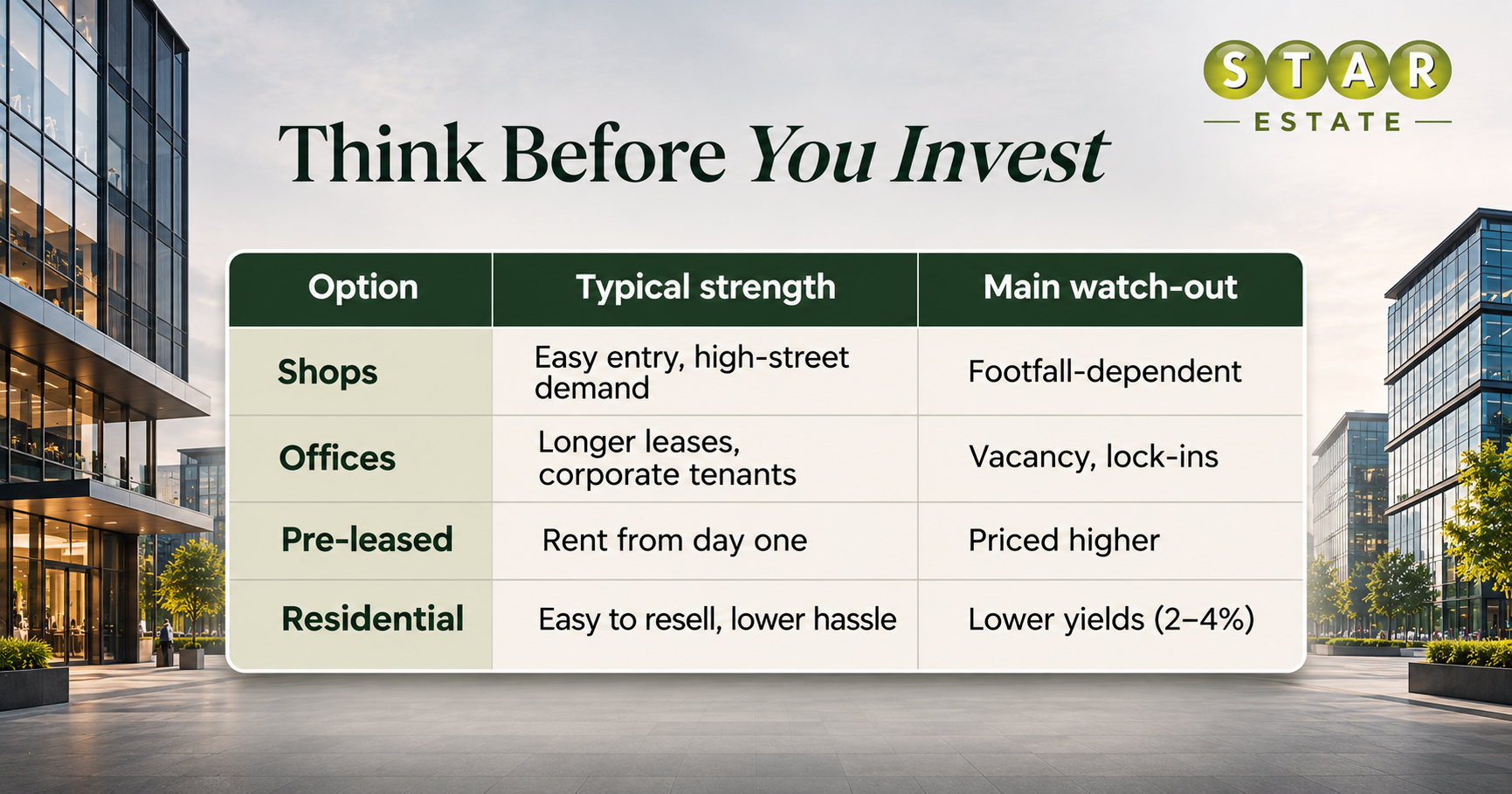
Shops suit small budgets, which makes office investment a flexible entry point. Offices suit patient investors. Pre-leased units suit beginners. Residential suits those who want simplicity. For rent-focused first-timers, pre-leased commercial usually beats the rest. Keep this commercial real estate guide handy, and start your commercial real estate investment journey for beginners with a clear budget and a trusted advisor.
Ready to pick yours? Talk to a Star Estate advisor for a free consultation on RERA-verified commercial projects. Fill in the enquiry form today.