Pre-Leased Commercial Property Investment in India: Steady Income, Lower Risk (FY2026-27)
Ask most people what “property investment” means, and the answer is a flat. Then the rent arrives: just 2.5 to 4 percent a year in India’s metros, before maintenance and taxation. That is why more investors are choosing pre-leased commercial property investment in India over other investment options. You buy any commercial property with a tenant already paying rent, so income starts the day you take possession. Gross yields of 6 to 9 percent, 3- to 5-year lock-ins, and built-in rent escalations make returns higher and more predictable. But is it really steady income with lower risk? Mostly yes, if you check the right things. This Star Estate guide explains exactly what to look for.
AI Powered Summary
Pre-Leased Commercial Property pays 6–9% Rent from Day One, Roughly Double a Residential Flat
Higher, steadier income: Yields run 6–9% gross against 2.5–4% for metro flats. Lock-ins of 3–5 years and built-in escalations keep rent predictable.
Safer than assured-return schemes: A real tenant pays you for a ready asset, not a developer’s promise. The main risks are tenant exit and lease expiry.
Lower risk isn’t no risk: Watch for single-tenant dependence, a 10–15% price premium and weak escalation clauses. Resale is also slower than for a flat.
Check before you pay: Verify the registered lease deed, the tenant’s financial health and 12 months of rent credits. Confirm clear title and RERA registration, and note GST applies above ₹20 lakh annual rent.
Suits NRIs and long-term holders: NRIs can buy without RBI approval and repatriate up to USD 1 million a year. It fits investors who can hold 5+ years, not those chasing quick appreciation.
What is a Pre-Leased Commercial Property Investment in India?
Pre-leased commercial property investment in India means buying an office, shop, or warehouse that already has a tenant paying rent. You earn rental income from day one, typically 6–9% a year, with the lease, deposit, and escalation clauses passing to you. The main risks are tenant exit and lease expiry, not construction delay.
What actually changes hands when you buy?
You don’t just buy walls. You step into the landlord’s shoes. The registered lease deed, the security deposit, and the escalation terms all pass to you, so the tenant pays, and you are at the receiver’s end. There’s no chase game to find a tenant and no vacant months while you wait for an appropriate tenant.
Which assets count as pre-leased?
Office spaces let to MNCs, IT firms, or banks.
High-street and mall retail shops let to brands, bank branches, or chains.
Warehouses and logistics units let to e-commerce.
A reasonable tenant matters as much as a quality property. A bank branch on a 9-year lease is a very different bet from a startup on a 3-year one.
Pre-leased Commercial Property Investment in India 2026: What Returns Can You Expect?
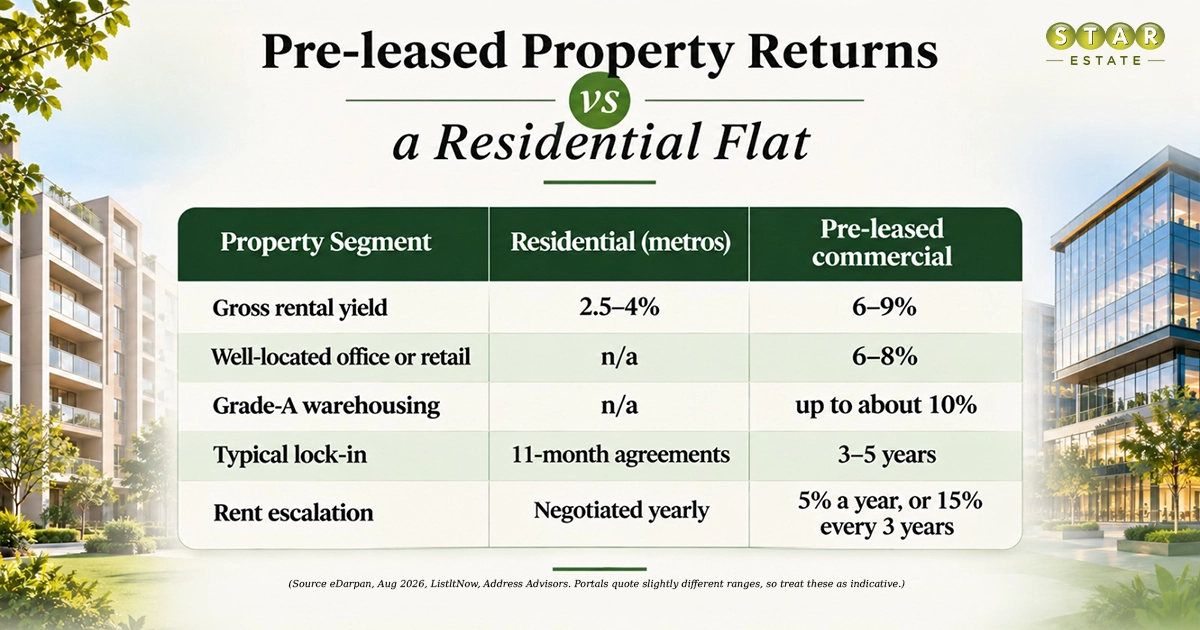
Here’s how the numbers line up this year. These are gross yields, before taxation, maintenance, and any GST.
The table compares what an investor can typically earn from a residential flat versus a pre-leased commercial property in India this year, using gross yields, meaning the figures are before tax, maintenance costs, and any GST.
Residential flats in the metros give a gross rental yield of only about 2.5 to 4 percent. Pre-leased commercial property in India does much better at 6 to 9 percent, so the rent you collect each year relative to the purchase price is roughly double or more. Within the commercial category, a well-located office or retail space generally yields 6 to 8 percent, while Grade-A warehousing sits at the top of the range, going up to about 10 percent. The “n/a” entries for residential simply mean those sub-categories don’t apply to flats.
The table also shows that the rental arrangement itself is more stable in commercial property. Residential tenancies usually run on 11-month agreements, so you may face vacancy or renegotiation every year. Commercial leases typically come with a lock-in of 3 to 5 years, which means the tenant is committed to paying rent for that period and your income is more predictable. Rent growth works differently too: for residential, any increase is negotiated each year, whereas commercial leases usually have a built-in escalation of 5 percent a year or 15 percent every three years, so your rental income rises automatically over time.
Overall, the table suggests that pre-leased commercial property in India offers higher and more reliable income than a residential flat, though remember that these are gross figures, so your actual take-home return will be lower after taxes, maintenance, and GST.
Why escalations and lock-ins matter more than the headline yield
A lock-in means the tenant can’t walk away for 3–5 years without paying. That’s your protection against sudden vacancy.
Escalation is what stops your rent from falling behind inflation. A 5% yearly bump on a 7% yield becomes a noticeably better return by year five.
Also, a flat 6% on a 15-year lease can beat 8% on a lease that ends in two years.
Is a Pre-leased Property safer than an Assured Return Commercial Scheme?
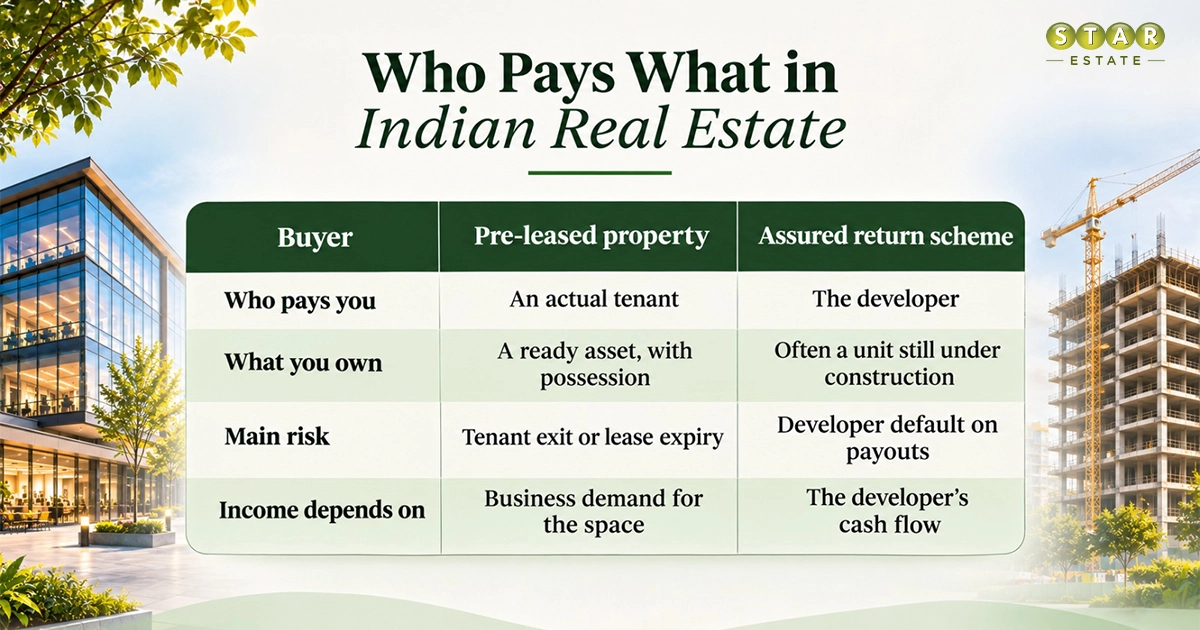
Usually, yes. People mix these two up all the time, and the difference is big.
A pre-leased property in India is usually safer than an assured return scheme. With a pre-leased unit, a real tenant pays you rent under a lease, and you own a ready asset with possession. Your main risk is that the tenant leaves or the lease expires, and your income depends on business demand for the space.
An assured return scheme is closer to a loan from the developer than to rental income. The developer pays you, the unit is often still under construction, and the main risk is that the developer defaults. If their cash runs dry, your payouts stop. The yield on a pre-leased unit may look lower, but the income is easier to trust.
Pre-leased Commercial Property Investment in India: The Risks and How to Check Them
What can go wrong with rented commercial property in India?
Lower risk isn’t no risk. Here’s what we see go wrong most often:
Single-tenant dependence. If the tenant leaves, income drops to zero until you find another.
Overpaying. Pre-leased units are often priced 10–15% above comparable vacant space, which eats into your yield.
Weak escalation clauses. Some leases barely move, so rent lags inflation.
Slower resale. Commercial property is harder to sell quickly than a flat.
Your due-diligence checklist before you pay
Lease length, lock-in period, and escalation terms, in the registered deed
The tenant’s financial health and track record, not just the brand name
Clear title, encumbrances, and RERA registration where applicable
Rent actually being received, matched against bank statements
GST on rent, which applies once annual rent crosses ₹20 lakh
Ask for the last 12 months of rent credits. If the seller hesitates, that tells you something.
Can NRIs invest in Pre-leased Commercial Property in India?
Yes, and it suits NRIs well. The tenant, the property manager, and the rent are all in place, so you don’t need to be in the country.
What the rules say
NRIs can buy commercial property without RBI approval, with no cap on the number of properties.
Rent is credited to your NRO account.
NRO funds can be repatriated up to USD 1 million per financial year, with a CA certificate (Forms 15CA/15CB).
Agricultural land, plantations, and farmhouses are excluded.
Tax points to confirm with your CA
Tax is deducted at source when rent is paid to an NRI, typically at the higher non-resident rate. Sale proceeds carry long-term capital gains tax too.
Pre-leased Commercial Property Investment in India: Who Should Buy, and Where to Start
Is it right for you?
It fits you if you want regular rent, can hold for 5+ years, and don’t need to cash out quickly. It fits less if you want fast appreciation or can’t tolerate a vacancy gap.
Pick the tenant first, then the location. Metro office hubs, high-street retail, and logistics belts each behave differently, so match the asset to your goal.