Common Red Flags to Watch when Buying Property in India
Property buying in India still marks a milestone in an individual’s life. Also, steady repo rates from the RBI, income growth, and aligned supply and demand are major factors for buyers to consider. However, believing only a lucrative deal can drown you in legal complications. Therefore, know the common red flags to watch when buying property in India.
Being one of the long-term investment options in India, property purchase is a subject of interest for everyone. However, it serves the purpose only when an individual follows a cautious approach. This blog post covers financial, legal, common, and developer’s credibility; buyers must know when investing in Indian real estate market.
Why Assessment Matters before Buying Property in India
Property buying is a strong monetary commitment that asks you to realign other financial allegiances. Therefore, do not risk this opportunity by trusting brochures and marketing billboards only. In fact, identifying loopholes before signing papers makes you an informed buyer. It lowers the chance of anxious nights you may have after losing money and time.
India’s top eight metro cities estimated sales of 1.71 lakh residential units in H1 2026, a 1% year-on-year rise. The new launches rose by 4% to nearly 1.87 lakh units, Knight Frank India reports. The market evolved more steadily, with a sharp rise between 2021 and 2023.
From 2017 till August 2026, RERA, the Real Estate Regulatory Authority, resolved 1.5 lakh consumer complaints, a leading news daily quotes. Unlike earlier, property purchase has become transparent thanks to stricter rules and technological advancements.
Therefore, every doubt in buyers’ minds now has an answer and a legal route to follow if it goes unanswered.
Common Red Flags to Watch before Buying Property in India
The mistakes to avoid when buying a property in India in 2026 aren’t only about big things. Rather, a casual approach to eliminate concern is amongst common red flags to watch before buying property in India. By overlooking these actions, you can actually hit a roadblock in the future. Therefore, have a read about things to check before finalizing an asset purchase in India this year.
Incomplete Approvals and Unclear Property Titles
Missing RERA Details
Comparatively Low Price Value
Hidden Charges and Unstructured Payment Options
Developer’s Background Check
Location and Infrastructure Concern
Urgency Tactics
Incomplete Approvals and Unclear Property Titles
Buying a property is a decision one can’t take overnight; however, an impulsive decision can turn your life around for bad. Therefore, buyers must pay attention to details. One thing to ask during the initial discussion with the sales representative is about clearances. Check if NOCs are in place. Is the building layout approved, applied for approval, awaiting approval, or rejected by the respective authority.
An unclear answer on the same is a red flag in the property purchase process in India. In case the answer comes with a direct and clear approval status, it’s good. Still, buyers are advised to verify details with the respective authority for clarity. Being blinded by lucrative offers and word of mouth can lead to serious legal complications in the future.
For a deeper dive into the essentials, explore Star Estate's comprehensive guide on the key questions to ask a builder before buying a flat in India.
Missing RERA Details
Under the Real Estate Regulatory Act 2016, developers must compulsorily register themselves and their every new project with the Regulatory Authority. The statutory body and Act are formulated to protect property buyers in India. It also makes the property purchase process transparent. Under Section 3 of the RERA Act, prohibit Developers from advertising/selling their residential or commercial projects before receiving an RERA registration number for the same.
Buyers must visit the official RERA website to check for project, developer, and agent RERA registration. It is one of the important things to check before buying a property in India instead of solely relying on the brochure. Missing or unmatched RERA details are one of the common red flags property buyers must consider in 2026.
Comparatively Low Price Value
The real estate market in India has a price pattern based on circle rates. However, if you find a property where location, features, and price aren’t on the same page, then pause. Check the same asset with a few sellers instead of finalizing the deal straight away.
While the deal looks like you have hit the jackpot, as a lower price is asked for more facilities. It is a fraudulent act, as no genuine seller can quote surprisingly low cost for a premium property. Therefore, a low value tag is one of the common mistakes to avoid when buying property in India.
Wondering why would someone quote low property value for sale? There can be various circumstances that raise the same. Maybe the seller is engulfed in thin cash flow or a legal dispute over land title. Therefore, always check the Government circle rate and stamp duty charges before blindly trusting a discount offer.
Hidden Charges and Unstructured Payment Options
As an informed buyer, ask the seller for a complete payment plan before paying the initial amount. The structure must define parking and maintenance charges. Also, check if the document states preferential location charges (PLC) and Government taxes. A genuine seller will share it upfront in the initial discussion. However, avoidance is one of the common red flags to consider before buying property in India.
Developer’s Background Check
A developer's past business records speak louder than anything. Timeliness, quality, and legal binding are strong indicators of a developer’s reputation. Therefore, factor in these parameters when buying property in 2026.
Location and Infrastructure Concern
A property value and capital appreciation depend on location and infrastructure. An area with sturdy road, rail, and metro connectivity appeals to end-users. Quality infrastructure, including proximity to schools, marketplaces, hospitals, and banks, adds value to the property. Also, end-users are concerned about civic facilities like sewage, power, and water supply, as life depends on these endlessly.
The absence of these facilities is one of the red flags to watch for when buying property in India.
Urgency Tactics
Don’t fall for limited-time offers and only limited inventory left like offers. These are the pressure tactics that often push buyers to take immediate action. Your decision to sign the deal in a minimum time leads to avoidance of cross-verification. As an informed buyer, you must take approvals and legal and financial checks into consideration instead of paying the booking fee upfront.
Mistakes to Avoid when Buying Property in India
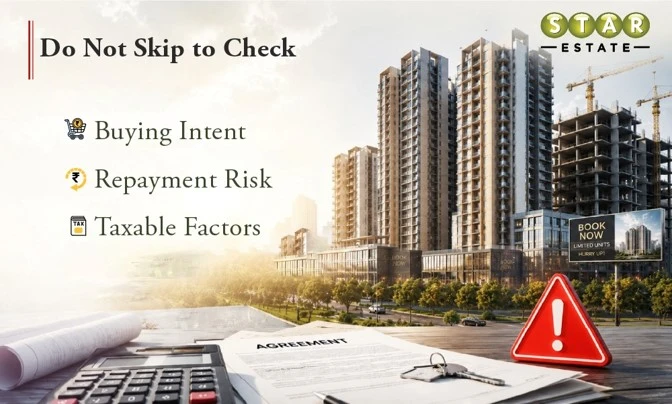
Unclear Buying Intent
Before investing money into a property, a buyer must have a strong intent, aka purpose to buy. Whether short-term, long-term, or rental yield, whatever, an individual must have a clear purpose. An unclear intent won’t lead a buyer anywhere; rather, it amplifies confusion about location, budget, and most importantly, a goal to achieve post-purchase.
Repayment Risk
A property isn’t a commodity to purchase in full cash. Apart from a small amount, the large value has to be paid via a banking partner. Know the current repo rate, home loan interest rates, and banks offering the same. Also, check your CIBIL score to know loan eligibility. Try the Star Estate EMI Calculator tool to estimate your monthly instalment.
With stringent laws to prohibit the entry of black money into the real estate market, the Government of India laid down strong guidelines. Reserve Bank of India (RBI), along with NHB (National Housing Bank), outlines the LTV (Loan-to-Value) ratio for property buyers in India.
A loan application rejection is a warning signal for property buyers in India.
The builder must agree to receive only 10% or 20% of the property value as a down payment, as rest can be covered under the loan. The demand for more than this is one of the red flags to consider when buying property in India.
Usually, banks provide an 80 to 90 percent loan against property value. However, insufficient paperwork from the builder’s side may shelve your loan application. You must not avoid checking the documentation from the builder while buying a home in India.
(Note – EMI calculator show estimated value, do not rely on the same as actual output, as there are several factor which affect loan amount sanction.)
Avoiding Taxable Factors
One of the common mistakes to avoid when buying property in 2026 is being ignorant of legal clauses. Stay updated with Stamp duty, registration charges, rental income tax, and capital gains tax. They all affect property value in India. Also, check the price, supply, and demand trends alongside taxable clauses. Star Estate’s blog on property price trends across India talks about the topic in detail.
GST Application – Ready-to-Move-In residential properties in India are exempted from GST. It is applicable at 1% for affordable housing and 5% for non-affordable housing properties.
Stamp Duty Charges – These charges vary from State to state. They typically range from 5% to 7% of the property value.
Registration Fee – It also usually varies from State to State; however, it stands at 1% of the property’s market value or the agreement value, whichever is higher.
If you wonder how I can calculate Stamp Duty and Registration Fee? Does a home loan cover these expenses? Then, you must know that a home loan doesn’t cover these expenses. The buyer has to bear these costs on their own. Read our detailed blog on the Stamp Duty and Registration Fee structure.
Why Talk to Star Estate before Finalizing a Property Deal
Star Estate works exclusively with RERA-verified developers across top Indian metro cities. Our seasoned professionals discuss options with buyers, considering the purpose of the property purchase. This approach makes Star Estate one of the top real estate consultants in India.
For a free property consultation and site visit, connect with our sales representative now.