Mumbai vs Navi Mumbai Property in 2026: Where Should You Buy?
Mumbai is India’s financial capital, with a sea-facing skyline, Bollywood glamour and some of the country’s costliest real estate. Across the harbour, Navi Mumbai has grown from a budget alternative into a serious investment destination. The new international airport, Atal Setu, metro expansion, and fresh employment corridors are bringing jobs, flights, and trains to a far more affordable address. In this guide, Star Estate compares the Mumbai vs Navi Mumbai property market in 2026 on price, infrastructure, rental demand, and risk. You will see why celebrity and high-net-worth investors are eyeing Navi Mumbai, where to buy property in Navi Mumbai in 2026 and the best places for property investment in Mumbai. Read on to find which side of the bridge meets your expectations.
AI Powered Summary
Mumbai vs Navi Mumbai Property at a Glance
Mumbai: India’s premium market, with established addresses and strong resale demand.
Navi Mumbai: A planned, affordable extension with airport-led growth and room to grow.
Growth story: The Navi Mumbai airport, Atal Setu, and metro expansion are driving demand in Ulwe, Panvel, and Kharghar.
Returns: Navi Mumbai nodes show indicative rental yields of about 3.4% to 3.8%, with Mumbai’s premium micro-markets driven more by capital value.
Best fit: Mumbai suits end-users and wealth preservations. Navi Mumbai suits first-time buyers and investors with a 5 to 10 year horizon.
Mumbai vs Navi Mumbai Property in 2026. Why do they matter to Investors at large?
Mumbai, India’s economic epicenter, is also home to Bollywood, a giant fishing industry, and industrialists. Here, the sea-facing skyline, old business families, a fashion and food culture are unmatched. Thus, the property market evolves continuously, with prices moving in an upward trajectory.
That’s why the Mumbai vs Navi Mumbai property question keeps popping up.
Evolution of Navi Mumbai Property Market
Navi Mumbai offers lower entry prices, planned nodes, and a big infrastructure-led growth cycle.
The year 2026 feels like a turning point. The Navi Mumbai International Airport (NMIA) began domestic commercial operations on 25th December 2025. Atal Setu (MTHL), metro expansion, and planned employment corridors are now falling into place.
Airport-linked locations like Ulwe, Panvel, and Kharghar have seen sharper appreciation than the rest of the region.
Which Is Better - Mumbai vs Navi Mumbai Property Market
Mumbai vs Navi Mumbai property comes down to budget and horizon. While, Mumbai offers an established address, rich resale demand, and a premium of ₹37,000+ per sq ft. Navi Mumbai is a new destination for property investors. Here, the large-format residential properties are estimated at roughly ₹9,000 to ₹18,000 per sq ft, if you can hold five to ten years.
(Property prices are subject to change upon various factors. Star Estate is not responsible for variation in real estate prices. )
Mumbai vs Navi Mumbai Property Market 2026: At a Glance
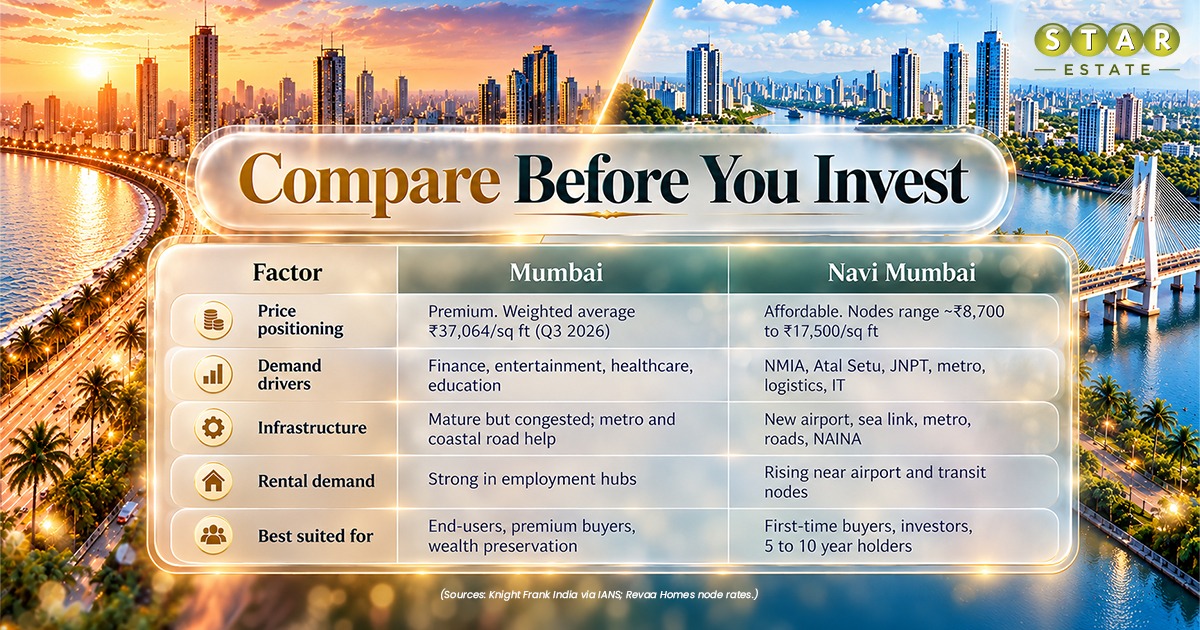
Mumbai charges you for the address. You’re paying for proximity to offices, schools, hospitals, and the sea, and for strong resale liquidity.
Navi Mumbai charges you for the future. Prices are less expensive because infrastructure is still maturing, so more of your return comes from appreciation and not from today’s rent.
That’s the core of the Mumbai vs Navi Mumbai property choice. Mumbai is for comfort now. Navi Mumbai is for growth later.
Answered! Why Is the Navi Mumbai Real Estate Market Suddenly Gaining Popularity?
The Infrastructural Growth
For years, Navi Mumbai was the “cheaper alternative”. That changed when the airport, the sea link, and the metro became real.
NMIA started domestic flights on 25th December 2025. Atal Setu cut the drive from South Mumbai to the Raigad side dramatically. Metro Line 1 links Belapur, Kharghar, and Taloja.
In short, jobs, flights, and trains are arriving where the land was still budget-friendly.
The Supply and Demand Signal
The data shows Navi Mumbai took 19% of MMR launches and 18% of sales, against only 14% of unsold stock. Buyers are clearly showing up in the region.
Thus, pricing mirrors the same. Ulwe’s node average is about ₹14,850 per sq ft, up roughly 7.4% year on year, a real estate analyst from the city estimates.
(The property price is subject to change based on different parameters; Star Estate is not responsible for changes in values.)
Why is Navi Mumbai Real Estate popular Amongst Celebrity Investors?
Celebrities and ultra-wealthy families rarely buy where they already live. They buy where they expect the next growth corridor to form. Mumbai's prime addresses such as Worli, Bandra, and Juhu are priced at a steep premium and have almost no fresh land left. Navi Mumbai is the opposite: planned, spacious, and in the middle of a large infrastructure cycle. That contrast explains most of the interest from high-profile investors.
Airport proximity. The Navi Mumbai International Airport began domestic commercial operations on 25th December 2025. JLL Homes notes that Panvel and Navi Mumbai are drawing high-net-worth interest because of the airport, and that Bollywood actors have already bought land parcels and apartments in the area. It does not name them, and neither do we.
Land banking. Investors with deep pockets prefer scarce, appreciating assets over decorative ones. The same JLL piece describes cricketer MS Dhoni's move into agricultural land and plotted developments as part of a wider shift from luxury homes to land banking. It also says industrialists are quietly buying small parcels in Panvel, Boisar, and Palghar.
More asset per rupee. Navi Mumbai nodes trade at roughly ₹8,700 to ₹17,500 per sq ft, against a Mumbai weighted average of ₹37,064. The same ticket size buys a bigger home, a plot, or several units.
Privacy and low density. Gated, low-density communities offer the space and quiet that crowded island-city towers cannot. L&T West Manor, for example, is planned as a gated community of about 70 homes.
Portfolio diversification. A typical celebrity portfolio already holds a prime Mumbai address. Navi Mumbai adds a lower-cost, growth-oriented asset with a different risk profile, and it is easy to hold for the five to ten years that infrastructure-led gains usually need.
The lesson for ordinary buyers is to copy the logic and not the headline. Celebrity purchases are often private, patchy in the press, and driven by tax, succession, or brand reasons that do not apply to you. Buy because the infrastructure, the MahaRERA registration, and the developer's delivery record stack up, and plan for a long holding tenure.
Where to Buy Property in Navi Mumbai in 2026

Navi Mumbai is a string of planned nodes, each with its own price band, buyer profile, and growth trigger. For 2026, four deserve a place on your shortlist: Ulwe, Panvel, Taloja and CBD Belapur. Here is how they differ, and where Star Estate's current Navi Mumbai listings fit.
Ulwe: The Airport Gateway
Ulwe is the node most directly tied to the new airport and the Navi Mumbai end of Atal Setu. The node average is about ₹14,850 per sq ft, up roughly 7.4% year on year (April 2026 estimates), and the Nerul–Uran suburban rail line gives it a direct train link. Sector-wise townships and new launches keep arriving, which is why Ulwe has already re-rated and is no longer the cheapest entry point in the region.
Suitable for: investors with a five- to ten-year horizon who want airport-led appreciation.
Verify: the sector, distance from the station, and how much of the promised social infrastructure is built.
Panvel: Space, Plots, and Connectivity
Panvel averages about ₹13,800 per sq ft and is the region's main rail junction, with quick access to the Mumbai–Pune Expressway and NH48. Plotted development and gated communities are strongest here, and the airport sits close by. Buyers get more space per rupee than in Ulwe or Belapur, which suits families and long-term holders.
Suitable for: buyers who want larger homes, plotted options, and a growth-plus-yield mix.
Verify: flood-level details, approvals for plotted land, and peak-hour travel time to your workplace.
Taloja: The Affordability Play
Taloja sits beside a large industrial and logistics belt, and Metro Line 1 now connects it to Belapur. Prices here are among the lowest in Navi Mumbai, which makes it the natural starting point for first-time buyers and for people employed in the industrial zone. Social infrastructure is still catching up, so expect appreciation to come from connectivity and population growth over time.
Suitable for: first-time buyers, end-users working nearby, and budget-conscious investors.
Verify: proximity to industrial units, school, and hospital access, and metro walking distance.
CBD Belapur: The Established Address
CBD Belapur is the oldest of the planned nodes, with offices, civic institutions, mature roads, and a ready neighbourhood. It is the starting point of Metro Line 1 and sits on the Harbour rail line, so daily commuting is easier than in newer nodes. Resale demand is steadier because buyers can see and live in what they are buying.
Suitable for: end-users and lower-risk investors who want ready infrastructure and good resale liquidity.
Verify: building age, redevelopment potential, and maintenance costs in older societies.
Star Estate Projects in Navi Mumbai
Star Estate's Mumbai listings currently include two Navi Mumbai projects, both by L&T Realty in Seawoods, the node next to CBD Belapur on the Palm Beach Road belt. They give you a ready-infrastructure option alongside the growth-led nodes above. For Ulwe, Panvel, and Taloja, ask a Star Estate advisor for a live shortlist, because availability and launches change often.
L&T West Manor – Well-positioned at Seawoods, Navi Mumbai, this RERA-approved (P51700056254) residential project offers 2BHK and 3BHK apartments. L&T Realty, one of the best developers in Mumbai, has launched this low-density gated community.
The Clubhouse, indoor swimming pool, Miyawaki garden, kids' play area, and CCTV are some of the key amenities here. Access to Palm Beach Road in about 5 minutes and Vashi in about 12 minutes positions L&T West Manor as one of the best residential projects for sale in Navi Mumbai.
L&T West Square – Strategically planned in Seawoods, Navi Mumbai, the project is a 40-acre transit-oriented development. The project has 2BHK and 3BHK apartments that overlook the clubhouse, pool, Jacuzzi, party lawn, gym, and wellness deck.
The RERA-approved project P51700045802 (plus P51700045794, P51700045795 and P51700045793) is 15 minutes away from the Airport. It takes approximately 35 minutes to reach the Mumbai-Pune Expressway from here.
Impact of Navi Mumbai Airport on Real Estate
The Navi Mumbai International Airport began domestic commercial operations on 25th December 2025, and 2026 is the first full year in which buyers can judge its effect on the ground. Demand has moved first to the airport-adjacent nodes. Ulwe’s node average is up roughly 7.4% year on year at about ₹14,850 per sq ft, and Panvel and Kharghar are seeing similar interest from homebuyers and investors.
Navi Mumbai also took 19% of MMR launches and 18% of sales in Q1 2026, per ANAROCK, a sign that developers and buyers are both following the airport. Commute time is the clearest benefit: West Square in Seawoods lists the airport at about 15 minutes away. Rental demand is also building from airline, logistics, and hospitality jobs.
The caution is that gains are uneven. Prices near the airport have already moved, so the best value now sits in RERA-registered projects with proven developers, good rail or metro access, and realistic possession dates, and capital appreciation of 8% to 12% a year over five to seven years remains an estimate, not a promise.
Which Is the Best Place to Invest in Mumbai in 2026?

Mumbai's weighted average price reached ₹37,064 per sq ft in Q3 2026, up 5% year on year, so the right micro-market depends on whether you want a trophy address, a family home or a cheaper way into the city's catchment. These are the pockets worth a closer look in 2026, with projects currently listed on Star Estate.
South and Central Mumbai: Worli, Mahalaxmi, Sewri, Mahim, and Matunga
This is the city's wealth-preservation corridor, with sea views, the Coastal Road and the Bandra–Worli Sea Link. In Worli, look at Lodha World Towers, Lodha Trump Tower and Birla Niyaara. In Mahalaxmi, Lodha Bellevue offers 4 BHK homes with a starting price of ₹4.05 crore* cited on its listing. L&T The Gateway in Sewri sits at the Mumbai end of Atal Setu, L&T Island Cove is in Mahim, and Lodha Vero is in Matunga.
Western Suburbs: Andheri West, Kandivali, Malad, and Borivali
The western suburbs balance space, schools, malls, and metro access. Lodha Cullinan in Andheri West is the premium pick. Further north, Mahindra Vista and Lodha Woods serve Kandivali, L&T Ahana is in Malad East, and Oberoi Sky City is in Borivali East. These suit families who want larger homes and green amenities without South Mumbai pricing.
Powai, Ghatkopar, and the Eastern Corridor
Powai combines lakeside living with IT-sector demand, and L&T Veridian is the project to compare. L&T Zen in Ghatkopar East is close to the Eastern Express Highway and Metro Line 1, and Kalpataru Vivant on the JVLR connects the eastern and western suburbs.
Thane and Palava: Value Beyond the City Limits
If your budget is tighter, Thane and the extended region offer newer towers at lower ticket sizes. Options include Birla Taranya and Kalpataru Paramount in Thane, L&T Vayam in Thane West, and Lodha Opulis in the Palava township.
Returns and Risk
In Mumbai, capital value and brand-developer delivery matter more than rental yield. Plan on a lower yield than Navi Mumbai nodes and a higher ticket size.
Want a plotted or beachside option beyond the city? Explore Hiranandani Sands Alibaug. Visit our Mumbai projects page for details.
Mumbai vs Navi Mumbai Property in 2026: Due Diligence Checklist
Whichever side of the bridge you pick, check these before you pay a token amount:
MahaRERA registration: Match the project number on the official portal, and read the promised possession date.
Title and approvals: Ask for the title report, commencement certificate and, for ready homes, the occupancy certificate (OC).
Developer track record: Visit a delivered project. Check the quality, not just the brochure.
Carpet area vs saleable area: Compare rates on carpet area, since portals mix both.
All-in cost: Add stamp duty, registration, GST on under-construction homes, and maintenance deposits.
Reckoner rate gap: Market prices in Ulwe, Panvel, and Taloja run well above ready reckoner rates, so budget for it.
Connectivity reality: Test the commute at peak hour. Don’t trust a map.
NRI buyers: Confirm repatriation, tax, and payment-route rules with a tax adviser before transferring funds.
Conclusion: So, Mumbai or Navi Mumbai?
Pick Mumbai if you want an established address, strong resale liquidity and a premium, lower-risk asset, and your budget stretches past ₹1 crore comfortably.
Pick Navi Mumbai if you want more space per rupee, early access to airport-led growth, and a holding period of five to ten years. Ulwe and Panvel favour growth, Kharghar favours lifestyle, and Taloja favours affordability.
No single answer fits everyone. Talk to a Star Estate advisor for a free, no-obligation shortlist built around your budget, and fill in our enquiry form today.