Indian Real Estate to Grow by $5.8 Trn by 2047; Technology, Informed Buyers play Crucial Roles.
 Indian Real Estate to Grow by $5.8 Trn by 2047; Technology, Informed Buyers play Crucial Roles.
Presently valued at $650 Billion, the Indian real estate sector expects massive growth in the future. A recent report by FICCI and KPMG considers informed buyers and technological adoption as key reasons for the positive outlook.
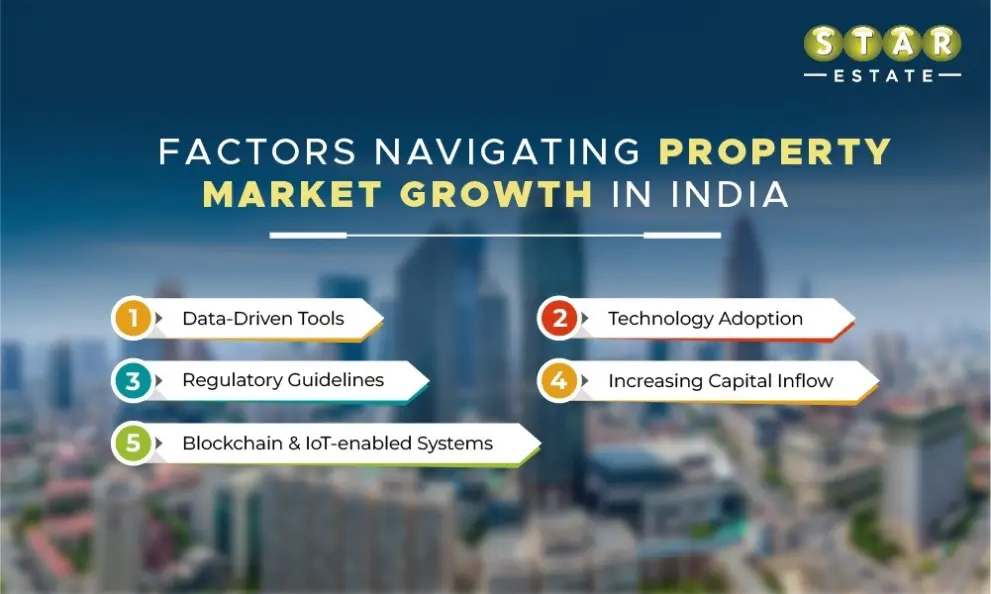
The increase in use of data-driven technologies resonates with better efficiency, while the market combats an inflationary cost scenario. With this, the Indian real estate is likely to grow to $5.8 trillion by 2047. Additionally, the regulatory framework and digital transition are also the primary reasons for massive growth in the future.
The report – Reimagining India’s Real Estate Landscape: The Role of Technology in Value Chain Transformation routes through key points. Structuring from fragmented workflows and paper-based documentation, the property market in India has come a long way.
By incorporating Artificial Intelligence (AI), Digital Twins, Blockchain, and IoT-programmed systems, the market redefines operations. Also, the amplified use of Drones and transparency in workflow lays the foundation for potential growth.
“Long characterised by fragmented workflows, paper-based processes and limited visibility across stakeholders, the sector is now increasingly adopting digital and data-driven tools across the value chain,” said the report, released at the 19th edition of the FICCI Real Estate Summit, held on 07th May, Thursday, in New Delhi.
Artificial Intelligence contributes to the sharp growth of Indian Real Estate
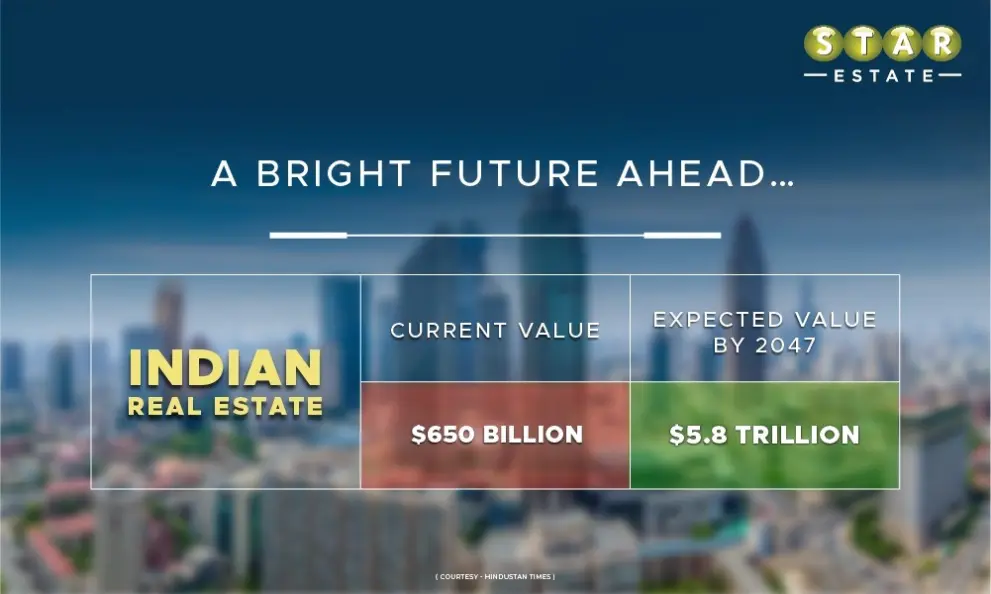
The report shed light on the fast adoption of AI in the corporate real estate sector, as a massive difference in AI usage is recorded in two years. The AI use in Indian real estate logged at less than 5% in 2023, and stood at 91% in 2025. Thus, estimating a ninefold rise in Indian real estate from the current $650 Billion to $5.8 Trillion in 2047.
What paves the way for the brighter future of Indian real estate includes the cost-efficiency imperative. Followed by regulatory guidelines and increasing capital inflow in the market.
“Technology is emerging as a core operating layer underpinning the entire real estate value chain, spanning site selection, design, construction delivery, sales and asset management. These forces are pushing developers to move away from manual, reactive processes towards scalable, proactive digital solutions,” report said.
The switch from fragmented private ownership to institutionally managed platforms is playing a determining role in the market growth.
Investment Tools guide Foreign Investors to Indian Real Estate

In Q1, 2026, the top nine Indian cities witnessed a record 9.1 million sq ft of office space lease activity from foreign establishments. Also, more than $16 Billion is unlocked via REITs (Real Estate Investment Trusts) and InvITs (Infrastructure Investment Trusts).
The report exhibits a rise in residential real estate in India. It suggests the expected value of new homes in the country is likely to reach $906 Billion by 2034. While CRE, i.e., Commercial Real Estate, is estimated to log 41 million sq ft operational development by 2028.
Experts’ advocate Determined Approach for Development across Cities
While speaking at the FICCI Real Estate Summit, Anand Kumar, Chairman, Real Estate Regulatory Authority, NCT of Delhi, suggested greater transparency and efficiency in the sector.
“I urge all stakeholders to be honest, to move beyond individual interests, and to make this sector more efficient and transparent,” he said.
He further emphasized the requirement of development in Tier- II and III cities as it will lower migrant footfall in metro cities. He said the property market should aim for “higher growth rates of 20-25 per cent.”
Neeraj Bansal, Partner and Head – India Global, KPMG in India, said real estate sector is transiting towards betterment. He said, “Integrated, technology-led platforms that strengthen decision-making and improve capital efficiency.”
Furthermore, Raj Menda, Chairman, FIICI Committee on Urban Development and Real Estate said, “India’s real estate sector has earned its place as one of the most consequential growth stories in the world. Sustaining that position now demands digital discipline, embedded not as a front-end tool but across the entire project lifestyle.”