A Strategic Move - How to Identify a Real Estate Growth Corridor in India (2026)
Still hunting for deals in Mumbai, Bengaluru, or Delhi? Take a pause. Most metros are mature now, and today’s prices already reflect the story. Thus, smartness lies in moving your money towards the best real estate growth corridors in India. Invest before it becomes crowded and exit when it becomes an obsessive location amongst end-users. The strategy sounds simple. But the question is how to identify a real estate growth corridor in India early. It isn’t about one master plan or one government announcement. A handful of signals, read together, tell you where prices are likely to head. Star Estate walks you through various factors in detail.
AI Powered Summary
Things Property Buyers Must Know About Identifying Real Estate Growth Corridors in India
Don't go by word of mouth, i.e., announced infrastructure development or advice from a well-wisher or a developer.
Be clear about the type of property you wish to invest in, as the location of real estate growth corridors in India caters to different property buyers.
Check for long-term connectivity, security, and price appreciation trends in the past 3-5 years in the locality.
Verify property titles along with RERA-details and the zone type under which the property falls, like residential or agricultural.
Check for rental yield and capital appreciation history and future potential.
What’s the best way to spot a growth area early in India?
To identify a real estate growth corridor in India, look for four things together: funded infrastructure already under construction, new job hubs, improving connectivity, and prices still lagging behind those changes. When all four line up and approvals are clean, you’re usually early.
This four-pack feature signals mean:
Funded infrastructure: Roads, metro lines, airports, or expressways with money sanctioned and work visible on the ground. A project with a budget and a contractor is real. A project without approval on paper is just a vision in mind.
Jobs: Offices, industrial parks, hospitals, or universities bring daily demand for homes, shops, and rentals. The absence of employment opportunities lowers demand for residential accommodation. Meaning, lower rental and capital appreciation potential.
Connectivity: The corridor should link easily to an established business district. If the drive is 40 minutes today it will be 20 once the road opens, that gap is where prices move.
Price lag: Compare rates with similar, already-developed neighbouring areas. A wide gap that’s narrowing slowly is an early stage to identify a real estate growth corridor in India.
Steps to Identify the Next Real Estate Hotspot in India:
Know Your Goal
A relevant corridor depends on your goals. Be clear in your head. Decide whether you’re buying commercial or residential property even before you connect with the leading real estate consultants in India. Primarily, because the same location can be great for one and below average for the other.
Things to consider about future real estate corridors if you’re buying a residential property
Social infrastructure within 15-20 minutes: Look for existing townships, schools, and hospitals within easy reach. These make a location a natural choice for families, and buyers pay more for that convenience, which supports resale value.
Rental demand: Nearby offices, colleges, and industrial units create steady demand for residential accommodation. So tenants are a major segment to cater to. Ask how long a typical flat stays vacant between tenants.
Compact layouts in a well-positioned property: Smaller, efficiently planned homes (a 1BHK or a smart 2BHK) keep the total ticket size within reach of first-time buyers and young professionals, which keeps demand steady. Size alone isn’t enough, though. Choose a property in proximity to the metro, main roads, or employment hubs, so a compact home is convenient to live in and easy to rent out or resell. Check that the layout has no wasted space, and compare the price per sq ft against the salaries of professionals working nearby.
Things to consider about future real estate corridors if you’re buying a commercial property
Offices and IT: These tenants look for metro access, a deep talent pool, and an established business district nearby. Check how much grade-A office space is already being leased, as that shows real occupier demand.
Retail: Footfall, household spending power, and parking decide whether a shop works. A busy road without parking can still fail, so check that customers can actually stop and walk in.
Warehousing and logistics: Expressways, freight corridors, and ports matter most. Rents follow how quickly a truck can reach the highway, so proximity to major routes is the key test.
Check vacancy before you buy. High vacancy in nearby commercial buildings today usually means weak rents tomorrow.
Which signals help you spot a growth area in India early?
An announcement and construction at the site are two completely different things. Therefore, as an informed buyer, you must check project progress:
Sanctioned budget: Look for the allocation in official state or central documents. Money on paper is the first real signal.
Awarded tender: Once a contractor is appointed, the project has moved beyond planning. Delays after this point are usually about months, not decades.
Visible work on the ground: Visit the site. Piling, earthwork, and barricades tell you more than any presentation.
A realistic completion date: Be skeptical of timelines that look too neat. Check whether past phases of the same project finished on time.
Under-progress projects are safer bets for assessing the best emerging property locations in India in 2026.
Timing: where is the corridor in its cycle?
Knowing the phase helps you identify a real estate growth corridor in India. Each corridor moves through three phases. At announcement, prices are lowest, and risk is highest. During construction, you get a sweet spot of visible progress and still-reasonable prices. After completion, most of the upside is priced in.
Most investors we speak to feel the pull to wait for “certainty.” The catch is that by the time everything feels certain, early buyers have already taken their gains. The aim isn’t to be first. It’s to be early enough to reap a high return on investment. Which is possible only with the paperwork in order.
The past growth record
Review 3–5 years of price-per-sq-ft data from RERA listings, registrar records, and local brokers. Steady growth with rising transactions is a stronger signal than one sudden spike, which can just be speculation.
Compare the locality with the city average too. If it’s growing faster than the city and the gap is widening, that’s momentum. If it’s flat while the city rises, ask why. Reading this gap is another way to spot a growth area early, before the crowd arrives.
How to Identify an Emerging Property Location in India in 2026: The Ground Checks
Approvals and legal comfort
RERA registration: A registered project has to disclose timelines and carpet areas. The buyers get a legal route if the developer misses any of these criteria. Check the registration number on your state’s portal yourself.
Government sanctions for civic amenities: Roads, water, power, and sewage connections must be approved, not just promised. Missing sanctions are a common reason for delayed handovers.
Land-use zoning: Confirm in the master plan that the land is meant for residential or commercial use. Buying in the wrong zone can block approvals later.
Clear title and no litigation: Get a lawyer to run a title search. A low price on a disputed plot isn’t a bargain.
Life around the property
Safety and law and order: Visit at different times of day. Street lighting, police presence, and how comfortable residents feel all affect rental demand.
Schools and hospitals: They should be operating already, not “proposed.” Families won’t move for promises.
Civic facilities: Ask residents about water supply, drainage, and power cuts. Poor basic facilities hurt rents more than a missing mall.
Multi-modal transit: Look for a mix of metro, bus, rail, and expressway access, plus last-mile options like autos and shuttles. The more ways in and out, the more resilient the location.
Developers' Approach
Watch who’s buying land. When reputed developers start acquiring parcels in an area, they’ve usually done their own homework on demand and approvals. That’s a strong clue that you have found the next real estate hotspot in India.
Check the developers’ past work record too. A big launch from a developer with delayed projects is not the same signal as one from a developer who hands over project possession on time.
Which future real estate corridors in India are worth watching in 2026?
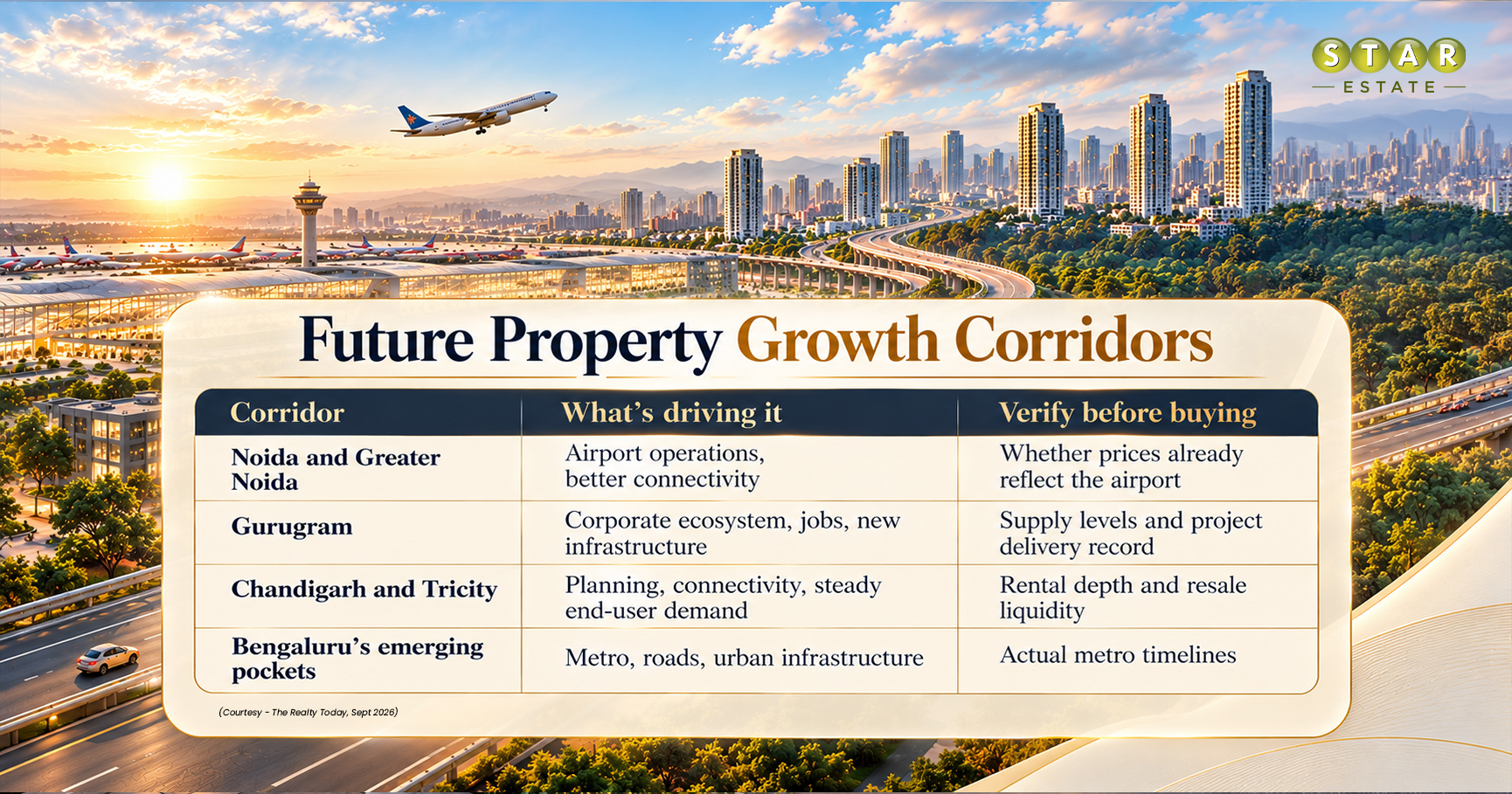
Future Property Growth Corridors: Key Takeaways
Next real estate hotspot:Noida and Greater Noida are being shaped by airport operations and better connectivity. Check whether prices already reflect the airport before buying.
Future real estate corridors:Gurugram is driven by its corporate ecosystem, jobs and new infrastructure. Evaluate demand, supply, and project timelines before making any monetary commitments.
Emerging property location: Chandigarh and Tricity benefit from planning, connectivity, and steady end-user demand. Do check for rental and resale liquidity.
Spot growth area early:Bengaluru’s emerging pockets are supported by metro expansion, roads, and urban infrastructure. Verify actual metro timelines, not just announced ones.
Smart early entry: Look for places where infrastructure, jobs, and connectivity are converging before prices fully reflect them. Then back your timing with due diligence.
What should NRI investors check before buying in an emerging property Location in India?
NRIs, the Non-Resident Indians, usually buy for appreciation first and rent second. Residential rental yields are often modest, roughly 2–4% (approximate), so the corridor’s growth story has to carry the return. Because you can’t visit often, due diligence matters even more.
RERA registration: Verify it on your state’s RERA portal. It’s the quickest way to confirm that the project, its timelines, and its promoter are on record.
Title and encumbrance: Get an independent legal check, not just the developer’s word. Ask for the title chain and an encumbrance certificate.
FEMA rules: NRIs can buy residential and commercial property, but not agricultural land, plantation property, or farmhouses. Confirm the land category before you transfer funds.
Repatriation and tax: TDS on an NRI’s property sale is higher than for residents, and repatriation has conditions. Speak to a CA early so there are no surprises when you exit.
On-ground support: A trusted local partner for handover, tenant search, and maintenance saves you flights and stress.
Your next step
Now that you know how to identify a real estate growth corridor in India, use the four-signal checklist, then visit the site, verify the paperwork, and compare 2–3 corridors side by side. Don’t buy on buzz. The next real estate hotspot rewards patient, well-researched buyers.
If you’d like to have a professional opinion, the advisors at Star Estate can help you shortlist emerging locations, check approvals, and match them to your budget, whether you’re in India or abroad.