Joint Development Agreement (JDA) in Indian Real Estate 2026: What Homebuyers Must Know
Heard your sales representative label the property as a JDA project? Wondering how different it is from the regular builder, and whether to relax or worry? The Joint Development Agreement (JDA) in Indian real estate has quietly become the way many new projects get built, so it’s worth understanding before you sign a booking form. This Star Estate guide explains how a JDA differs from buying land outright, what the Supreme Court said in 2026, what the land-deal numbers show across Bengaluru, Pune, Mumbai and NCR, and the exact checks that protect homebuyers’ interests. Whether you’re a first-time buyer, an investor or a resale buyer, you’ll leave with a clear yes, no, or wait.
AI Powered Summary
Things Homebuyers Must Know About Joint Development Agreement in 2026
A RERA-verified JDA Project is safe to consider for purchase.
Responsibility is divided between landowner and builder in case of JDA project in India
Income Tax rebate applies to JDA project in India
Several reputed developers prefer JDA project in top metro cities in India
Check builder’s past work record before buying a property in JDA project in India
What Is a Joint Development Agreement (JDA) in Indian Real Estate?
A JDA in Indian real estate is a joint development agreement. It is a deal where a landowner contributes land and a developer funds and builds the project, sharing either revenue or built-up area. For homebuyers, a JDA is not automatically risky, but clear title, RERA registration, and the developer’s past work record matter more than usual.
What Is Land Acquisition, and Why Are Developers Turning to JDAs?
Land acquisition simply means a developer securing the land on which a project will rise. Land is the biggest upfront cost in any housing project, especially in cities like Bengaluru, Pune, and Mumbai, where well-positioned land parcels are scarce and expensive.
A JDA lets the developer skip paying the full land price upfront. The landowner gets a share of the revenue or flats instead. That frees up cash for approvals and construction, which is exactly why JDAs keep multiplying.
JDA in Indian Real Estate vs Direct Land Purchase: What’s the Difference?
How a direct purchase works
The developer pays the landowner and becomes the owner. The developer alone holds title, takes all the risk and keeps all the profit. For buyers, the chain of ownership is shorter and easier to verify.
How a JDA works
The landowner stays involved. The developer builds and sells, and the two share the outcome in one of two ways:
Revenue sharing: The landowner and builder gets an agreed percentage of sales income.
Area sharing: The landowner gets a fixed share of the built-up flats and the developer sells the rest.
What Does the Law Say About Joint Development Agreements in Indian Real Estate?
The Supreme Court’s 2026 ruling
In Sriganesh Chandrasekaran v. M/s Unishire Homes LLP (2026 INSC 172), the Supreme Court held that landowners were not liable for a developer’s delay in handing over flats. Signing a GPA did not by itself make them promoters. Reports on the case say liability follows actual control and contractual responsibility, not mere ownership of land.
For buyers, the message is straight. In a JDA where the developer controls construction, your delay claim is against the developer. Reports note that if the developer turns insolvent, recovery from landowners may be limited.
RERA and Tax
RERA can still treat a landowner as a co-promoter in some situations, for example when the landowner’s name or image is used to promote the project, according to law-firm commentary on JDAs and RERA. Always check the JDA terms and RERA listing together.
This is general information, not legal advice. Have a property lawyer review the JDA, GPA and title papers of any project you’re buying into. The case summary relies on law-firm and news reports; check the official judgment before relying on it.
How Do JDAs Affect Your Homebuying Decision in India in 2026?
Mostly in two ways: more choice and more paperwork. JDAs bring prime-location projects within reach, because developers can launch without buying every plot. But your title check now involves two parties, not one.
Your home loan bank will ask the same questions too. If you’re a first-timer, our first-time home buyer checklist walks you through them step by step.
Land Deals in India, 2021–2026: The Numbers behind the JDA Surge
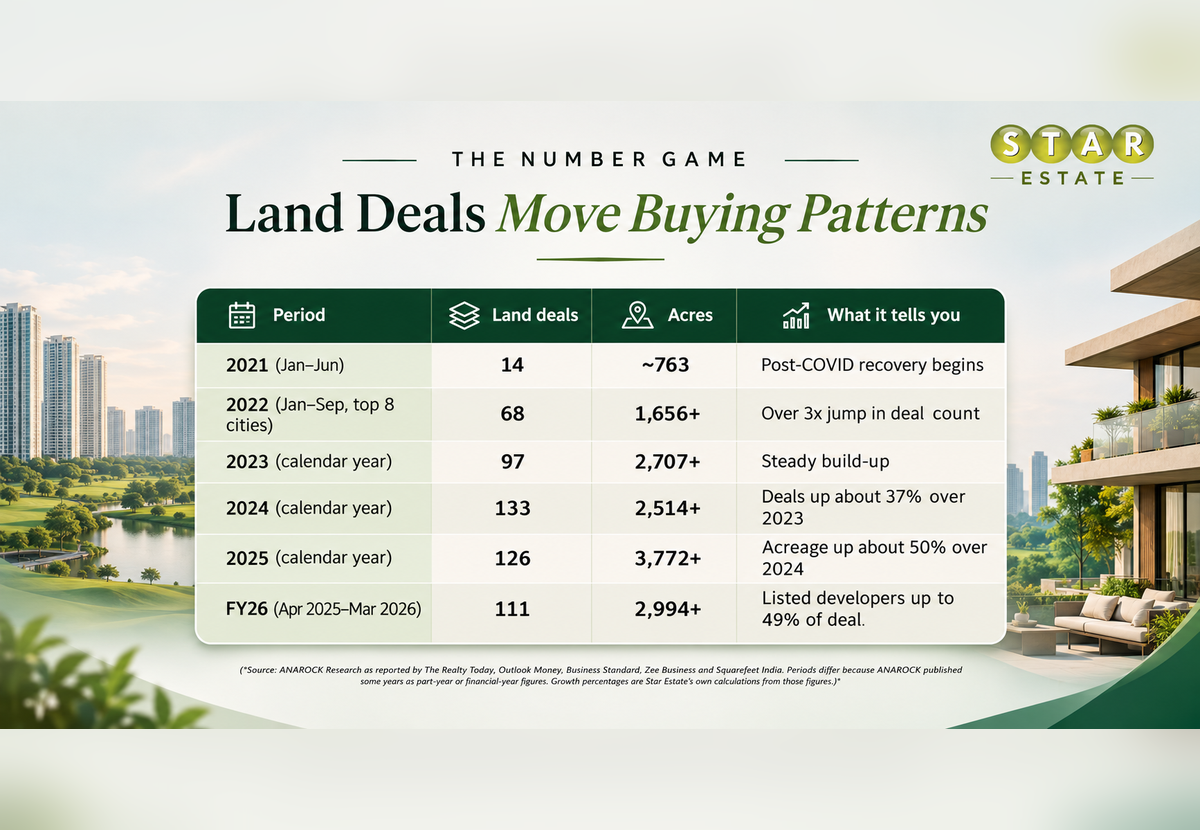
The rise of JDAs in India can be understood through ANAROCK’s land-deal tracking. It covers outright purchases and joint development agreements between builders and landowners. Here’s how activity has moved:
What do these numbers mean for you? Developers are buying and tying up land at a steady pace, and the JDA route in Indian real estate is one of the main ways they do it. Acreage hit 3,772+ in 2025, the highest in the table, even though the number of deals dipped. Bigger parcels mean bigger, longer-running projects.
Benefits of Buying in a JDA Project in India in 2026
Better locations. Developers can reach established localities where outright land purchase would be too expensive.
Stronger builders. With listed developers leading about half of FY26 land deals, many JDA launches come from well-capitalised brands.
Lower developer cash strain. The developer isn’t paying the entire land price upfront, which can ease financing pressure on a project.
RERA protection. A JDA project that sells units to buyers must be registered with the state RERA authority, with approvals and title documents disclosed.
Landowner is invested. A landowner with a stake in sales has a reason to see the project finished.
What Homebuyers Must Check Before Buying in a JDA Project in FY2026-27
The documents to ask for
Registered JDA and registered General Power of Attorney (GPA).
RERA registration number, verified on your state’s RERA portal.
Encumbrance certificate and land revenue records, showing a clean title.
Sanctioned plan and all approvals.
The questions to put to the builder
Ask who controls construction and sales under the JDA, whether any landowner shares are unsold, and how many past projects the builder has delivered on time. Our list of 11 questions to ask a builder before booking a flat covers the rest.
And before you pay a token amount, understand what you’re signing. Our guide on agreement to sell vs sale deed explains the legal and fundamental difference.
Is Buying in a JDA Project in India a Wise Decision?
It can be, if the paperwork and the developer both meet your expecttions. A JDA doesn’t make a project better or worse. However, a weak builder with a clean title is still risky. A strong builder with a messy JDA is risky too. You need both to hold up.
Should homebuyers wait a little longer to understand the trend?
Wait only if a document is missing. If RERA registration, title, and approvals are in place and the builder has a quality past work record, waiting makes little sense. Meanwhile, test affordability early with our home loan EMI calculator, and see how property price trends in India might affect your timing.
Top Developers and JDA Deals in Indian Real Estate, 2022–2026

JDA Deals in Bengaluru: The Most Deals In A City
Bengaluru has 6 of the 16 deals, more than any other city.
The deals cover several parts of the city: Yelahanka and Sathanur in the north, Hoskote and another Brigade site in the east, and Banashankari in the south.
Three reputed developers (Brigade, Shriram, Puravankara) are doing JDAs there, so it is not one player’s strategy. It looks like a market-wide pattern.
Land is scarce and expensive in a fast-growing city. A JDA lets developers add projects without tying up capital in land.
Brigade Is the Most Active JDA Developer
Brigade has 5 of the 16 deals, spread over three years and three cities.
Its deals include a 14-acre site in Yelahanka (2023), a 10.75-acre site in East Bengaluru and 7.5 acres in Banashankari (both 2025), 6.6 acres in West Chennai (Oct 2025) and about 1 million sq. ft. in Hyderabad (May 2026).
The order suggests it first built depth in its home city and then moved into Chennai and Hyderabad.
Deal values scale with size: about ₹2,100 cr for Yelahanka, ₹2,500 cr for East Bengaluru and ₹850 cr for Hyderabad.
JDA Deals in NCR: Fewer but Larger
Three deals are in NCR: Signature Global (Sector 71, Gurugram), Max Estates (Sector 36A, Gurugram) and Max Estates (Indirapuram, Ghaziabad).
Together they cover about 49 acres. The headline figures are over ₹5,000 cr, over ₹9,000 cr and ₹2,500–3,000 cr.
The Max Estates Sector 36A deal is the highest-value deal in the whole table.
Max Estates appears twice, in two different NCR markets, so it seems to be using JDAs to grow in the region.
Signature Global’s Sector 71 deal involved three separate JDAs with landlords. That suggests NCR land is held by several owners, and developers combine them into one project.
JDA Deals in Mumbai: Highest Value per Acre
Worli (K Raheja Corp): 2.5 acres, over ₹2,000 cr revenue. That works out to roughly ₹800 cr per acre, the highest in the table.
Mahim West (Raymond): size not disclosed, about ₹1,800 cr.
Thane (Godrej): 18 acres, about ₹7,500 cr revenue. This is a large township-style land parcel rather than a small city plot.
Mumbai deals are therefore either small plots with very high value, or large parcels in the extended region.
JDA Deals in Pune: Wadgaon Khurd and Wakad
Wadgaon Khurd (Kolte-Patil): 22 acres, ₹4,000 cr GDV, roughly ₹180 cr per acre.
Wakad (Macrotech/Lodha): about 5.06 acres, ₹165.3 cr, roughly ₹33 cr per acre.
These are suburban micro-markets, not premium city-centre locations. The Wakad deal is also the smallest by value in the table.
(Per-acre figures are rough, because the table mixes GDV and revenue numbers.)
The Pace of JDA Deals Is Picking Up
The table shows 1 deal in 2023, 3 in 2024, 7 in 2025 and 5 in 2026 so far. The latest entry is dated 12 Oct 2026, so the year is not yet complete.
2025 was the peak, with 7 deals across Pune, Mumbai, Bengaluru, and Chennai.
2026 is on track to come close to 2025. It also has the widest mix of cities: Thane, Hyderabad, Bengaluru, Ghaziabad, and North Bengaluru.
A caution: the list is compiled from media reports, so it shows the deals that were publicised, not the whole market. The rise may partly reflect more announcements, not just more deals.
The overall picture
JDAs are spreading from a few cities to almost every major market.
Bengaluru has the most deals, NCR has the biggest, and Mumbai has the highest value per acre.
The same developers keep coming back for more JDAs, which suggests the model is working for them.
What Is the Future of JDAs in Indian Real Estate?
Expect JDAs to stay popular over the next 12 to 24 months. Land remains the costliest input, and 2025’s 3,772+ acres of deals show developers are still stocking up. Listed developers’ rising share suggests more JDAs with stronger, better-documented counterparties.
Courts will keep refining who is liable for what. After the 2026 ruling, expect tighter indemnity clauses and clearer drafting. For buyers, that should mean better disclosure, though it also means reading the fine print matters more.
Things to Check in a JDA Project before You Book in 2026
Every JDA project in Indian real estate looks polished in a brochure. What matters is what sits behind it. Star Estate’s advisors check RERA status, title documents and the builder’s delivery record before recommending a project, so you aren’t left doing it alone.
Fill in the enquiry form on starestate.com today for a free, no-obligation consultation, and let us shortlist RERA-verified projects that match your budget and city.