RBI Repo Rate Unchanged at 5.25% is a breather for Homebuyers
 RBI Repo Rate Unchanged at 5.25% is a breather for Homebuyers
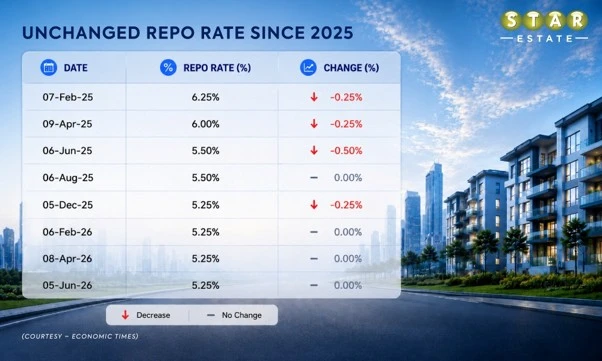
 The Reserve Bank of India kept the Repo Rate unchanged. The decision to maintain 5.25% Repo Rate comes in the second bi-monthly Monetary Policy Meet of FY27. Considering the global scenario and inflation, the RBI continues to follow a neutral stand.
The bi-monthly Monetary Policy Meet was conducted from 03rd to 05th June. Here, Sanjay Malhotra, Governor, RBI, evaluated macroeconomics and financial conditions. The decision by the RBI MPC is unanimous in reference to keeping the value of the Liquidity Facility (LAF) constant.
“Consequently, the Standing Facility (SDF) rate remains at 5 per cent and the Marginal Standing Facility (MSF) rate and the Bank Rate at 5.5 per cent,” Malhotra said.
What is Repo Rate? How does it affect Home Loan EMI in India?
A repo rate is the interest rate at which the Reserve Bank of India lends money to banks in the country to meet their funding requirements. The increase in this rate makes borrowing from banks expensive. Similarly, the unchanged or lowering of the Repo Rate make the same cheaper. Thus, it is important to know the latest repo rate in India if you are a homebuyer.
Sanjay Malhotra, Governor, RBI, focused on the global scenario and said disruption in important trade routes is a concern. Also, the supply and unprecedented challenges the world is facing do impact the economy. However, the Reserve Bank of India continues to take preventive measures to lower inflation risk.
“The global economy has been shaped by heightened uncertainty, disruptions to key trade routes and supply chains, increased volatility, and cautious business sentiment. Let me at the very outset emphasise that the Indian economy entered this episode of global turbulence with much better fundamentals than in previous similar episodes,” he said.
He also said that despite being in a strong position in alignment with the external situations, India has to create a strong ecosystem to deal with further economic turbulence.
“It is important to not only confront and address these challenges, but also, at the same time, take this as an opportunity to further enhance our resilience,” he said.
The decision is a continuation of RBI no change in Repo Rate in April 2026
The Reserve Bank of India’s Monetary Policy Committee kept the repo rate unchanged in its maiden bi-monthly meet of FY26-27. The decision is taken in the meeting headed by Sanjay Malhotra, Governor, RBI.
Considering the disruptions caused by the escalation in tension over the geopolitical scenario, the repo rate stands at 5.25%.
How will stable repo rates impact homebuyers in Indian Cities?
Anshuman Magazine, Chairman & CEO, India, South-East Asia, Middle East & Africa, CBRE said, “The RBI MPC’s decision to maintain the status quo on the repo rate is a testament to the inherent resilience and momentum of the Indian economy. By prioritizing macroeconomic stability and maintaining a vigilant stance on aligning inflation with its target, the central bank has successfully navigated the complexities of the global landscape. Thus calibrated approach signals robust underlying fundamentals and a confident domestic outlook.”
Earlier in February, the Reserve Bank of India, in its first policy meeting post the Union Budget 2026, kept the repo rate unchanged at 5.25%. Sanjay Malhotra, RBI Governor, stated that the decision was made considering strong fiscal growth and the removal of tariffs following the trade agreement with the United States of America.
How will an unchanged Repo Rate affect Commercial Real Estate in India?
CRE (Commercial real estate) in India is likely to witness stability in business. The steadiness is likely to occur from stable borrowing costs for developers, investors, and end-users. The rise in office leasing activity in top Indian cities is likely to continue, with the bare minimum possibility of a sudden price rise of commercial properties.